NASA Prepares for Critical Artemis III Lunar Lander Flight Tests in Earth Orbit to Secure Future Moon Landings

NASA is currently advancing its most ambitious exploration initiative in half a century, gearing up for a series of high-stakes flight demonstrations that will pave the way for the return of humanity to the lunar surface. For the first time since the conclusion of the Apollo 17 mission in 1972, the United States is orchestrating a complex multi-vehicle architecture designed to establish a sustainable human presence on the Moon. While the primary objective remains the Artemis III crewed landing, currently targeted for the latter half of the decade, NASA and its commercial partners are preparing for a vital "dress rehearsal" in Earth orbit. This mission, scheduled to take place next year, serves as a foundational milestone to ensure that the intricate maneuvers required for deep-space exploration can be executed with precision and safety.
The upcoming demonstration mission will focus on the most critical phase of the Artemis profile: the rendezvous and docking between the Orion spacecraft and the Human Landing System (HLS). This Earth-orbit rehearsal is designed to simulate the "highly choreographed dance" that astronauts will eventually perform in lunar orbit. By conducting these tests in Low Earth Orbit (LEO), NASA can rigorously evaluate the flight software, control systems, and hardware interfaces in a controlled environment before committing crew and resources to the lunar vicinity. The success of this mission is paramount, as it validates the collaborative efforts of NASA, SpaceX, and Blue Origin, the two primary commercial contractors tasked with developing the next generation of lunar landers.
The Dual-Contractor Strategy: SpaceX and Blue Origin
In a departure from the single-provider model of the Apollo era, NASA has embraced a competitive commercial landscape to drive innovation and redundancy. SpaceX and Blue Origin are currently developing distinct landing systems that offer unique capabilities and architectural approaches. For the Artemis III and IV missions, NASA will utilize these providers to ensure a steady cadence of lunar sorties.
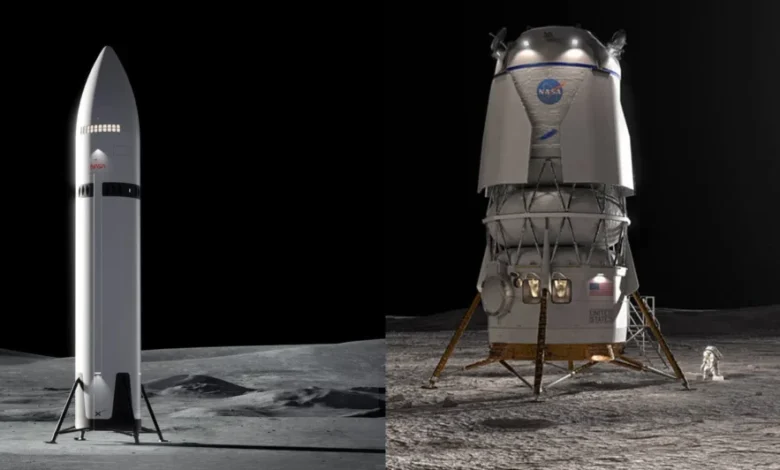
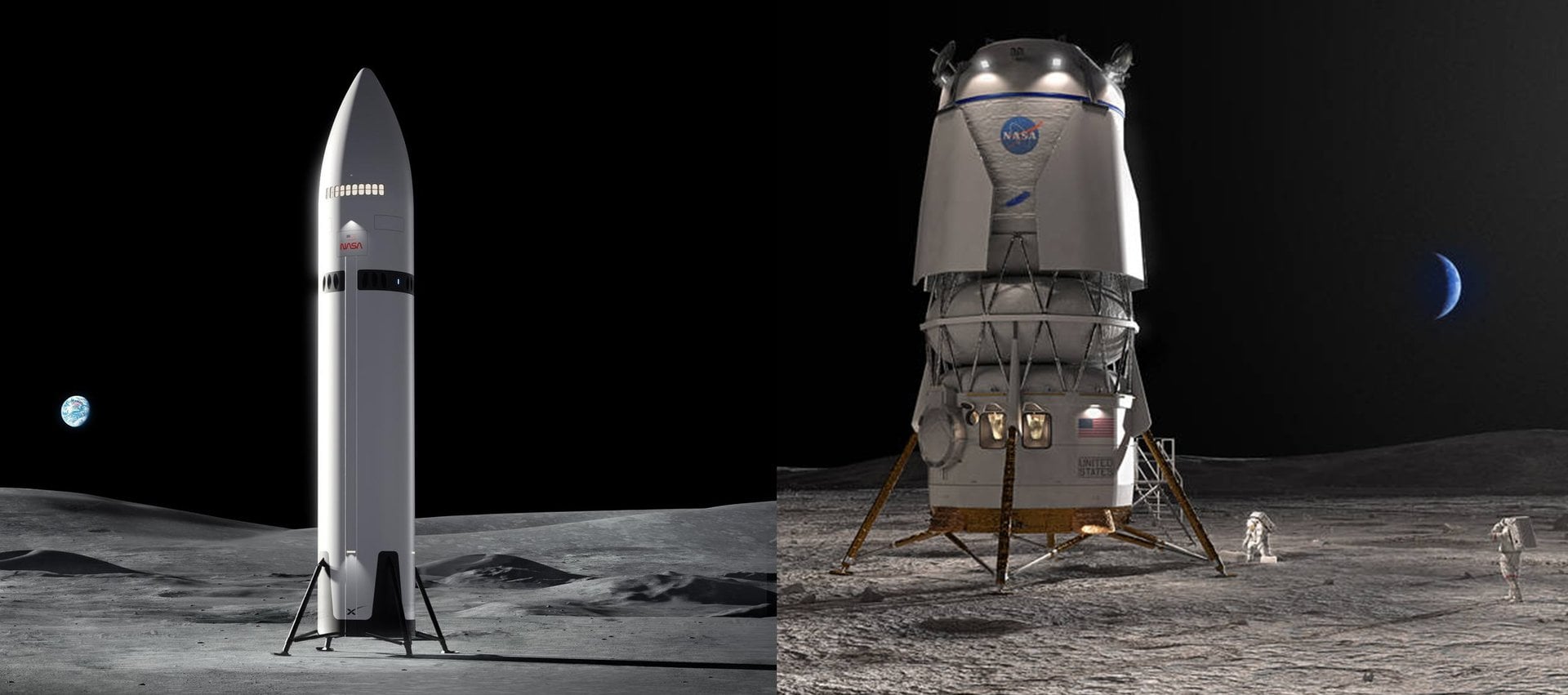
SpaceX is developing a modified version of its Starship vehicle, specifically tailored for lunar operations. Known as the Starship HLS, this massive spacecraft leverages the company’s "Version 3" (V3) architecture. Unlike traditional landers, Starship HLS offers unprecedented internal volume and payload capacity, potentially allowing for longer-duration missions and more significant scientific equipment transfers. During the upcoming LEO demonstration, SpaceX will test a specialized docking system integrated into the nose of the Starship. This test article will interact with the Orion spacecraft to evaluate structural loads and the integrity of the pressurized seal. Notably, while the vehicles will dock, NASA has indicated that crew members will not transition into the Starship test vehicle during this specific rehearsal, focusing instead on the mechanical and navigational aspects of the rendezvous.
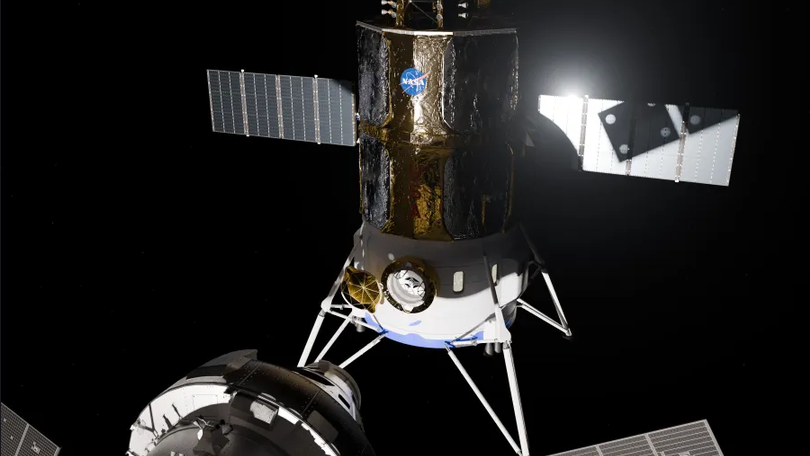
Blue Origin, leading the "National Team," is developing the Blue Moon Mark 2 lander. This system represents a more traditional yet highly advanced modular design. The Blue Moon lander is engineered to be launched by Blue Origin’s New Glenn rocket and is designed for high-precision landings near the lunar south pole. In the Earth-orbit demonstration, the Blue Moon test article will feature a different docking configuration than Starship. While Starship docks nose-to-nose with Orion, the Blue Moon lander will dock adjacent to the crew cabin, utilizing a side-hatch interface. This variety in docking methods requires NASA to maintain a versatile set of protocols and training programs for its astronaut corps.
Technical Milestones and Life Support Integration
A significant portion of the LEO demonstration is dedicated to testing the Environmental Control and Life Support System (ECLSS). For a spacecraft to be "human-rated," it must demonstrate the ability to maintain atmospheric pressure, manage oxygen and nitrogen levels, remove carbon dioxide, and regulate temperature and humidity. The flight hardware used in these rehearsals will incorporate fully functional crew cabins and avionics suites to mirror the conditions of a lunar mission.
To gather empirical data on the internal environment without risking human lives in the early stages of HLS testing, Blue Origin will utilize a lunar surface spacesuit mass simulator. This "Moonikin," similar to the sensor-laden "Commander Moonikin Campos" that flew aboard Artemis I, will be equipped with a suite of instruments to record radiation levels, vibration, and thermal fluctuations. This data will be cross-referenced with the lander’s telemetry to ensure that the internal cabin environment remains within safe physiological limits for future astronauts.
Furthermore, the mission will see two Artemis crew members don the Orion Crew Survival System (OCSS) suits. These suits are designed for high-pressure environments and serve as the primary protection for astronauts during launch, reentry, and emergency scenarios. During the docking rehearsal, the crew will practice the procedures for opening the Orion hatch and preparing to transition to the HLS, a task that requires meticulous coordination between the flight crew and ground control teams at the Johnson Space Center and Marshall Space Flight Center.
The Logistics of a Dual-Launch Campaign
One of the most complex aspects of the Artemis program is the "dual-launch campaign." Unlike the Saturn V missions, which launched the command module and the lander on a single rocket, the Artemis architecture requires multiple launches to assemble the necessary components in space. For the demonstration mission, the lander (either Starship or Blue Moon) will be launched first and prepositioned in a circular parking orbit.
Blue Origin’s test vehicle is designed to remain in this "parking orbit" for up to 30 days. This duration allows ground teams to perform exhaustive system checks, ensuring the lander is fully healthy before the Space Launch System (SLS) rocket lifts off with the Orion spacecraft and its four-person crew. This staggered launch cadence is a necessity of modern heavy-lift logistics, as it allows for the prepositioning of fuel and supplies. In the case of SpaceX, multiple "tanker" Starship launches may eventually be required to refuel the HLS in orbit before it departs for the Moon—a technological hurdle that NASA and SpaceX are working to solve through these early flight tests.
Steve Creech, the HLS Program Manager at NASA’s Marshall Space Flight Center, emphasized the importance of this phased approach. "Each human landing system provider has taken a different approach to the Artemis III mission," Creech stated. "Ultimately, SpaceX and Blue Origin have put forward a list of aggressive objectives and goals intended to complement upcoming uncrewed demonstration missions at the Moon so that we can gain both understanding and confidence in the spacecraft and launch vehicles prior to a crewed landing."
Historical Context and the Artemis Timeline
The Artemis program represents a strategic shift in NASA’s exploration goals. While Apollo was primarily a series of "flags and footprints" missions driven by Cold War competition, Artemis is built on international cooperation and the intent to stay. The program is named after the twin sister of Apollo in Greek mythology, symbolizing a return to the Moon with a more diverse astronaut corps, including the first woman and the first person of color to walk on the lunar surface.
The chronology of the program reflects a steady buildup of capability:
- Artemis I (2022): A successful uncrewed flight of the SLS and Orion, testing the heat shield and deep-space navigation.
- Artemis II (Planned 2025/2026): The first crewed flight of Orion, which will perform a lunar flyby to test life support systems with humans on board.
- LEO HLS Demonstration (Planned 2025/2026): The "dress rehearsal" involving docking with commercial lander prototypes.
- Artemis III (Targeted 2026/2027): The first crewed landing near the lunar South Pole.
- Artemis IV (Targeted 2028): The first mission to utilize the Lunar Gateway station and a second crewed landing.
By testing the HLS in Earth orbit first, NASA mitigates the risks associated with the "Near-Rectilinear Halo Orbit" (NRHO) used near the Moon. NRHO is a highly stable orbit that provides constant communication with Earth, but it is difficult to reach and requires precise timing. Testing docking in LEO allows for more frequent launch opportunities and easier abort scenarios should a system fail.
Official Perspectives and Mission Complexity
The leadership at NASA views the upcoming demonstration as one of the most significant engineering challenges in the agency’s history. Jeremy Parsons, the Artemis Program Manager, highlighted the operational demands of the mission. "Artemis III will be a highly choreographed dance with a demanding launch sequence across multiple launch pads and equally demanding mission operations for our ground and flight crews," Parsons noted. He described the demonstration mission as the "next giant leap" that will utilize NASA’s decades of expertise in systems engineering to bring disparate commercial and government technologies together.
The complexity is not limited to the hardware. The mission requires the synchronization of multiple control centers. NASA’s Mission Control in Houston will manage the Orion spacecraft, while SpaceX’s facility in Hawthorne and Blue Origin’s center in Huntsville will manage their respective landers. This tri-party communication network must be seamless to ensure the safety of the crew during the critical docking phase.
Broader Implications and the Future of Lunar Exploration
The successful execution of these Earth-orbit tests will have implications far beyond the Artemis III mission. By validating the HLS docking and life support systems, NASA is effectively certifying a new class of spacecraft that will eventually facilitate the construction of the Lunar Gateway—a small space station that will orbit the Moon and serve as a staging point for surface missions and, eventually, missions to Mars.
Furthermore, the data gathered from these rehearsals will inform the "Moon to Mars" objective. The landing systems being developed today are seen as prototypes for the massive transport ships that will one day carry humans to the Red Planet. The reliance on commercial partners also signals a permanent shift in the aerospace economy, moving from a government-owned-and-operated model to one where NASA is one of many customers in a thriving cislunar marketplace.
As NASA, SpaceX, and Blue Origin prepare for next year’s demonstration, the eyes of the global scientific community are fixed on the progress. The transition from theoretical designs to flight-ready hardware marks the beginning of a new era. If the Earth-orbit dress rehearsal succeeds, the path to the lunar South Pole will be cleared, bringing humanity one step closer to once again stepping onto the dusty surface of another world. The "highly choreographed dance" in LEO is not just a test; it is the final rehearsal before the most significant curtain call in the history of space exploration.
Related posts: