The Discovery of Exoplanet GJ 3090 b Challenges Established Models of Planetary System Formation

In our own solar system, the architecture of the planets is characterized by a remarkable degree of symmetry and order. All eight major planets orbit the Sun in a near-coplanar arrangement, with none deviating by more than 7 degrees from the solar equator. Furthermore, every planet follows the Sun’s rotation, a vestige of the orderly collapse of the primordial gas cloud from which our system emerged 4.6 billion years ago. However, a groundbreaking study published in the journal Astronomy & Astrophysics has shattered the assumption that such alignment is a universal requirement for planetary stability. A research team led by Yann Carteret, a doctoral candidate at the University of Geneva (UNIGE), has identified the first known exoplanet orbiting a red dwarf star in a retrograde direction—a discovery that forces a significant reassessment of contemporary planet formation theories.
The Characteristics of GJ 3090 b
The subject of this study is GJ 3090 b, a "sub-Neptune" exoplanet located approximately 73 light-years from Earth within the southern constellation of Phoenix. The planet possesses a radius roughly 2.2 times that of Earth and a mass approximately 4.5 times greater, placing it firmly in the category of gas-rich or volatile-rich worlds common throughout the Milky Way. GJ 3090 b maintains an exceptionally tight orbit, completing a full revolution around its host red dwarf every 2.9 days.
Red dwarfs, or M-dwarfs, are the most common type of star in the galaxy. Because they are significantly smaller and cooler than our Sun, they are often the primary targets for astronomers searching for habitable worlds. However, the discovery that such a compact system could host a retrograde planet—one that orbits in the opposite direction of the star’s rotation—suggests that the early developmental stages of these systems are far more chaotic than previously hypothesized.
Methodology: Detecting the Rossiter-McLaughlin Effect
To determine the orbital orientation of GJ 3090 b, the UNIGE-led team utilized the 3.6-meter telescope at the European Southern Observatory (ESO) in Chile, specifically employing high-precision spectroscopy. The researchers sought to measure the Rossiter-McLaughlin (RM) effect, a phenomenon that occurs when a planet transits across the face of its star.
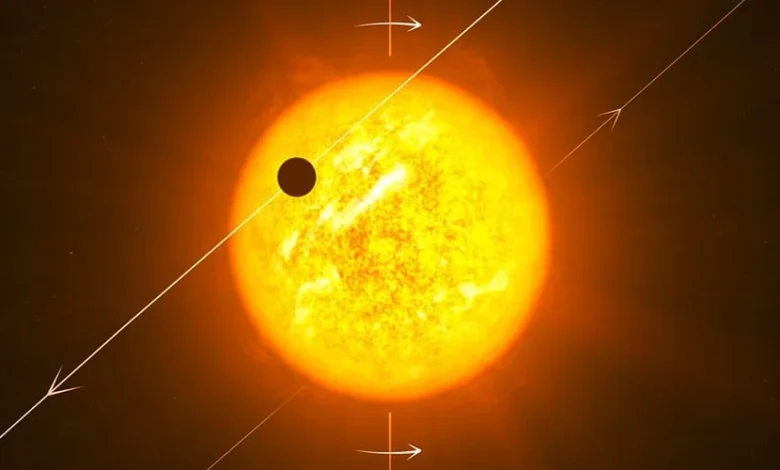
As a star rotates, one limb moves toward the observer, causing the light from that side to be blueshifted due to the Doppler effect. Simultaneously, the opposite limb rotates away from the observer, resulting in a redshifted signature. When a planet passes in front of the star, it selectively obscures these regions. If a planet is in a "prograde" orbit—moving in the same direction as the star’s rotation—it first blocks the blueshifted light, creating a temporary red-shifted signature, before moving to the redshifted side and inducing a blue-shifted signature.
Over the course of five separate transits, the team observed the exact inverse of this sequence. GJ 3090 b consistently moved across the "red" hemisphere of the star before traversing the "blue" hemisphere. These spectroscopic measurements allowed the researchers to calculate an orbital obliquity of approximately 136 degrees. In orbital mechanics, any value exceeding 90 degrees indicates a retrograde orbit. This finding is not merely an anomaly; it is a profound deviation from the standard disk-accretion models that dictate how planets settle into their final orbits.
Chronology of the Discovery and Investigation
The investigation into GJ 3090 b represents the culmination of years of targeted observation. The project began with the identification of the transit signal via space-based photometry, which established the existence of the planet. Following this initial detection, the team shifted their focus to the ground-based ESO facilities to resolve the orbital geometry.
The timeline of the research proceeded as follows:
- Initial Detection: Photometric surveys identified the transit signatures of GJ 3090 b, confirming its sub-Neptune status and short orbital period.
- Spectroscopic Campaign: Researchers utilized the NIRPS (Near Infrared Planet Searcher) instrument, specifically designed to study red dwarf systems, to observe five consecutive transits.
- Data Analysis: The team spent several months analyzing the velocity shifts associated with the RM effect to ensure that the observed obliquity was not an instrumental artifact.
- Validation: By comparing the data against stellar rotation models and known gravitational dynamics, the team concluded that the orbital tilt was definitively retrograde.
- Publication: The final analysis was submitted to Astronomy & Astrophysics, where it underwent peer review before its release in the 2026 cycle.
The Problem of "Gravitational Drama"
In previous instances where retrograde exoplanets have been discovered, astronomers could typically point to a culprit. Most known "hot Jupiters" or other misaligned planets exhibit such traits due to "gravitational drama"—a violent interaction involving a massive companion planet or a secondary star that scatters the inner planet into a tilted or retrograde path long after the protoplanetary disk has dissipated.
GJ 3090 b, however, presents a distinct challenge. While the system does contain another planet, the team found that the gravitational influence exerted by this secondary body is insufficient to have forced GJ 3090 b into such a radical orbital shift. Without a massive perturber to explain the misalignment, the traditional dynamic models fail. This lack of an obvious external force suggests that the cause of the retrograde motion was "primordial"—implanted during the very birth of the system rather than through subsequent interaction.
The "Primordial Disk Flip" Theory
To explain this phenomenon, the research team has proposed a "primordial disk flip" mechanism. This hypothesis suggests that shortly after the star formed and the initial protoplanetary disk dissipated, the system was subjected to an influx of fresh material from the surrounding interstellar medium.
If this gas and dust fell into the star system at a significant angle, it could have formed a secondary, misaligned protoplanetary disk. If planet formation occurred within this second-generation disk, the resulting worlds would inherit the angular momentum of that material, which could be tilted or even reversed relative to the star’s own rotation.
This theory finds support in the observation of "Peter Pan disks"—circumstellar disks that persist for tens of millions of years, far longer than the standard 1-to-5-million-year lifespan typically associated with planetary formation. These disks provide a reservoir of material that can be replenished or redirected, potentially leading to the formation of planets like GJ 3090 b. Under this framework, GJ 3090 b is not the result of a violent collision, but rather the product of a complex, extended, and potentially chaotic formation environment.
Broader Implications for Exoplanetary Science
The implications of the GJ 3090 b discovery are far-reaching. If a significant percentage of exoplanetary systems undergo disk-flipping events or form from secondary disks, our current understanding of "habitable zones" may need adjustment. A planet in a retrograde orbit might have experienced a different thermal history than those in circular, prograde orbits, potentially affecting the retention of an atmosphere or the development of water-based chemistry.
Furthermore, this discovery serves as a milestone for technical capability. GJ 3090 b is the smallest exoplanet for which orbital obliquity has been mapped around a red dwarf. As next-generation instruments like the Extremely Large Telescope (ELT) come online, astronomers will be able to probe smaller, rocky planets for similar signs of orbital instability.
"This is not just about one planet," noted a member of the research team in a supplemental statement. "It is about the variety of ways that nature builds a solar system. We have spent decades looking at our own neighborhood and assuming it was the blueprint. We are now realizing that our solar system may be the exception rather than the rule."
As the scientific community turns its attention to other multi-planetary systems orbiting red dwarfs, the quest to identify more retrograde worlds continues. By mapping the diversity of orbital architectures, astronomers hope to determine whether the "primordial disk flip" is a common occurrence in the life cycles of stars or if GJ 3090 b represents a truly rare cosmic curiosity. For now, the "rebellious" planet remains a sentinel, reminding us that the universe is far more dynamic, and far more unpredictable, than our early models suggested.
Related posts: