NASA Accelerates Lunar Return Strategy Through Streamlined Artemis Lander Operations and Strategic Partnership Realignment

As NASA accelerates its timeline to return humans to the lunar surface by 2028, the agency has unveiled a comprehensive restructuring of its human landing system (HLS) operations. In a move designed to minimize technical risk and optimize orbital mechanics, NASA has pivoted away from the previous reliance on near-rectilinear halo orbits, opting instead for a more flexible, mission-specific rendezvous architecture. This strategic shift involves a deep integration with primary commercial partners SpaceX and Blue Origin, both of which are currently refining their lander designs to meet the ambitious requirements of an enduring Moon base.
A New Architecture for Lunar Access
The core of this operational update lies in the transition of the rendezvous point for the Artemis missions. By moving away from the complex near-rectilinear halo orbit (NRHO) and toward orbits better suited to the specific flight profiles of the SpaceX Starship HLS and the Blue Origin Blue Moon Mark 2, NASA aims to reduce propellant requirements and decrease the duration of transit between the surface and the Orion spacecraft.
Under this new framework, the Artemis III mission will serve as a foundational test of docking capabilities in low Earth orbit (LEO). This shift ensures that both SpaceX and Blue Origin can demonstrate the readiness of their respective systems in a controlled environment before attempting the more complex trans-lunar injection burns required for a surface landing.
SpaceX: Propellant Aggregation and the Starship HLS
SpaceX’s strategy for the Artemis program remains centered on its massive Starship architecture. The company plans to utilize an in-space propellant transfer system, essentially creating a "gas station" in low Earth orbit. This process, known as propellant aggregation, requires multiple launches of Starship "tanker" variants to fill a "depot" Starship. Once fully fueled, this depot will transfer the necessary cryogenic liquid methane and liquid oxygen to the Starship HLS.
This approach offers significant logistical advantages. By decoupling the launch of the crew on the Space Launch System (SLS) from the launch of the lander’s fuel supply, NASA gains increased flexibility in mission scheduling. Once the crewed Orion spacecraft docks with the Starship HLS in Earth orbit, the Starship’s engines will perform the critical trans-lunar injection, essentially pushing the entire stack toward the Moon. This "tug" capability simplifies the propulsion requirements for Orion, which was originally intended to perform a greater portion of the transit maneuvers.
Blue Origin: The Multistage Mark 2 Approach
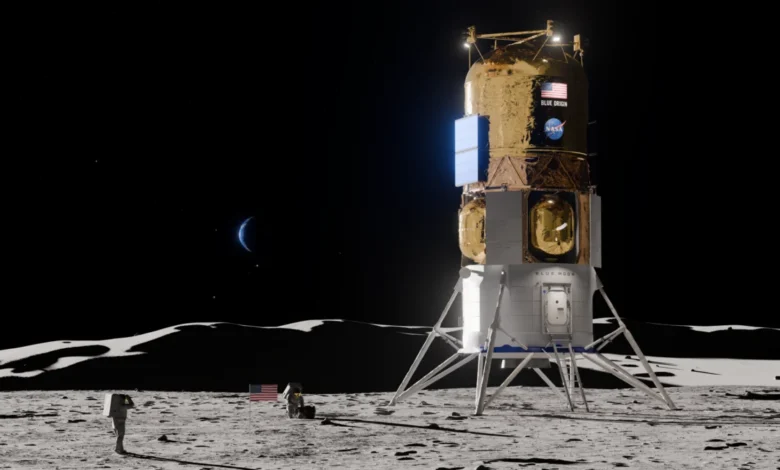
Blue Origin has adopted a distinct, modular strategy for its Blue Moon Mark 2 Alpha lander. Rather than relying on in-space refueling, Blue Origin will utilize a series of three transfer stages that operate in a manner similar to a conventional multistage rocket. These stages are designed to launch into low Earth orbit and then dock with the primary lander, creating a stack that departs for an elliptical polar orbit around the Moon.
As the mission progresses, these stages are jettisoned once their propellant is exhausted, shedding unnecessary mass and maximizing the efficiency of the remaining descent vehicle. This architecture is particularly well-suited for missions to the lunar South Pole, a region of high scientific interest due to the presence of water ice. By utilizing an elliptical polar orbit, Blue Origin provides a more direct and faster return path for astronauts ascending from the surface to link back up with the waiting Orion spacecraft.
The Role of SLS and Orion
Despite the heavy reliance on commercial landers, the Space Launch System (SLS) remains the backbone of the Artemis program. As the world’s most powerful operational rocket, SLS provides the high-energy boost necessary to send the Orion crew capsule on a trajectory toward the Moon. NASA Administrator Jared Isaacman has emphasized that the integration of SLS and Orion with these new commercial landers creates a "Super Bowl-caliber team."
The agency is currently engaged in modifying the Orion spacecraft to ensure it can withstand the forces of being pushed by the larger Starship HLS, as well as integrating new communication and docking interfaces for the Blue Origin lander. These technical modifications are part of a broader effort to ensure that the mission architecture is not just robust, but also adaptable to the unique operational characteristics of both providers.
Chronology of the Artemis Evolution
The path to the 2028 landing has been marked by significant milestones and continuous adaptation.
- 2021: NASA awards the initial HLS contract to SpaceX, followed by the inclusion of Blue Origin in 2023 to foster competition and redundancy.
- March 2024 (Ignition Day): NASA announces a major shift in mission architecture, focusing on streamlining the rendezvous process and increasing the cadence of launches.
- Late 2024 – 2025: Current phase of technical refinement, with both companies adding human-in-the-loop testing and cabin design demonstrations to their development timelines.
- 2026 (Projected): Scheduled uncrewed demonstration missions for both the SpaceX Starship HLS and the Blue Origin Blue Moon lander.
- 2028: Target year for the first crewed return to the lunar surface.
Safety, Testing, and Certification
NASA’s commitment to safety remains the governing principle of the Artemis program. Before any astronauts board these landers, both SpaceX and Blue Origin are required to perform successful uncrewed demonstration missions. These flights will prove that the complex sequences of docking, descent, and ascent can be performed autonomously and reliably.
Furthermore, NASA has instituted additional milestones to provide closer insight into the engineering process. SpaceX is adding two specific demonstrations of its "Cabin 1" crew environment to ensure that the living quarters are both functional and safe for long-duration stays. Similarly, Blue Origin has incorporated new hardware readiness milestones, which involve testing how their systems respond to the physical constraints of human astronauts, including ergonomics, life support monitoring, and emergency egress procedures.
Broader Implications: A New Era of Space Exploration
The strategic realignment of the Artemis program represents more than just a change in orbital flight paths; it signifies the maturing of the public-private partnership model in space exploration. By fostering competition between SpaceX and Blue Origin, NASA is not only driving down costs but also creating a redundant industrial base that ensures the United States remains at the forefront of space exploration.
The implications of this effort extend far beyond the Moon. The technology being developed—including cryogenic fluid management, long-duration life support systems, and autonomous landing precision—forms the "critical path" for the eventual crewed mission to Mars. Every hour spent on the lunar surface, every sample of ice collected, and every landing performed by these commercial providers serves as a dress rehearsal for the deeper solar system exploration that NASA intends to lead in the coming decades.
Official Perspectives
Jeremy Parsons, NASA’s Artemis program manager, recently noted that the collaboration between the agency and its commercial partners is unprecedented. "Working hand in hand with our partners to align our requirements ensures that we are not just building a lander, but an entire ecosystem for sustained lunar presence," Parsons said. "The updates we have made since March ensure that we have the visibility and the technical oversight required to meet the highest safety standards in the history of human spaceflight."
The economic impact of this initiative is also significant. The 24/7 activity in NASA’s machine shops and the rapid scaling of production at SpaceX and Blue Origin facilities across the United States are creating a surge in high-tech employment and infrastructure investment. As the agency moves toward its 2028 deadline, the project stands as a testament to the renewed focus on maintaining American leadership in space, echoing the spirit of the Apollo era while utilizing the agile, innovative techniques of the 21st century.
Conclusion
As the Artemis program continues to evolve, the clarity provided by these new operational plans offers a stable roadmap toward the lunar surface. With the combined strengths of the SLS, the Orion spacecraft, and the diverse capabilities of the SpaceX and Blue Origin landers, NASA is positioning itself to not only return to the Moon but to stay there. The transition to a sustainable, frequent, and safe lunar presence is now officially underway, marking a critical chapter in the ongoing history of human exploration.