Amazon Announces ECS Gateway to Eliminate Container Ingress Management Bottlenecks and Streamline Cloud Infrastructure

Managing containerized applications at massive scale has long presented platform teams with a persistent operational friction point: ingress networking configuration. For every microservice deployed onto Amazon Elastic Container Service (Amazon ECS), engineers traditionally had to manually provision, wire together, and continuously maintain a complex web of Application Load Balancers (ALBs), AWS Certificate Manager (ACM) SSL/TLS certificates, AWS WAF web access control lists (web ACLs), and intricate security groups. As organizations scaled from dozens to thousands of containerized workloads, this per-service operational overhead dramatically slowed deployment velocity, increased the risk of configuration drift, and introduced unnecessary administrative costs.
To address these systemic challenges, Amazon Web Services has officially announced the launch of Amazon ECS Gateway, a transformative account-level resource designed to automate and simplify ingress networking for containerized workloads. By dynamically provisioning and managing the requisite underlying infrastructure directly within customer accounts, ECS Gateway bridges the gap between infrastructure efficiency and developer agility, fundamentally redefining how modern cloud architectures handle application traffic routing.
The Evolution of Container Ingress and the Birth of ECS Gateway
Over the past decade, container adoption has surged across enterprises of all sizes, shifting the primary bottleneck of software delivery from raw compute provisioning to networking and traffic management. Platform engineering teams have spent countless hours building custom automation scripts, Terraform modules, and continuous integration pipelines merely to connect newly spun-up containers to the outside world.

When a single application team creates a new service, they require a dedicated entry point complete with secure TLS termination, distributed denial-of-service (DDoS) protection, and health check routing. Multiplying this requirement across dozens of independent development squads often results in fragmented networking topologies, underutilized load balancers, and a sprawling attack surface that is difficult to audit.
Recognizing these industry-wide pain points, AWS architects developed ECS Gateway to function as a centralized orchestrator. Rather than treating ingress as a bespoke, per-service chore, ECS Gateway introduces an intelligent, account-level control plane that abstracts away the manual labor of load balancing and certificate provisioning. The system is engineered to establish a strict yet collaborative boundary between platform teams—who govern overall security boundaries, VPC topologies, and global gateway parameters—and application teams, who can effortlessly attach their services to pre-approved gateways with minimal friction.
Architectural Mechanics and Cost Optimization
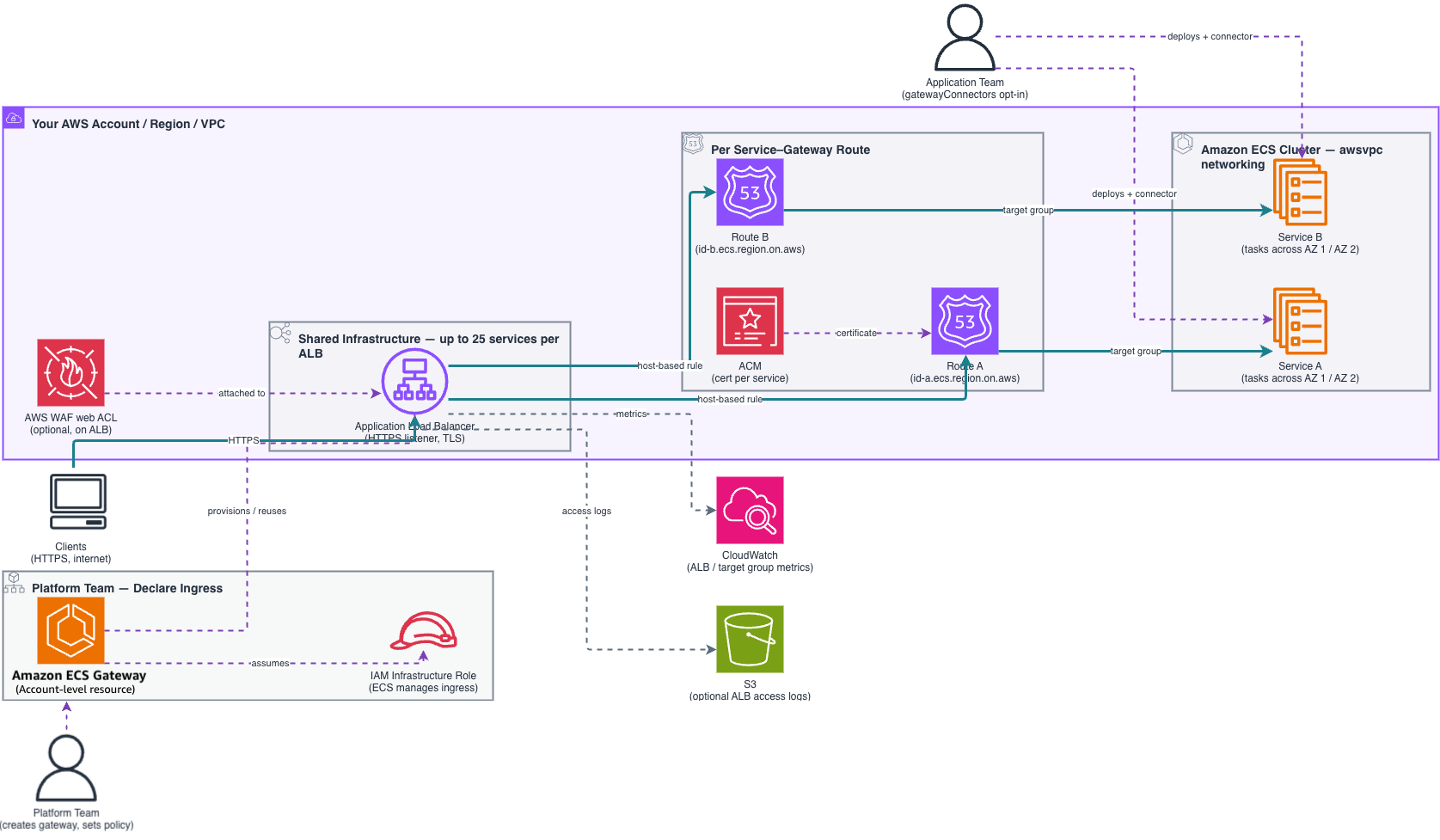
At its core, ECS Gateway leverages host-based routing via Application Load Balancers to maximize resource utilization and drive down cloud expenditures. Historically, many organizations fell into the trap of provisioning a dedicated ALB for every individual microservice, leading to inflated infrastructure bills due to the fixed hourly costs of load balancers. ECS Gateway radically alters this economics model by allowing up to 25 distinct containerized services to securely share a single ALB.
Amazon ECS takes full responsibility for managing the lifecycle of this underlying infrastructure. When an organization deploys its very first service and connects it to a newly minted gateway, ECS automatically provisions the initial ALB. As application teams continue to launch services and approach capacity thresholds on that load balancer, ECS dynamically scales out by provisioning additional ALBs without requiring manual intervention. Conversely, when services are decommissioned and traffic volume recedes, ECS scales down the underlying infrastructure, removing unneeded load balancers to prevent resource waste.

Upon successful provisioning, ECS instantly generates a unique Domain Name System (DNS) hostname for the connecting service. This grants developers a production-ready, highly available endpoint the exact moment their deployment completes, eliminating the lag time typically associated with DNS propagation and target group registration.
Deployment and Configuration Workflow
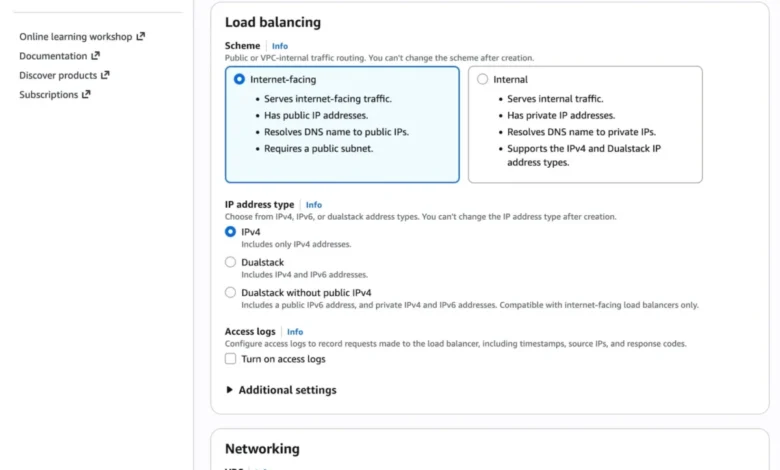
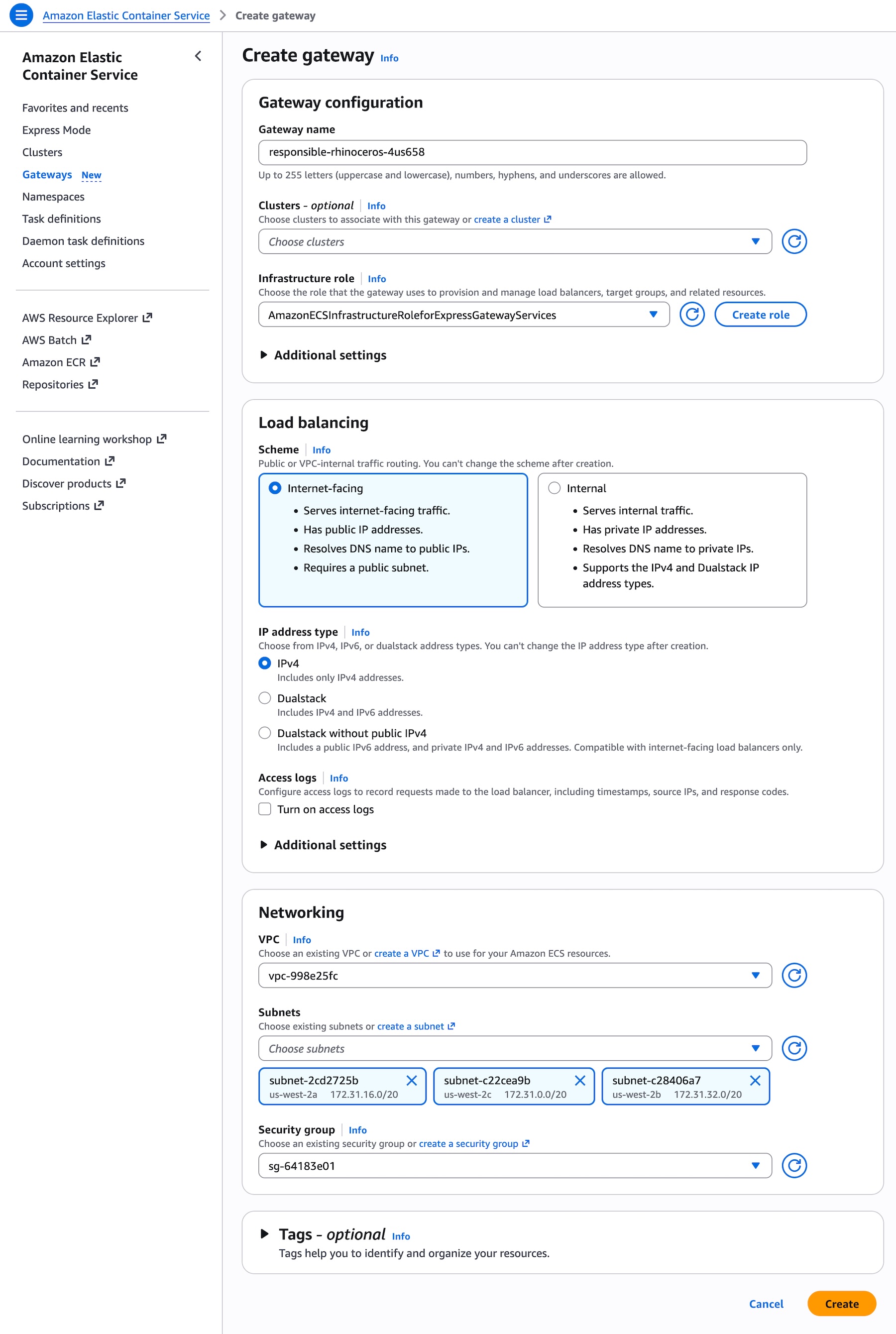
Platform administrators can provision and configure Amazon ECS Gateways using either the AWS Management Console or the AWS Command Line Interface (AWS CLI). The initialization process requires defining a unique gateway name and assigning an IAM infrastructure role. This specialized role grants ECS the necessary permissions to provision and manage networking artifacts—such as ALBs, security groups, and ACM certificates—directly inside the customer’s AWS account.
When setting up a gateway via the console, operators select whether the traffic routing scheme should be public (internet-facing) or VPC-internal. Additional configurations include specifying listener ports, establishing maximum load balancer scaling counts, and attaching AWS WAF web ACLs to shield applications from common web exploits and malicious traffic patterns. For automation-first environments, administrators can execute the CreateGateway command via the AWS CLI:
aws ecs create-gateway
  --name my-team-gateway
  --infrastructure-role-arn arn:aws:iam::123456789012:role/ECSGatewayRole
  --configuration '
    "HostSharedAlb":
      "networkConfiguration":
        "subnets": [
          "subnet-080779f9bd887757a",
          "subnet-03d5b2fead6bc6258",
          "subnet-0861210a397d31252",
          "subnet-06539e194023cb77a"
        ],
        "ipAddressType": "ipv4"
      ,
      "scheme": "internet-facing"

  '
Once the gateway is active, platform teams establish many-to-many associations between the gateway and their ECS clusters. A single gateway can be associated with up to 10,000 distinct clusters, while an individual cluster can support up to five concurrent gateway associations. This architectural flexibility enables organizations to segment traffic logically—such as maintaining separate public-facing and private-internal gateways—or share a unified gateway across multiple staging and production environments.
Incremental Adoption and Application Team Integration
A critical design consideration for enterprise-grade tools is the ability to migrate legacy architectures without inducing catastrophic downtime. AWS engineered ECS Gateway with a seamless migration path in mind. Application teams can adopt the technology incrementally by adding a gateway connector to their service definitions using either the CreateService or UpdateService API operations.
For services already operating with their own legacy load balancers, engineers can execute an UpdateService call to attach a gateway connector alongside their existing setup. This dual-path ingress capability allows teams to rigorously validate the new gateway routing, test connectivity, and inspect target health before safely dismantling their legacy load balancer configurations.
aws ecs create-service
  --cluster my-cluster
  --service my-api-service
  --task-definition my-api-service:1
  --gateway-connectors '[ "portName": "api", "filters": "accessTypes": ["PUBLIC"], "healthCheck": ... ]'
When a deployment is triggered, Amazon ECS evaluates the available gateways associated with the target cluster, identifying compatible options based on access types, VPC boundaries, and Availability Zone coverage. Once compatibility is verified, ECS provisions the requisite per-service artifacts: an ACM certificate for secure HTTPS traffic, a unique DNS routing record, precise listener rules pointing to the service target group, and hardened security groups that restrict inbound traffic exclusively to the originating ALB.
Industry Implications and Strategic Analysis
From a broader industry perspective, the introduction of Amazon ECS Gateway represents a mature evolution in container orchestration tooling. Over recent years, platform engineering has crystallized as a vital discipline focused on building internal developer platforms (IDPs) that abstract underlying cloud complexities. By shifting ingress management from a fragmented manual checklist to an automated, policy-driven platform capability, AWS is directly addressing the cognitive load placed on modern development teams.
Analysts note that features like dynamic ALB sharing and automated lifecycle management deliver immediate financial and operational dividends. In traditional setups, organizations routinely waste substantial capital on under-utilized load balancers assigned to low-traffic internal microservices. By pooling up to 25 services under a single shared ALB—while retaining automated scaling limits—enterprises can significantly trim their monthly AWS expenditures. Furthermore, the tight integration of AWS WAF and AWS Certificate Manager at the gateway level ensures that security posture is maintained by default, satisfying rigorous compliance frameworks without requiring manual intervention from individual developers.
To further streamline operations, AWS has ensured that ECS Gateway is fully compatible with modern AI-driven coding assistants and orchestration frameworks through the AWS MCP Server and associated plugins, allowing developers to query documentation and manage gateway resources programmatically via their preferred integrated development environments.
Availability and Pricing Structure
Amazon ECS Gateway is available immediately across all commercial AWS Regions where Amazon ECS is supported. AWS has structured the release with a developer-friendly pricing model: the ECS Gateway feature itself incurs no additional software or platform charges. Customers pay solely for the underlying infrastructure resources provisioned within their accounts when services actively connect to a gateway. This includes standard pricing for Application Load Balancers, CloudWatch logs and metrics, ACM certificates, and standard data transfer rates.
As cloud-native architectures continue to scale in complexity, tools like Amazon ECS Gateway signal a clear industry shift toward hyper-automated, developer-centric infrastructure management—reducing human error, accelerating software delivery pipelines, and letting engineering teams focus squarely on writing business logic rather than wrestling with network topologies.