Engineers at Aarhus University unveil a light-powered silicone frog that moves without motors or batteries.

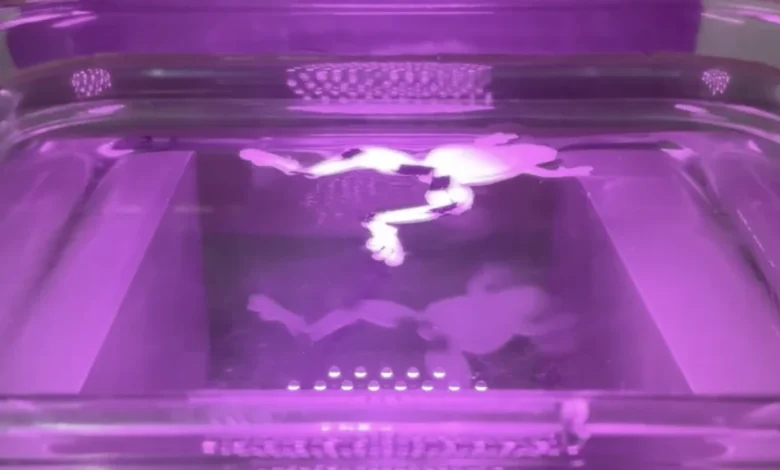
In a remarkable convergence of soft robotics and materials science, researchers at Denmark’s Aarhus University have successfully developed a miniature, silicone-based robot frog capable of aquatic locomotion without the aid of internal motors, batteries, or complex wiring. The breakthrough, detailed in the peer-reviewed journal Advanced Materials Technologies, represents a significant shift in how engineers conceptualize autonomous soft robotics, replacing traditional mechanical actuators with light-responsive synthetic tissues.
The Mechanics of Light-Driven Motion
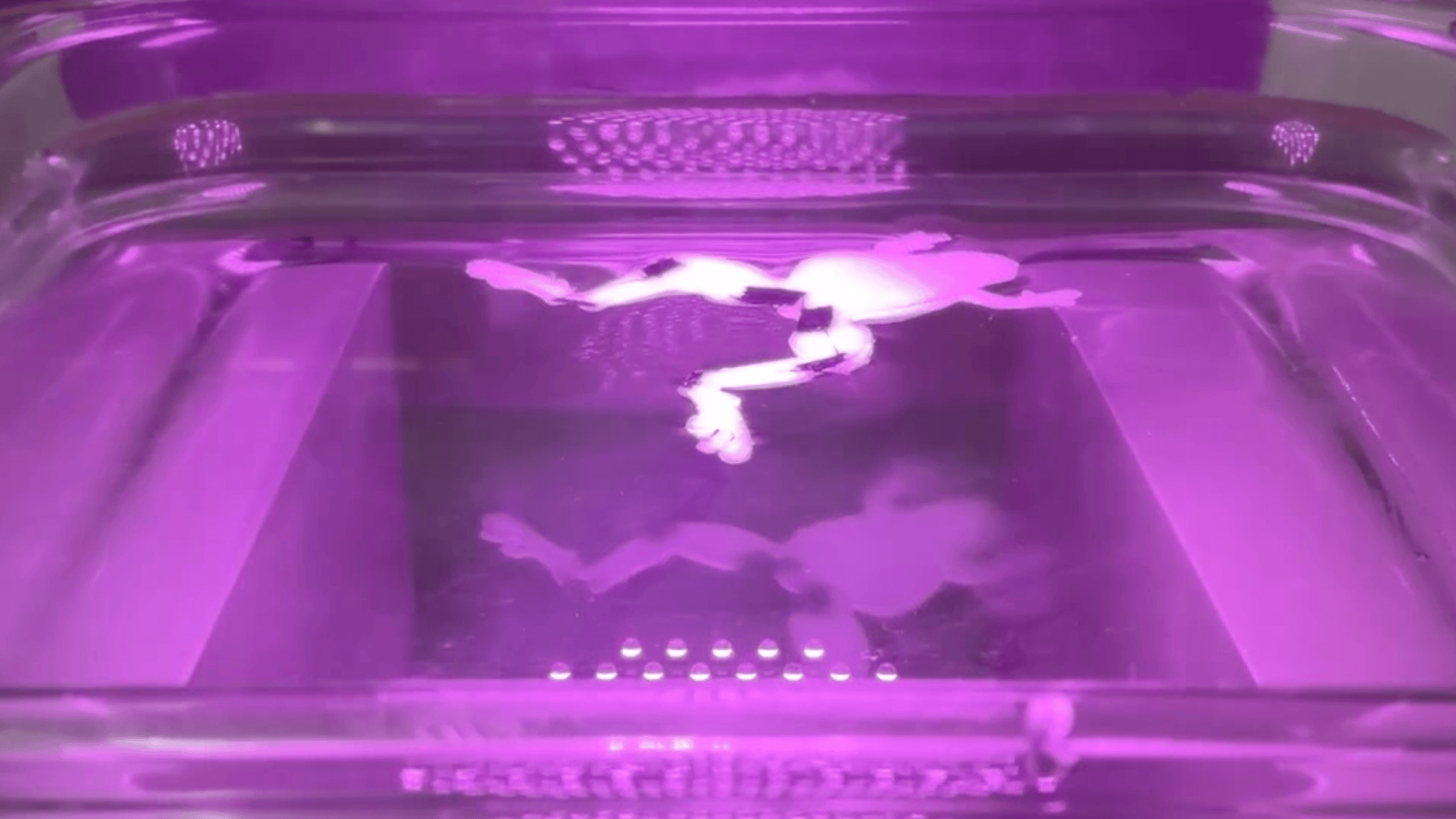
The primary innovation behind the robot frog lies in its "musculature." Rather than relying on electric motors or hydraulic systems, the robot utilizes six specialized artificial muscles crafted from crystal elastomers. These materials possess a unique thermal response profile: they contract when subjected to heat and return to their original, resting state upon cooling.
To bridge the gap between this physical property and functional mobility, the research team, led by chemists Cecilie Ryberg and Brigitte Städler, incorporated specific light-sensitive molecules into the elastomer matrix. These molecules are engineered to absorb near-infrared (NIR) light and convert that energy into localized heat. When an external NIR light source is focused on specific segments of the frog’s body, the muscles undergo a rapid, controlled contraction, mimicking the biological action of amphibian muscles.
However, the transition from static contraction to coordinated swimming proved to be the project’s most significant hurdle. Achieving fluid, directional motion required precise synchronization of the six muscles. According to Professor Brigitte Städler, the lack of coordination in early prototypes led to erratic behavior, where the device would merely spin in place rather than propelling itself through the water. Through a series of iterative design adjustments, the team successfully tuned the contraction timing and material elasticity to achieve a functional, if leisurely, swimming stroke.
A Chronology of Development
The development of this project was a multi-year endeavor that bridged the gap between theoretical chemistry and applied robotics.
- Initial Conception: The project began with the fundamental challenge of creating "smart" materials capable of responding to environmental stimuli. The team identified crystal elastomers as a viable base due to their durability and mechanical flexibility.
- Material Optimization: Ryberg and her colleagues spent extensive time refining the chemical composition of the elastomers. The goal was to find a consistency that could be reliably 3D-printed. Unlike standard plastic filaments used in conventional 3D printing, which require high-heat melting, the team developed a substance with the viscosity of heavy syrup or icing. This allowed for intricate, layer-by-layer deposition of the muscle structures.
- System Integration: Once the muscles were printed, they were integrated into the silicone frame of the frog. This phase involved intense trial-and-error testing to ensure that the material’s expansion and contraction cycles were fast enough to overcome the drag of water.
- Experimental Validation: The final validation occurred in controlled water tanks, where the team measured the speed and maneuverability of the device under varying intensities of near-infrared light.
Performance Data and Material Challenges
The performance of the robot frog is modest by biological standards. In experimental trials, the device achieved a speed of approximately three inches (roughly 7.5 centimeters) over a duration of two minutes. While this velocity is significantly slower than that of a living bullfrog, the achievement is not measured in speed, but in the efficiency of the propulsion system.
The reliance on 3D printing technology for these soft actuators marks a departure from traditional robotic assembly. The "syrup-like" consistency of the elastomer allows for the creation of complex geometries that are impossible to machine using traditional subtractive manufacturing methods. By adjusting molecular chain lengths and the chemical density of the polymers, the researchers were able to dictate the precise threshold at which the muscles respond to light, effectively allowing for "programmable" motion.
Broader Implications for Soft Robotics
The successful demonstration of a motor-less, wire-free robot has garnered attention from the broader robotics community. While the immediate application of the device is limited to small-scale, remote-controlled environments—or as the researchers suggest, high-tech educational toys—the implications for the future of soft robotics are profound.
Current soft robots often struggle with the "tether problem," where the need for bulky power supplies and control circuitry limits their size and agility. By utilizing light as both a power source and a control signal, the Aarhus team has effectively decoupled the robot from its power supply. This methodology could eventually be adapted for use in:

- Environmental Monitoring: Soft robots could be deployed in delicate ecosystems where the noise, heat, or pollution from traditional electric motors would be disruptive.
- Search and Rescue: In scenarios involving tight, debris-filled spaces, a small, flexible robot capable of moving through light-controlled pulses could navigate areas where rigid, battery-operated drones would fail.
- Medical Microsurgery: The potential to trigger muscle-like contractions in a non-invasive, light-driven manner offers a roadmap for future bio-integrated devices that could operate within the human body.
Official Perspectives and Future Outlook
"I could easily imagine these robots being used as toys before we see them on rescue missions," stated Cecilie Ryberg in a university profile. "I think people would have fun playing with a frog like this using a suitable light source."
This sentiment reflects a grounded, scientific approach to the technology. The team acknowledges that significant scaling is required before these devices can perform complex tasks in unpredictable, real-world environments. The primary technical barrier remains the "speed of response." Because the muscles rely on heating and cooling cycles, their frequency is limited by the time it takes for the elastomer to release heat back into the surrounding water. Accelerating this process without damaging the material or requiring excessive light intensity is the next major objective for the research group.
Furthermore, the integration of multiple light sources could allow for more sophisticated, multi-directional navigation. If an operator could target specific muscles independently, the robot could theoretically turn, dive, or accelerate with greater precision.
Conclusion: A Shift in Engineering Paradigms
The Aarhus University project serves as a compelling proof-of-concept for the viability of light-driven soft robotics. By synthesizing chemical engineering with robotic design, the team has bypassed the limitations of traditional hardware.
While the "robot frog" is not yet ready to patrol the seas or assist in high-stakes rescue operations, it demonstrates that the future of robotics may not necessarily be found in faster processors or more powerful batteries. Instead, it may lie in the material itself—specifically, in materials that can "think" and "act" by responding directly to the energy present in their environment. As researchers continue to refine the sensitivity and speed of these crystal elastomers, the boundary between biological life and synthetic machines continues to blur, opening new possibilities for the next generation of autonomous technology.