NASA Chandra X-ray Observatory Unmasks the Hidden Companion Driving Periodic Stellar Outbursts in Galaxy NGC 4559

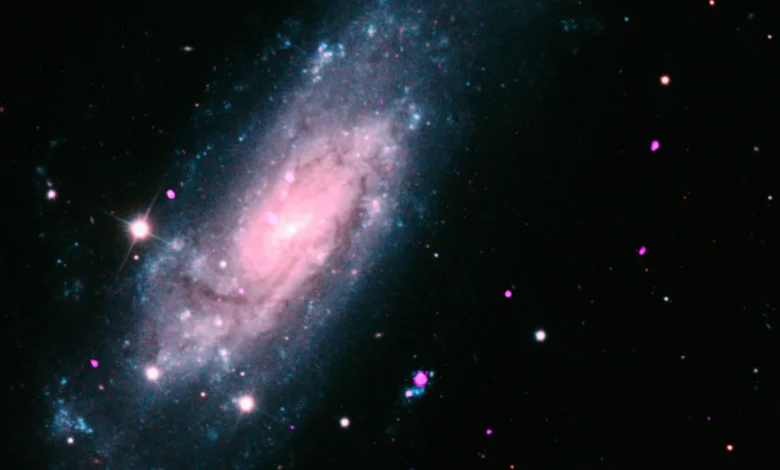
Astronomers utilizing the unparalleled sensitivity of NASA’s Chandra X-ray Observatory have successfully identified the mechanism behind the enigmatic, rhythmic flares of a massive star situated 30 million light-years away. The object, designated AT 2016blu, resides within the outer reaches of the spiral galaxy NGC 4559. For over a decade and a half, researchers have observed the star undergo dramatic fluctuations in optical brightness, a phenomenon that has long defied definitive explanation. By cross-referencing long-term optical monitoring with recent high-resolution X-ray data, an international team of researchers has confirmed that these outbursts are the result of a violent gravitational dance between the massive star and an unseen, compact companion—likely a black hole or a neutron star.
The Anatomy of a Stellar Titan
AT 2016blu is no ordinary star. With an estimated mass approximately 33 times that of our Sun, it belongs to a class of massive, highly evolved stars that are nearing the final, most volatile stages of their life cycles. Such stars are inherently unstable, often shedding mass through powerful stellar winds and intense radiation pressure. However, the specific behavior of AT 2016blu—a predictable, periodic brightening and dimming cycle occurring exactly every 113 days—suggested that external forces were at play.
The galaxy NGC 4559, which hosts this celestial drama, is a sprawling spiral structure characterized by its intricate arm patterns and active star-forming regions. In the composite images released on November 9, 2026, the galaxy appears tilted, showcasing a delicate blend of pink and blue hues. Within this complex environment, AT 2016blu sits near the outer edge of the spiral, appearing as a modest point of light that belies its gargantuan proportions. The discovery of its companion required the unique capabilities of the Chandra X-ray Observatory, which can detect the high-energy signatures generated when matter is heated to millions of degrees—conditions typically associated with the violent interaction of binary systems.
A Chronology of Discovery
The investigation into AT 2016blu is a testament to the power of multi-decade astronomical monitoring. The star first drew significant attention in 2016 when its optical activity became a focal point for transient-event researchers.
- 2011–2016: Early optical observations noted irregular light curves, leading to initial classifications of the star as a potential Luminous Blue Variable (LBV) or an eruptive variable.
- 2016–2020: Continuous monitoring confirmed the periodic nature of the brightening events. The regularity of the 113-day cycle became the primary mystery, as isolated stars do not typically exhibit such precise, long-term clockwork behavior.
- 2021–2025: Researchers began targeting the location with space-based X-ray observatories, hypothesizing that the brightening was not due to internal pulsations but rather external accretion processes.
- November 2026: The official announcement of the discovery, led by M. Aghakhanloo and colleagues, solidified the theory of a hidden binary companion. By correlating the X-ray pulses with the optical peaks, the team proved that the companion captures material from AT 2016blu, creating a "hot spot" of X-ray emission during each orbital periastron.
The Physics of the Periodic Flare
The mechanism driving these outbursts is a process known as accretion. In a binary system where one star is significantly more massive and evolved, the stronger gravity of the companion—a compact object like a stellar-mass black hole or a neutron star—can strip gas from the outer atmosphere of the primary star.
As this material is drawn toward the compact companion, it forms an accretion disk. The intense gravitational potential energy is converted into kinetic energy and heat, reaching temperatures high enough to emit copious amounts of X-rays. Because the orbit of these two bodies is likely eccentric, the transfer of material is not constant; rather, it intensifies significantly whenever the two objects reach their closest approach, or periastron, every 113 days. This surge of matter into the accretion disk creates the luminous outburst observed by optical telescopes, while the hot, ionized gas simultaneously blazes in the X-ray spectrum detected by Chandra.
This discovery is significant because it provides a rare, real-time look at how mass transfer occurs in massive binary systems. These systems are the progenitors of many high-energy events in the universe, including the formation of binary black hole mergers—the primary sources of the gravitational waves currently being detected by LIGO and Virgo.
Supporting Data and Observational Challenges
The identification of this system was not without its difficulties. NGC 4559 is crowded with stellar clusters and unresolved background objects, all of which appear as pink and blue specks in standard imaging. Distinguishing the signal of AT 2016blu from the "noise" of its galactic neighborhood required advanced image processing techniques.
Chandra’s ability to resolve X-ray sources with sub-arcsecond precision was the deciding factor. By isolating the specific X-ray source corresponding to the optical location of the star, astronomers could rule out background contamination from other star clusters. The supporting data from the Sloan Digital Sky Survey (SDSS) provided the necessary optical context, allowing researchers to build a comprehensive, multi-wavelength profile of the star’s behavior over the 15-year study period.
Scientific Perspectives and Official Responses
The research, led by M. Aghakhanloo of the University of Virginia and supported by a team of international experts, highlights the critical importance of long-term funding for archival data analysis. In a statement regarding the findings, the Chandra X-ray Center emphasized that this discovery would not have been possible without the synergy between current X-ray observations and historical optical records.
"The case of AT 2016blu underscores that some of the most profound secrets of the universe are hiding in plain sight, waiting for the right observational window to be unmasked," noted the research team in their briefing. Experts in stellar evolution have noted that this system provides a "laboratory" for testing models of binary interaction. If the companion is indeed a black hole, it would be one of the few known examples of a black hole accreting from a massive, supergiant donor in a stable, repeating cycle. This has major implications for our understanding of how stars live, interact, and eventually die.
Broader Implications for Stellar Evolution
The study of AT 2016blu is more than an isolated success story; it offers a broader understanding of the life cycles of massive stars. In the standard model of stellar evolution, many stars are born in binary or even multiple-star systems. However, predicting how these systems interact during their final millions of years remains a challenge.
- Mass Loss Rates: The interaction observed here demonstrates that mass loss in massive stars is not always a steady, spherical process. Binary interactions can significantly accelerate the stripping of a star’s hydrogen envelope, which in turn dictates whether the star will eventually explode as a Type II supernova or collapse directly into a black hole.
- Binary Population Synthesis: By identifying more systems like AT 2016blu, astronomers can better calibrate models of binary population synthesis. This helps determine how many massive stars end up in binary systems, which is essential for predicting the rates of gravitational wave events in the local universe.
- Future Observations: The 113-day periodicity provides a predictive timeline for future study. Astronomers can now schedule targeted observations with the James Webb Space Telescope (JWST) or future X-ray missions to capture the next outburst in unprecedented detail, perhaps even measuring the composition of the material being stripped from the star.
As we look toward the future, the case of AT 2016blu reminds the scientific community that the universe is highly dynamic. While stars may appear static over the course of a human lifetime, the precise, rhythmic heartbeat of this distant giant confirms that the cosmos is a theater of constant, high-energy change. Through the continued operation of instruments like Chandra, humanity remains better equipped to decipher the complex interplay of forces that shape the evolution of galaxies and the life cycles of the most massive stars within them. The mystery of the 113-day flare has been solved, but in its place, a new door has opened to the study of the complex, often hidden relationships that define the stellar landscape.