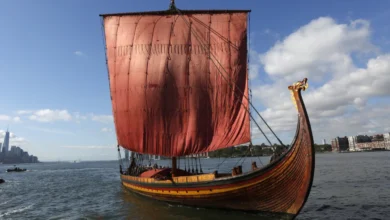
The Economic Engine of Discovery: Why the Future of Space Exploration Requires a Commercial Imperative


Despite the growing narrative surrounding a burgeoning "new space economy," the tangible benefits of off-world mining, manufacturing, and tourism remain largely theoretical. While public interest in space exploration is at an all-time high, the sector faces a fundamental disconnect between ambitious scientific goals and the economic realities required to sustain them. History, however, offers a clear roadmap: the most significant leaps in human exploration have rarely been driven by pure scientific curiosity alone. Instead, they have been catalyzed by the transformative power of commerce. Five centuries ago, Western Europe was similarly preoccupied, not with the stars, but with the elusive, high-value commodity of spices.
The Spice Trade as the Original Space Race
In the late 15th century, the global economy was tethered to the Silk Road—a grueling, fragmented, and expensive network of overland routes that spanned the Eurasian landmass. For spices such as cloves, nutmeg, and ginger, the journey from the volcanic soils of the Moluccas—the "Spice Islands" of modern-day Indonesia—to the tables of European elites was fraught with inefficiency. Every hand-off between merchants, regional rulers, and middlemen added costs that made these goods worth their weight in gold.
As author Lewis Dartnell outlines in Origins: How the Earth Shaped Human History, these specific spices were geographically constrained to a handful of volcanic islands. Cloves were native to only a few spots in the northern Moluccas, while nutmeg was restricted to the nine small islands of the Banda archipelago. The extreme scarcity of these products, combined with their lightweight, durable nature, made them the perfect cargo for long-distance trade. By the early 1500s, the potential for profit was astronomical; records indicate that a single voyage’s cargo, once docked in Lisbon, could yield a return on investment of 700 percent.
This profit motive ignited a geopolitical frenzy. Portugal and Spain, in particular, sought to bypass the Mediterranean and Silk Road middlemen by securing a direct sea route to the source. The resulting competition triggered the Age of Discovery, fundamentally shifting global power structures and establishing the first true era of international maritime commerce.
A Chronology of Commercial Ambition
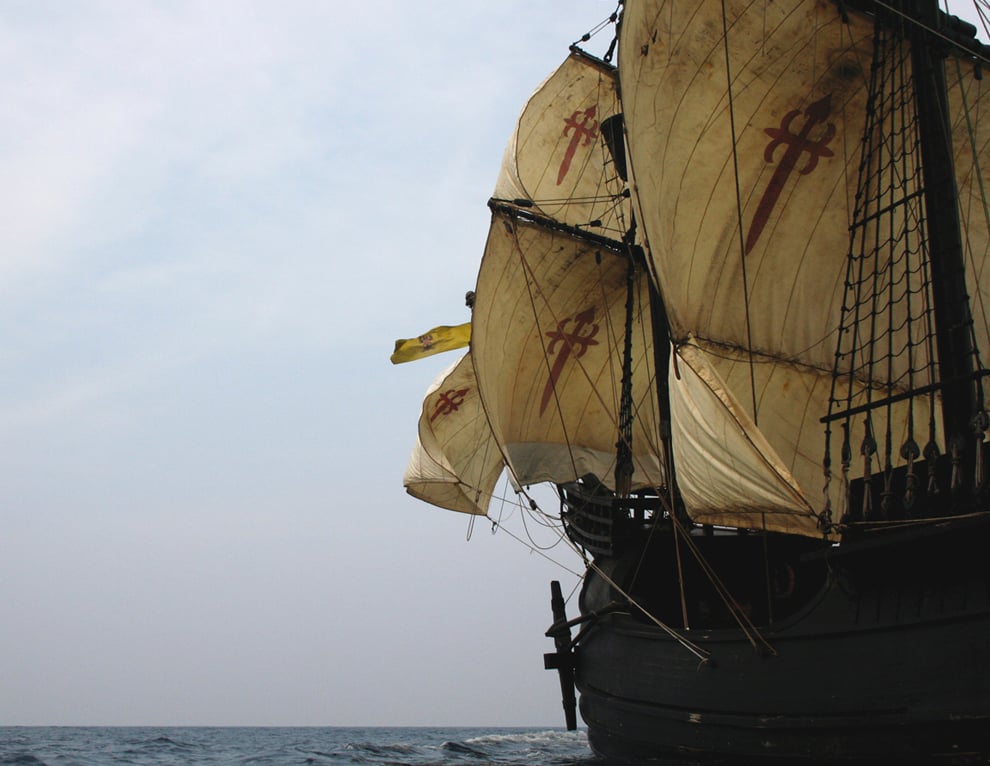
The quest for the Spice Islands was not merely a maritime challenge; it was a feat of logistical innovation. Ferdinand Magellan, a figure of minor nobility, successfully convinced King Charles V of Spain that the riches of the East could be reached by sailing West—an audacious gamble that bypassed the eastern routes entirely.
- 1515: The spice trade reaches a fever pitch, with Portuguese ships returning to Lisbon with cargo valued at 700% above costs.
- 1519: Ferdinand Magellan departs Spain with five ships, seeking a westward path to the Moluccas.
- 1520: The spice trade accounts for approximately 40% of the Portuguese Crown’s total annual revenue, demonstrating the massive influence of trade on state policy.
- 1677: The economic value of spice-producing territory is underscored when the Dutch trade the island of Manhattan to the British in exchange for Run, a tiny island in the Banda archipelago essential for nutmeg production.
This timeline reveals a pattern: when a commodity is sufficiently valuable and its source sufficiently remote, nations and private enterprises will endure immense risks to establish trade routes. The question now facing the 21st century is whether the extraction of resources from the Moon, Mars, or the Main Belt asteroids will follow a similar trajectory.
The Modern Frontier: Helium-3 and Beyond
Space entrepreneurs today are looking toward a different set of "spices." The focus has shifted to rare earth minerals and Helium-3—an isotope that could potentially fuel fusion reactors, providing a clean and nearly inexhaustible energy source. Harrison Schmitt, the Apollo 17 geologist, has long championed the mining of lunar Helium-3 as a viable justification for a permanent human presence in cislunar space.
However, the barrier to entry remains the "cost-per-kilogram" to orbit. Just as Magellan had to solve the problem of navigating the globe to reduce the cost of spices, modern space agencies and private firms must solve the problem of launch and extraction costs. Without a commercial return that justifies the initial capital expenditure, deep space exploration risks remaining a government-subsidized endeavor, vulnerable to the shifting priorities of political administrations.
Insights from Industry Leaders
Retired U.S. Brigadier General Pete Worden, former director of NASA’s Ames Research Center and current chairman of the Breakthrough Prize Foundation, argues that the transition to a sustainable space presence requires a fundamental shift in how NASA operates.
"I would rely heavily on robots for science and give commercial companies a larger role in developing and operating human spaceflight systems," Worden suggests. He advocates for NASA to return to the model of its predecessor, the National Advisory Committee for Aeronautics (NACA). In this framework, NASA would focus primarily on high-level research and technology development—the "infrastructure" of space—while industry partners handle the operational, revenue-generating sorties.
Worden notes that the volatility of government funding is a significant inhibitor to progress. "Over the past 30 years, NASA’s plans for the Moon and Mars have had to survive changes in administrations, budgets, and priorities," Worden says. "When a program needs agreement from too many people, it becomes harder to take sensible risks." By offloading routine transport to the private sector, government agencies could de-risk the exploration process, allowing for more ambitious, long-term scientific objectives.
Economic Implications and Future Outlook
If the historical analogy holds, the transition from government-led "expeditions" to commerce-led "trade routes" is inevitable. Just as the spice trade was the catalyst for the development of modern global shipping, the development of a lunar or asteroid-based mining industry would necessitate the creation of a robust infrastructure in space.
This infrastructure would include:
- In-orbit refueling stations: Analogous to the port cities that supported the Spice Route.
- Standardized modular cargo systems: Reducing the costs associated with custom-built spacecraft.
- Autonomous extraction and processing facilities: Allowing for continuous, high-volume production without the need for a constant human presence.
The economic implications are profound. If energy costs were to drop due to the successful importation of Helium-3, or if the scarcity of rare earth elements were mitigated by asteroid mining, the global economy would undergo a paradigm shift equivalent to the opening of the Silk Road or the discovery of the Americas.
The Bottom Line
The history of exploration teaches us that while the human spirit drives us to reach into the unknown, commerce provides the fuel to stay there. For humanity to move beyond the current "fits and starts" of its space program, it must identify the modern-day equivalent of the clove: a resource or a capability that is sufficiently valuable to justify the high costs of the journey.
If humanity succeeds in making forays beyond low Earth orbit that are as commercially viable as the 16th-century spice trade, then the vast, untapped resources of our solar system will transition from a distant dream to an accessible reality. The next chapter of human history will likely be written not just by those who dream of the stars, but by those who find the economic imperative to reach them. The path is clear: align the objectives of scientific exploration with the cold, hard logic of profit, and the final frontier may finally become a permanent home.