Dark Energy Camera Captures Deep Space Masterpiece in the Corona Australis Molecular Cloud

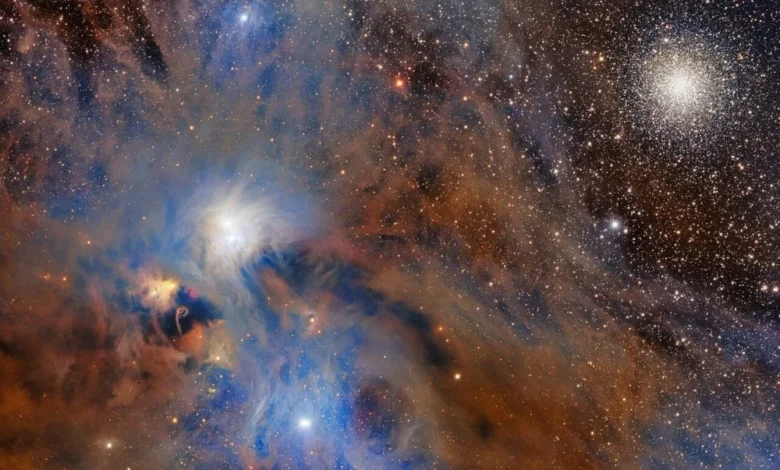
The Dark Energy Camera, a high-performance wide-field imager mounted on the Víctor M. Blanco 4-meter Telescope at the Cerro Tololo Inter-American Observatory, has produced a striking new image of the Corona Australis molecular cloud, revealing a complex tapestry of gas, dust, and newborn stars. This latest observation provides a rare and detailed glimpse into one of the closest star-forming regions to Earth, located approximately 425 light-years away in the southern constellation of Corona Australis. The image has drawn immediate comparisons to Vincent van Gogh’s 1889 masterpiece, "The Starry Night," due to its swirling eddies of dust and the vibrant, contrasting hues of its nebulae. While Corona Australis is less frequently cited in popular astronomy than the Orion or Ophiuchus nebulae, this new data from the Dark Energy Survey (DES) highlights its scientific significance as a dynamic laboratory for studying the earliest stages of stellar evolution.
A Celestial Canvas: The Visual Splendor of Corona Australis
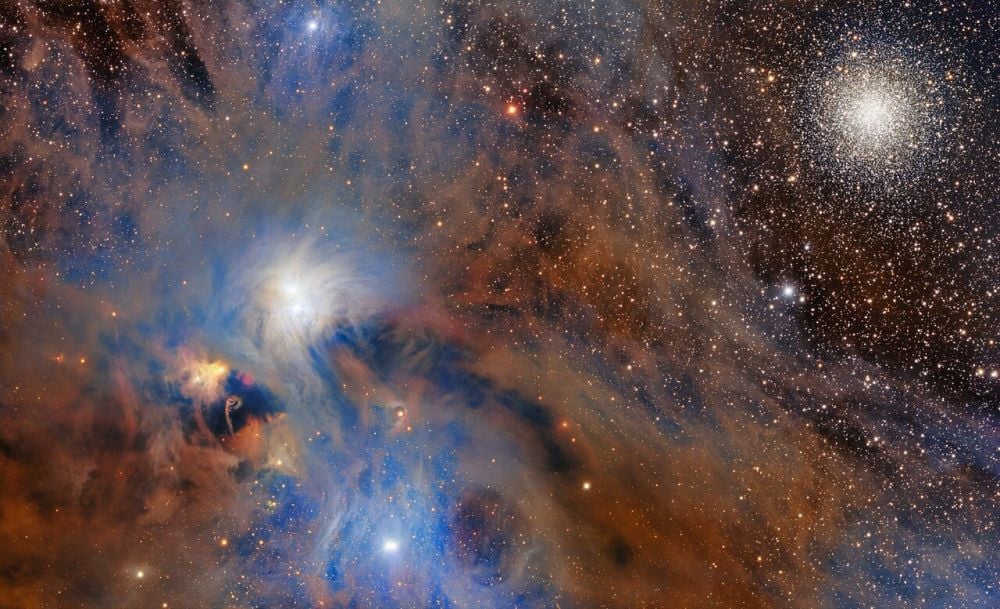
The Corona Australis molecular cloud (CrA) is categorized as a dark nebula, a region where the density of interstellar dust is high enough to obscure the light from background stars and internal objects. However, the Dark Energy Camera (DECam) utilizes a massive 570-megapixel sensor and a sophisticated array of filters to pierce through this cosmic shroud. The resulting image showcases a diverse collection of astronomical phenomena, from the deep oranges of dust-shrouded stars to the ethereal blues of reflection nebulae.
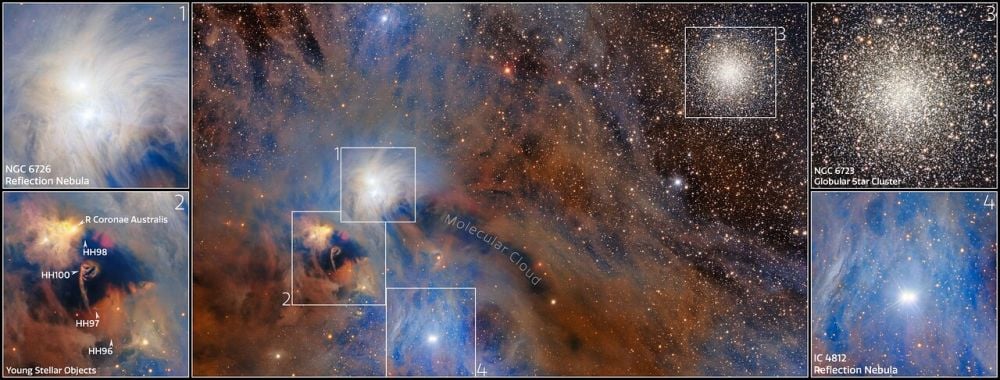
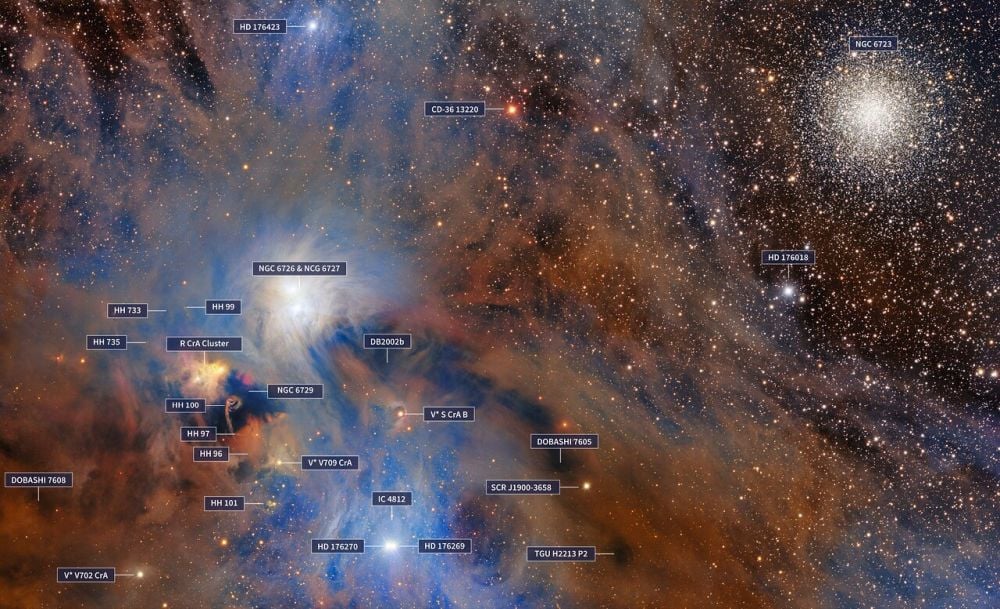
At the heart of the image’s left side sits R Coronae Australis, a binary star system that serves as a primary light source for the surrounding medium. This system consists of a red dwarf and a pre-main-sequence star. The latter is a stellar object that has successfully gathered the bulk of its mass from the surrounding cloud but has not yet reached the internal temperatures and pressures required to initiate hydrogen fusion in its core. This "proto-star" phase is critical for astronomers seeking to understand how stars transition from gravitational collapses into stable, shining suns. The light from this system reflects off the surrounding dust, illuminating the gas in a warm, orange glow that dominates the left quadrant of the frame.
The Dark Energy Camera: A Technological Marvel
The clarity of the Corona Australis image is a testament to the capabilities of the Dark Energy Camera. Managed by the U.S. Department of Energy (DOE) and the National Science Foundation’s (NSF) NOIRLab, DECam was originally designed for the Dark Energy Survey, a five-year mission to map hundreds of millions of galaxies and investigate the accelerating expansion of the universe. Though its primary mission concluded in 2019, the camera remains one of the most powerful tools in the Southern Hemisphere for wide-field imaging.
DECam’s ability to capture such large swaths of the sky—its field of view covers approximately 3 square degrees, or about 14 times the area of the full moon—allows it to contextualize molecular clouds within their larger galactic environments. In the case of Corona Australis, the camera’s sensitivity to both visible and near-infrared light allows it to distinguish between the various types of nebulae present in the complex, providing a multi-layered view of the interstellar medium.
Illuminating the Void: Reflection and Emission Nebulae
The image features several distinct nebulae, each formed by different physical processes. To the lower right of the R Coronae Australis system, the beige and yellow swirls represent the reflection nebulae NGC 6726 and NGC 6727. Reflection nebulae do not emit their own light; instead, they consist of clouds of interstellar dust that scatter the light from nearby stars. This scattering process is similar to why the Earth’s sky appears blue, as shorter wavelengths of light are scattered more efficiently by small particles. In the dense environment of Corona Australis, these nebulae take on a stormy, textured appearance, merging further down with IC 4812, another prominent reflection nebula.
Contrasting with these is NGC 6729, also known as Caldwell 68. This is an emission nebula, created when high-energy ultraviolet radiation from young, massive stars ionizes the surrounding hydrogen gas. As the electrons recombine with protons, they emit light, often in the reddish part of the spectrum, though the specific colors can vary based on the chemical composition and energy levels involved. Because NGC 6729 is illuminated by the variable binary star R Coronae Australis, its shape and brightness are not static. The orbital dance of the two stars causes the light hitting the nebula to shift, making NGC 6729 one of the most visually dynamic objects in the region.
The Chandelier Cluster: A Distant Galactic Neighbor
While the Corona Australis cloud dominates the foreground, the upper right corner of the image features a stunning contrast: NGC 6723, popularly known as the Chandelier Cluster. This object is a globular cluster, a spherical collection of hundreds of thousands of ancient stars held together by gravity.
The inclusion of the Chandelier Cluster in the same frame as Corona Australis provides a profound sense of cosmic scale. While the molecular cloud is a relatively "local" feature at 425 light-years away, NGC 6723 is located nearly 29,000 light-years from Earth. The stars within the cluster are among the oldest in the galaxy, having formed billions of years ago, whereas the stars in the Corona Australis cloud are among the youngest, some being only a few million years old. This juxtaposition allows researchers to observe the beginning and the twilight of stellar lifecycles in a single field of view.
Recent Scientific Breakthroughs: A Cloud on the Move
Despite its proximity, Corona Australis has historically received less attention than more massive regions like the Orion Nebula. However, recent data from space-based observatories such as Gaia, Chandra, and XMM-Newton have sparked a renewed interest in the region’s kinematics and history.
A landmark paper published in 2023 in the journal Astronomy & Astrophysics revealed that the Corona Australis complex is not sitting still. According to the research, the entire molecular cloud is accelerating away from the Galactic plane. By analyzing the kinetic energy of the cloud, researchers calculated that this motion was likely triggered by at least two massive supernova explosions in the relatively recent past. These cataclysmic events would have acted like a cosmic hammer, striking the cloud and propelling it out of its original orbit.
Building on this, a 2025 study further deconstructed the complex into two distinct subregions: CrA-Main and CrA-North. The study utilized high-precision astrometry to show that while these two regions were once closely associated, they are currently drifting apart. CrA-Main is the younger, more active site of star formation seen in the DECam image, while CrA-North is older and contains stars that have already begun to disperse. This discovery underscores the fact that molecular clouds are transient, evolving structures rather than permanent fixtures of the galaxy.
The Transient Nature of Herbig-Haro Objects
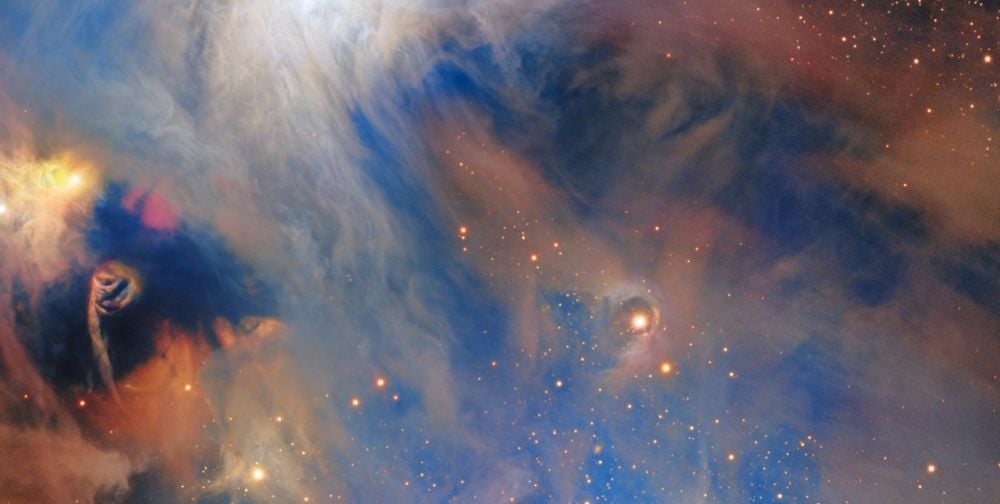
One of the most intriguing features highlighted in the DECam zoom-in images is HH100, a Herbig-Haro object. These are small patches of nebulosity associated with newly born stars. They are formed when narrow jets of partially ionized gas, ejected by a young star at speeds of several hundred kilometers per second, collide with nearby clouds of gas and dust.
HH100 is a visual manifestation of the "birth cries" of a star. These objects are extremely short-lived by astronomical standards, typically lasting only a few tens of thousands of years. They evolve visibly over the course of a human lifetime, with their brightness and structure changing as the jets plow through the interstellar medium. The presence of HH100 in Corona Australis confirms that the region is currently in a peak state of productivity, actively forging new stellar systems that may one day host their own planets.
Implications for Galactic Evolution and Future Research
The new imaging of Corona Australis serves as more than just a visual spectacle; it provides a data-rich map for future astrophysical inquiries. By studying the interaction between the young stars and the dust in CrA, scientists can refine their models of "feedback"—the process by which young stars influence their environment and potentially halt further star formation by blowing away the remaining gas.
Furthermore, the observation of Corona Australis’s rapid movement away from the Galactic plane offers insights into how supernovae shape the structure of the Milky Way. If molecular clouds can be displaced so significantly by stellar explosions, it suggests that the "geography" of our galaxy is far more fluid than previously thought.
The Dark Energy Camera’s contribution to this field highlights the importance of multi-purpose astronomical instruments. While its primary goal was the study of dark energy, its high resolution and wide field of view have made it an indispensable tool for stellar archaeology and galactic dynamics. As researchers continue to analyze the high-resolution versions of these images, Corona Australis will likely move from the periphery of astronomical study to the center of our understanding of how the "Starry Night" of our galaxy is actually constructed.
For the general public, the image remains a reminder of the inherent beauty of the cosmos—a natural masterpiece of light and shadow that rivals the greatest works of human art. For the scientific community, it is a call to look closer at the "quiet" corners of the sky, where the secrets of stellar birth are waiting to be unraveled.
Related posts: