Google updates Pixel Weather with crowd-sourced reporting and refined interface aesthetics

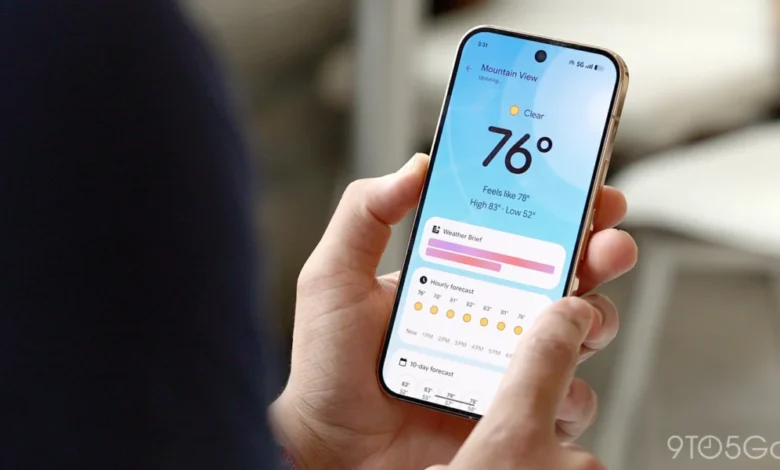
Google has officially released a significant update to its Pixel Weather application, introducing a crowd-sourced reporting feature designed to enhance local forecast accuracy while simultaneously refining the app’s visual interface. This update, arriving as version 1.1.20261012.x, marks the latest iteration in Google’s ongoing strategy to provide a more cohesive and data-driven weather experience for its hardware ecosystem. The changes, which began rolling out to users over the weekend, represent a balance between aesthetic refinement and functional utility, reflecting the company’s increasing focus on community-driven data collection to augment traditional meteorological modeling.
Interface Refinements and Aesthetic Adjustments
The most immediate change noticed by users is the departure from the high-contrast, aggressive visual cues previously used for weather alerts. In earlier versions of the Pixel Weather app, active weather warnings—such as flood watches or wind advisories—were highlighted by a bold, bright red background for the city cards on the home screen. While effective at drawing attention, the aesthetic often clashed with the app’s otherwise muted, Material You-inspired design language.
In the latest update, Google has opted for a more subtle approach. The pill-shaped containers for cities currently under a weather alert now retain their standard Dynamic Color theming, which aligns with the user’s system-wide wallpaper and theme settings. The warning notification itself has been shifted from a full-card background color to a simple red-colored text, ensuring that users are still immediately informed of potential dangers without disrupting the app’s visual harmony. This design language has been extended to the individual city pages, creating a consistent look across the entire application. Furthermore, the source attribution label, traditionally displayed at the bottom of the feed as “Google Weather,” has been updated to adopt the app’s native theming, replacing the static, flat text style with a more integrated appearance.
The Introduction of Crowd-Sourced Weather Reporting
The most substantial functional addition in this release is the “Report current weather” feature. Situated at the bottom of the main interface for a user’s current location, the card invites users to share their real-time meteorological observations. By tapping this card, users are prompted to “Share the current weather condition to improve local forecasts,” a move that signals Google’s intent to leverage its massive install base of Pixel devices as a distributed network of environmental sensors.

The reporting mechanism is designed for simplicity and speed. When a user initiates a report, a sheet titled “Report weather in [City Name]” appears, allowing for quick input. While the current implementation focuses on binary or categorical inputs to gauge atmospheric conditions, it serves as a powerful feedback loop. The primary objective, as stated by Google, is to allow users to “Submit a report if the weather conditions don’t look right.” This is particularly useful in micro-climates or areas where large-scale radar data might fail to capture localized phenomena such as sudden squalls, localized hail, or pockets of freezing rain.
Data Privacy and User Security
Because the new feature relies on user-provided data, Google has been proactive in addressing privacy concerns. The application explicitly states that all submissions are treated with anonymity. According to the technical disclosures provided with the update, the collected information—which includes the user’s feedback, device location, and relevant diagnostic data—is not associated with the user’s Google account.
This separation of data is a critical component of Google’s modern privacy framework. By decoupling the weather report from the user’s identity, the company aims to encourage participation without raising red flags regarding surveillance or personal tracking. The diagnostic information collected alongside the weather report is likely intended to verify the validity of the submission, ensuring that data is not skewed by malfunctioning sensors or localized software errors.
Context and Chronology: The Evolution of Pixel Weather
The Pixel Weather app has evolved rapidly since its inception as a standalone entity within the Google ecosystem. Originally, weather information was relegated to the “At a Glance” widget or accessed via Google Search. Over the past twenty-four months, Google has invested heavily in creating a dedicated, high-fidelity weather experience that rivals specialized third-party applications.
The timeline of these updates reflects a clear progression:

- Early 2025: Initial rollout of the standalone Pixel Weather application, focused on clean design and basic forecast metrics.
- Mid-2025: Introduction of deeper integration with the Pixel’s internal sensors, allowing for more precise local temperature readings.
- Late 2025: Expansion of the app to include advanced maps, pollen data, and air quality index (AQI) tracking.
- October 2026: The current update (version 1.1.20261012.x), marking the shift toward community-driven, crowd-sourced data collection.
This chronology demonstrates a clear roadmap: Google is transitioning from being a consumer of meteorological data to being a curator of it. By integrating user reports, the company is effectively closing the "last mile" gap in weather forecasting, where traditional satellite and ground-station data often struggle to provide the granular detail required for hyper-local urban environments.
The Broader Impact of Crowd-Sourced Meteorological Data
The implications of this update are significant for both the meteorology industry and the end-user. In the field of atmospheric science, “citizen science” has long been a subject of debate. While individual reports may be subject to human error, the aggregation of thousands of reports from a localized area can provide a statistical baseline that is remarkably accurate.
If Google successfully integrates this user-provided data into its core forecasting models, the company could see a marked improvement in the accuracy of its “now-casting”—the ability to predict weather events within a zero-to-six-hour window. This is the period where traditional forecast models are often least reliable, as they rely on massive, slow-moving atmospheric simulations.
For the average Pixel user, the impact is more immediate: a sense of community contribution and increased confidence in the information displayed on their home screen. When a user reports that it is currently raining in their neighborhood, and the app reflects that reality shortly thereafter, the trust in the platform increases.
Industry Analysis and Future Projections
From a broader technological perspective, this move aligns Google with other major players in the digital weather space, such as The Weather Channel and AccuWeather, both of which have utilized user reporting for years. However, Google’s advantage lies in the depth of its integration. Because the Pixel Weather app is a system-level application, it has access to ambient light sensors, barometer readings, and historical location data that third-party apps cannot access with the same level of granular precision.

Industry analysts suggest that this update is likely the first step in a larger project to create a global “Hyper-Local Weather Network.” By utilizing the millions of Pixel devices currently in circulation, Google could theoretically build a global network of barometric and humidity sensors that far exceeds the density of any government-run weather station network.
However, there are challenges to this approach. Maintaining the integrity of the data is paramount. Google will need to implement robust machine learning algorithms to filter out "bad actors" or erroneous reports, such as a user accidentally reporting rain when they are actually inside a shower or near a sprinkler system. The privacy-focused, account-decoupled approach mentioned earlier suggests that Google is aware of these hurdles and is prioritizing a "trust-first" data collection model.
Conclusion
The latest update to Pixel Weather is more than a mere cosmetic refresh. While the changes to the UI improve the overall visual consistency of the Android experience, the introduction of crowd-sourced weather reporting represents a fundamental shift in how Google approaches meteorological data. By empowering users to act as active contributors, Google is not only improving the quality of its local forecasts but also reinforcing the value proposition of the Pixel hardware ecosystem.
As the rollout continues, it will be interesting to observe how the data collected from these reports is utilized by Google’s backend systems. If successful, this feature could redefine the expectations for mobile weather applications, moving them from passive information displays to dynamic, community-aware systems that provide unprecedented levels of local environmental intelligence. For now, users can look forward to a more polished interface and the opportunity to contribute to the accuracy of the weather information they rely on daily.