Critical NGINX Flaw CVE-2026-42533 Exposes Web Servers to Remote Code Execution and Denial of Service

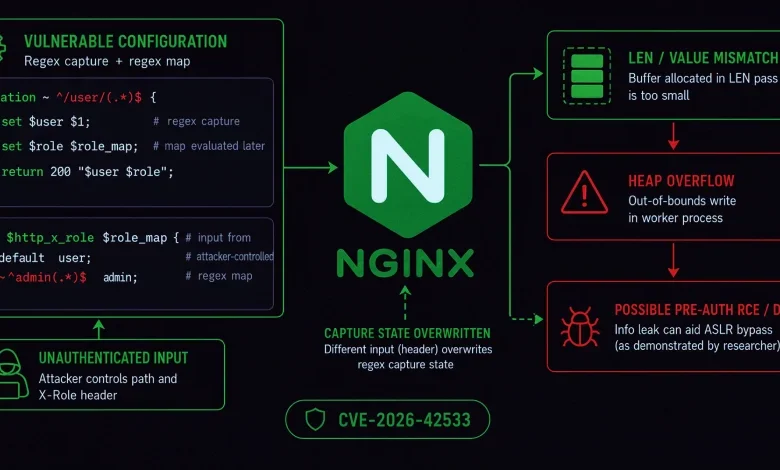
F5, the company behind the widely used NGINX web server and reverse proxy, has released urgent patches to address a critical heap buffer overflow vulnerability, identified as CVE-2026-42533. This severe flaw could allow an unauthenticated, remote attacker to trigger a denial of service (DoS) by crashing or restarting NGINX worker processes through specially crafted HTTP requests. More alarmingly, under specific conditions, security researchers warn that this vulnerability could lead to remote code execution (RCE), granting attackers full control over affected systems.
Deep Dive into the Vulnerability: The Script Engine Flaw
The core of CVE-2026-42533 lies within NGINX’s script engine, a critical component responsible for assembling strings from directives during request processing. This engine employs a two-pass evaluation mechanism: the first pass calculates the required buffer size for the resultant string, and the second pass writes the actual bytes into the allocated buffer. The vulnerability arises when this two-pass system fails due to a specific configuration involving regex-based map directives.
Specifically, the flaw manifests when an NGINX configuration utilizes a regex-based map directive whose output variable is subsequently referenced in a string expression, particularly after a capture from an earlier regex match. In such a scenario, the map‘s regex evaluation, which occurs between the two passes of the script engine, inadvertently overwrites the shared capture state. This leads to a critical discrepancy: the initial measuring pass calculates the buffer size based on the original capture (e.g., $1 from a location match), while the subsequent writing pass attempts to fill the buffer using a different, attacker-controlled capture.
The consequence is a classic heap buffer overflow: the buffer allocated is too small for the data being written, allowing the attacker to overflow the buffer. Crucially, both the length of the overflow and the content written into the overrun memory segment can be controlled directly by the attacker via their malicious HTTP request. This direct control over memory corruption is what elevates the risk from a simple crash to potential remote code execution.
Understanding Heap Buffer Overflows and Remote Code Execution
A heap buffer overflow occurs when a program attempts to write more data into a fixed-size memory buffer located on the heap than it was designed to hold. This excess data spills over into adjacent memory regions, corrupting data or even overwriting critical program instructions. The implications can range from application crashes (denial of service) to, in the worst-case scenario, arbitrary code execution.

Remote Code Execution (RCE) is a cybersecurity vulnerability that allows an attacker to execute arbitrary code on a remote server. For a heap buffer overflow to lead to RCE, attackers typically need to bypass memory protection mechanisms such as Address Space Layout Randomization (ASLR). ASLR randomizes the memory addresses used by system libraries and executables, making it significantly harder for attackers to predict where to inject and execute their malicious code. F5’s initial advisory noted that RCE might be possible "where ASLR is disabled or can be bypassed." However, as detailed below, independent research suggests the vulnerability itself may offer an ASLR bypass.
Impact Assessment: From DoS to Critical RCE Potential
The immediate and confirmed impact of CVE-2026-42533 is a denial of service. Triggering the flaw can cause the NGINX worker process to crash or restart, disrupting service for legitimate users. For mission-critical applications and websites that rely on NGINX for high availability, even a temporary DoS can have significant financial and reputational consequences.
However, the potential for remote code execution dramatically escalates the severity. If an attacker can achieve RCE, they could gain unauthorized access to the server, steal sensitive data, install malware, pivot to other systems within the network, or completely compromise the affected web infrastructure. Given NGINX’s pervasive use across the internet, including by major websites, content delivery networks, and enterprise applications, the implications of widespread RCE could be catastrophic.
Chronology of Discovery and Patching
The vulnerability, assigned CVE-2026-42533, was patched by F5 on July 15, marking a swift response following its disclosure. The fixes were integrated into NGINX 1.30.4 (stable branch) and 1.31.3 (mainline branch), as well as in NGINX Plus 37.0.3.1. Users operating on any earlier builds are strongly advised to upgrade without delay.
Remarkably, this critical flaw was not a singular discovery. F5 publicly acknowledged that "more than a dozen researchers independently" brought the issue to their attention, highlighting the collective effort of the cybersecurity community in identifying and reporting vulnerabilities. NGINX’s own changelog specifically credits Mufeed VH of Winfunc Research and maintainer Maxim Dounin for their contributions to the fix.
The timeline of vulnerability for this flaw is particularly extensive, reaching back over a decade. All NGINX versions from 0.9.6 through 1.31.2 are susceptible, a range that spans from 2011—the year the map directive gained regex support—up to the immediate pre-patch versions. This longevity underscores the subtle and complex nature of the bug, allowing it to persist undetected for such a significant period.

The Broader Landscape: Affected Products and Severity
F5’s advisory confirms that the flaw affects not only the core NGINX server and NGINX Plus but also several of its integrated products, including NGINX Ingress Controller, Gateway Fabric, App Protect WAF, and Instance Manager. While patches for the core server and NGINX Plus were promptly released, F5 had not, at the time of publication, listed fixed builds for these four downstream products, leaving a potential gap in immediate protection for users of these specialized offerings. This delay could expose a broader range of enterprise deployments, especially those leveraging NGINX within Kubernetes environments (via Ingress Controller) or for advanced security functions (App Protect WAF).
The severity of CVE-2026-42533 is reflected in its CVSS (Common Vulnerability Scoring System) ratings. F5 assigned it a score of 9.2 on CVSS v4 and 8.1 on the older CVSS v3.1 scale. Both scores indicate a "Critical" severity, denoting a vulnerability that can be exploited remotely with high impact on confidentiality, integrity, and availability, often without requiring authentication. While the attack complexity is rated as "high" by F5, implying that specialized skills or conditions might be required for successful exploitation, the potential for RCE still makes it a top-tier concern for security teams.
Expert Insight and Discrepancies: Stan Shaw’s Analysis
One of the researchers who independently reported the vulnerability, Stan Shaw (publishing under the moniker "cyberstan"), has provided a more detailed write-up that expands significantly on F5’s official advisory. Shaw’s analysis presents a stronger claim regarding the exploitability of the flaw, particularly concerning remote code execution.
Cyberstan’s Deeper Dive into RCE:
While F5’s advisory conditions RCE on ASLR being disabled or bypassable, Shaw argues that the flaw itself provides a mechanism to bypass ASLR. He posits that the capture clobbering, in addition to causing an overflow when the attacker-controlled capture is larger, can also run in reverse. When the clobbered capture is smaller than the original, the oversized buffer that the NGINX script engine allocates inadvertently hands back uninitialized heap data. Shaw demonstrated that on a default Ubuntu 24.04 build, a single unauthenticated GET request can recover the necessary memory addresses required for an RCE payload. This direct information leak effectively negates the protection offered by ASLR, making RCE more broadly achievable than F5 initially indicated.
"A reader of the F5 advisory could reasonably conclude this is DoS-only on default systems. It is not," Shaw stated to The Hacker News, emphasizing the critical difference in his findings. He reported a 100% success rate (10 out of 10 attempts) in his own testing for achieving the information leak necessary for ASLR bypass. To prevent immediate widespread exploitation, Shaw is responsibly withholding full exploitation details and a proof-of-concept (PoC) for now.
Critique of F5’s Mitigation:
Shaw also raised concerns about the completeness of F5’s temporary mitigation strategy. F5 suggested that for those unable to patch immediately, switching affected regex maps to named captures (e.g., (?<name>...)) would close the main attack vector and cover most configurations. However, Shaw discovered a narrower, secondary path to the same overflow. He found that a map directive defining the same named group as a location regex could still lead to the overflow. This variant, confirmed with AddressSanitizer, was not mentioned in F5’s advisory, suggesting the proposed workaround might not be a comprehensive solution. "Upgrading to 1.30.4 / 1.31.3 is the only complete fix," Shaw asserted, underscoring the limitations of partial mitigations.

Mitigation Strategies and Urgent Call to Action
The primary and unequivocally recommended solution for CVE-2026-42533 is to upgrade NGINX to a patched version immediately. This means upgrading to NGINX 1.30.4 (for stable branch users) or 1.31.3 (for mainline branch users), or NGINX Plus 37.0.3.1. These versions contain the definitive fixes that eliminate the vulnerability.
Immediate Patching: The Only Complete Solution:
Given the high severity and the strong evidence of RCE potential, delaying patches significantly increases an organization’s risk profile. System administrators should prioritize this upgrade across all NGINX deployments. Before patching, it is crucial to review NGINX’s official documentation for upgrade procedures and to test the new versions in a staging environment if possible, to ensure compatibility with existing configurations and applications.
Temporary Workarounds and Their Limitations:
For environments where immediate patching is not feasible due to operational constraints or extensive testing requirements, F5’s temporary mitigation involves modifying affected regex-based map configurations to use named captures instead of numbered captures. However, as Stan Shaw’s research highlights, this mitigation is not foolproof. A specific configuration where a map defines the same named group as a location regex could still be vulnerable. Therefore, this workaround should only be considered a very short-term, partial measure, and the ultimate goal must remain a full upgrade.
Configuration Scanning for Exposure:
To help administrators identify if their NGINX servers are configured in a vulnerable manner, Stan Shaw has released a configuration scanner on GitHub (0xCyberstan/CVE-2026-42533-Config-Scanner). This tool automates the process of checking NGINX configurations, including include directives, and specifically flags the exploitable ordering: a regex-based map whose variable appears in a string expression alongside a numbered capture ($1, $2) from an earlier regex, with the capture written ahead of the map variable. While the scanner itself does not exploit the flaw, it is an invaluable tool for assessing exposure and prioritizing patching efforts.
A Pattern of Vulnerabilities: NGINX’s Script Engine Under Scrutiny
CVE-2026-42533 is not an isolated incident but rather the third heap overflow vulnerability disclosed in NGINX’s expression-evaluation code within approximately two months. This recent cluster of flaws suggests a systemic weakness in how NGINX handles dynamic string processing and memory allocation.
Recent Precedents: Rift and Overlapping Captures:
In May, the "Rift" vulnerability (CVE-2026-42945) was disclosed, another heap overflow flaw that was actively exploited in the wild shortly after its public release. Days later, an overlapping-captures bug in the rewrite module (CVE-2026-9256) also came to light, again involving memory corruption due to flawed string handling.

The Underlying Design Flaw:
All three vulnerabilities share a common root cause: NGINX’s two-pass script engine. In each case, the first pass calculates a buffer size, and the second pass writes data into it. The flaw arises when an intervening operation or a specific configuration causes the state used for the second pass to differ from the state used for the first, leading to a write operation that exceeds the measured buffer size. Whether it’s a stale flag (Rift), overlapping captures (rewrite bug), or clobbered capture state (CVE-2026-42533), the underlying weakness is a design that implicitly trusts its own initial measurement without sufficient re-validation or state protection during the two-pass process. This pattern indicates a need for a deeper review of the script engine’s architecture to prevent future similar vulnerabilities.
Forward-Looking Implications and Recommendations
The Threat of Public Exploits:
As of July 20, CVE-2026-42533 was not yet listed on CISA’s Known Exploited Vulnerabilities (KEV) catalog, and no public exploit code had appeared. However, Stan Shaw’s intention to publish his proof-of-concept 21 days after the patch date creates a clear deadline for organizations. The "Rift" vulnerability serves as a cautionary tale: its exploit went public within days, and active exploitation soon followed. This highlights the critical importance of patching before public exploit code becomes widely available, as the window of opportunity for attackers dramatically widens once a reliable PoC is in the wild.
CISA’s KEV Catalog and Industry Awareness:
Inclusion in CISA’s KEV catalog typically signals that a vulnerability is being actively exploited and requires immediate attention from federal agencies and critical infrastructure. While not yet listed, the high severity and potential for RCE make it a prime candidate for future inclusion. Security teams should monitor this and other official advisories closely.
Best Practices for NGINX Users:
- Prioritize Patching: Upgrade NGINX to versions 1.30.4, 1.31.3, or NGINX Plus 37.0.3.1 without delay.
- Scan Configurations: Utilize tools like Cyberstan’s scanner to identify vulnerable configurations that might be exposing your servers.
- Monitor F5 Advisories: Stay updated on F5’s releases for fixed builds for NGINX Ingress Controller, Gateway Fabric, App Protect WAF, and Instance Manager.
- Implement Defense in Depth: While patching is paramount, layer security controls such as robust firewalls, intrusion detection/prevention systems (IDS/IPS), and Web Application Firewalls (WAFs) to detect and block potential exploitation attempts.
- Regular Audits: Conduct regular security audits of NGINX configurations and custom scripts to identify and remediate potential vulnerabilities.
- Principle of Least Privilege: Ensure NGINX worker processes run with the minimum necessary privileges to limit the impact of a successful exploit.
Conclusion
The discovery of CVE-2026-42533 underscores the persistent challenge of securing foundational web infrastructure. While NGINX remains a cornerstone of the internet, the series of recent critical vulnerabilities in its script engine demands heightened vigilance from administrators. The stark warning from researchers like Stan Shaw, detailing a more direct path to remote code execution than initially conveyed, transforms this from a serious denial-of-service threat into an immediate, critical security imperative. Proactive patching and thorough configuration reviews are not merely recommended; they are essential to protect web services from potentially devastating attacks. The race is on to secure systems before public exploit details turn potential risk into widespread compromise.
Related posts: