Unmasking Haise: How Operational Security Failures Exposed the Alleged Mastermind Behind the Qilin Ransomware Empire

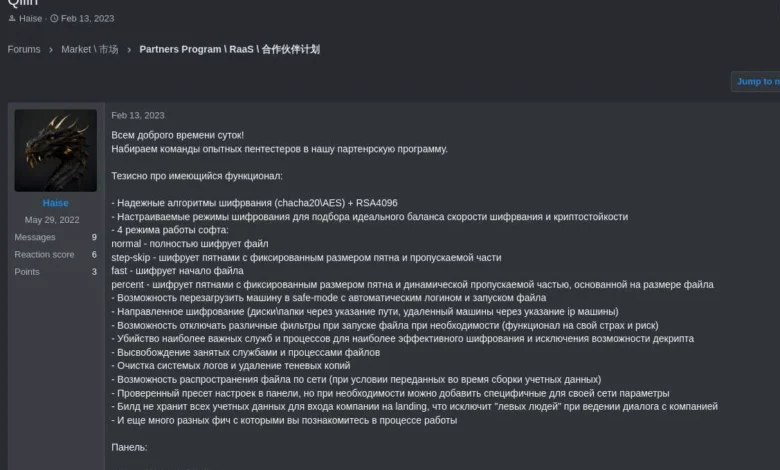
The shadowy architecture of the global cybercrime economy was severely compromised following a series of digital breadcrumbs that allegedly link the master administrator of the world’s most industrious ransomware-as-a-service (RaaS) operation, Qilin, to a 36-year-old resident of St. Petersburg, Russia. According to comprehensive threat intelligence data compiled by cybersecurity firms including NCC Group, Intel 471, Flashpoint, and Spycloud, the individual operating under the online pseudonym "Haise" has been unmasked as Aleksey Mikhailovich Yakovtsev.
This revelation underscores a persistent paradox within the elite echelons of the cybercriminal underworld: despite commanding sophisticated affiliates, utilizing double-extortion tactics, and operating with relative impunity from within Russian borders, even the most prolific threat actors remain vulnerable to historical operational security (opsec) missteps, data breaches, and the relentless evolution of de-anonymization technologies.
The Rise of Qilin and the Mechanics of Modern Ransomware
Emerging publicly in September 2022, Qilin rapidly ascended to become the most aggressive and industrious ransomware affiliate program operating on the global stage. Recent metrics released by NCC Group indicate that Qilin claimed at least 365 victim organizations in a mere three-quarter window, positioning it far ahead of competing criminal syndicates. The group relies on a lucrative financial model, offering its network of affiliates up to 80 percent of any extortion payment extracted from victim organizations.
Qilin specializes in the "double-extortion" paradigm. Before deploying cryptographic lockers to paralyze a target’s internal infrastructure, affiliates exfiltrate gigabytes of sensitive proprietary, financial, and personal data. If a victim refuses to negotiate or pay the ransom demand, the stolen assets are systematically published on leak sites to maximize reputational and regulatory damage.
Unlike many Russian-speaking ransomware syndicates that maintain insular recruitment policies and strictly vet participants based on linguistic and geographic lines, Qilin has historically cast a wider net. The group’s leadership has openly collaborated with prominent English-speaking and multinational cybercrime vectors, including notorious threat ecosystems such as Scattered Spider and RansomHub. At the epicenter of this sprawling illicit enterprise sits the administrator known as Haise, whose digital footprint spans nearly a decade of progressive cybercriminal activity.
Tracing the Digital Evolution: From Arbitrageur to Ransomware Kingpin
The investigation that ultimately cornered Yakovtsev demonstrates how historical digital identities, when preserved across breached underground forums and messaging platforms, can be systematically correlated to real-world identities.

Security researchers note that cybercriminals frequently cycle through nicknames as an elementary opsec measure to distance themselves from past mistakes. However, underground survival often requires threat actors to reference their former monikers when applying for membership to elite, heavily vetted Russian-language cybercrime forums—forums that are frequently targeted and ultimately compromised by international law enforcement or intelligence agencies.
In June 2022, the user operating as Haise applied for membership on RAMP, a closed-membership Russian cybercrime forum established specifically as a sanctuary for ransomware affiliate programs. Archived direct messages recovered from RAMP—which was seized by the FBI in January 2026—reveal that the forum’s administrator approved Haise’s application while explicitly cross-referencing the applicant with a Telegram handle: Alexbigboss44.
Intelligence platforms such as Intel 471 and Flashpoint mapped this Telegram identifier backward across the timeline of Russian-language cybercrime forums, including Exploit and XSS. Between 2018 and 2020, the account associated with Alexbigboss44 was actively utilized by a user going by the handle "Rjun." During this earlier phase of operations, Rjun functioned primarily as a high-volume broker and operator in the illicit traffic, log, and corporate access markets. Records indicate this persona managed sprawling networks of web traffickers, acquired compromised Facebook logs, and manipulated Google Ads accounts to fuel widespread financial fraud, credential harvesting, and illegal gambling schemes.
The Technological Breakthrough: Stylometry and Data Breaches
The definitive bridge connecting the contemporary ransomware administrator to his historical aliases was forged using advanced threat intelligence platforms, notably IntelHawk—an AI-based system specializing in de-anonymizing threat actors through historical usernames, behavioral patterns, and stylometric analysis.
According to Leo Bogod, founder and chief technology officer of IntelHawk, a deep-dive analysis into the linguistic and operational progression of these accounts revealed a clear trajectory: a novice arbitrageur and payment card fraudster active between 2018 and 2019 evolved into a sophisticated organizer of complex cybercrime infrastructure, botnets, and malware deployment frameworks by 2023.
Further archival mining by Intel 471 uncovered that while operating under the Rjun moniker, the individual registered accounts across several older Russian crime forums—including Darkmarket, Verified, and Zloy—using a specific email address: [email protected].
This seemingly innocuous email address became the critical vulnerability in Yakovtsev’s opsec armor. Data protection and breach-tracking firms Spycloud and Constella Intelligence discovered that the [email protected] account had previously utilized the plaintext password "Rjun132" and, more importantly, appeared prominently within a massive data leak originating from gosuslugi.ru, the official digital portal for state and municipal services in the Russian Federation. The Gosuslugi database suffered a devastating breach in late 2025 that exposed upwards of 20 million citizen records, including full legal names, dates of birth, and primary mobile telephone contacts.
The leaked government records tied the [email protected] address directly to Aleksey Mikhailovich Yakovtsev, born August 18, 1990. Corroborating educational registry data from Russia’s federal education watchdog, Rosobrnadzor, indicated that Yakovtsev completed his formative grade school education in Murmansk before earning a master’s degree in computing and information systems.

Geographic Verification and Family Operational Security Flaws
The investigation did not rely solely on breached government portals; it extended into telecommunications and travel manifests. Flashpoint’s historical analysis of Telegram user ID 118329521—linked directly to Haise through more than 5,000 conversational messages recorded since 2018—revealed an associated Russian cellular telephone number: +79602347275.
Pivoting on this telephone number within breach intelligence repositories exposed secondary email addresses, including [email protected] and [email protected]. IntelHawk’s analysis further determined that the telephone number formally belongs to Yakovtsev’s biological sister, pointing to a recurring opsec failure wherein the suspect utilized family contact vectors and registered credentials across commercial websites.
Flight manifest databases obtained from Russian travel agencies—themselves victims of historical cyber incidents—cemented Yakovtsev’s physical movements. Travel records demonstrate that Aleksey Yakovtsev flew roundtrip between St. Petersburg and Murmansk multiple times between 2013 and 2014. More recent transit tracking indicates that while Yakovtsev has avoided international air travel outside of the Russian Federation, he frequently commutes between St. Petersburg and Sochi, the country’s prominent Black Sea resort city located approximately 1,200 miles south of his primary residence.
Independent verification by independent investigative collective GangExposed corroborated these findings, publicly releasing parallel de-anonymization breakdowns that credited advanced AI-driven stylometric matching for successfully tracing the architectural core of the Qilin ransomware syndicate back to a single keyboard in St. Petersburg. Attempts by researchers and journalists to reach Yakovtsev via his known email addresses and telephone numbers for comment were unsuccessful.
Broader Implications for the Ransomware Landscape
The public exposure of Aleksey Yakovtsev highlights shifting dynamics in the global fight against ransomware-as-a-service enterprises. While geopolitical tensions and safe-harbor jurisdictions historically insulate Russian-based cybercriminals from direct law enforcement extradition, the erosion of anonymity severely restricts their ability to travel internationally, manage offshore financial assets, or operate without paranoia within their own underground communities.
As threat intelligence platforms leverage artificial intelligence, stylometry, and big-data breach correlation to dismantle the digital walls protecting cybercrime administrators, the cost of operational mistakes continues to rise. For Qilin and similar syndicates, the unmasking of "Haise" serves as a stark reminder that even the most meticulous digital criminal empires are ultimately anchored to physical lives, real-world histories, and human vulnerabilities.
Related posts: