Astranis Upgrades SpaceX Falcon 9 Contract to Dedicated 2028 Mission for Entire Block 4 MicroGEO Satellite Fleet


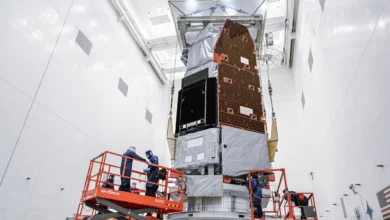
SAN FRANCISCO — In a strategic maneuver that highlights the accelerating commercial and national security demand for dedicated orbital real estate, satellite manufacturer and operator Astranis announced on October 26, 2026, that it has significantly upgraded its fourth launch agreement with SpaceX. Originally structured as a shared payload opportunity, the modified contract has been transformed into a fully dedicated mission aboard a Falcon 9 rocket slated for liftoff in 2028. This dedicated flight will exclusively carry the complete "Block 4" production run of Astranis MicroGEO satellites, deploying six advanced spacecraft directly into geostationary orbit (GEO) via an Impulse Helios upper stage.
The upcoming 2028 mission represents a major milestone for the San Francisco-based aerospace company, expanding its total operational fleet size to 16 satellites. This figure encompasses 10 previously built spacecraft distributed across Blocks 1, 2, and 3. By securing an entire Falcon 9 payload capacity for a single block production run, Astranis continues to validate its responsive manufacturing model, which aims to bypass the protracted, multi-year timelines traditionally associated with geostationary satellite procurement and deployment.
Evolving Dynamics of High-Orbit Infrastructure
The decision to scale up production and secure dedicated launch capacity directly responds to a shifting paradigm among global enterprises and sovereign governments. For decades, entities requiring geostationary communications relied heavily on massive, multi-ton traditional satellites procured through cumbersome, expensive, and protracted acquisition cycles. Alternatively, these organizations purchased shared capacity on commercial transponders, often sacrificing absolute control, customizability, and dedicated security.
In recent years, however, geopolitical tensions and escalating cybersecurity threats have driven a surge in demand for dedicated space infrastructure. Governments, allied military forces, and multinational enterprises increasingly require secure, unshared networks that they can independently control. Furthermore, these stakeholders are expanding their operational needs beyond basic telecommunications to include space domain awareness (SDA) and maneuverability—capabilities critical for monitoring orbital assets and protecting space-based critical infrastructure.
While low-Earth orbit (LEO) constellations have dominated headlines for broad-band internet provisioning, geostationary orbit offers unique, irreplaceable advantages for persistent regional coverage, low-latency regional beaming, and fixed-point connectivity. Astranis has successfully capitalized on this niche by engineering high-performance, refrigerator-sized MicroGEO satellites that deliver the power and throughput of traditional geostationary behemoths at a fraction of the cost and build time.
Chronology of the SpaceX Partnership and Fleet Expansion
The path to the 2028 Block 4 dedicated mission reflects a methodical scaling strategy by Astranis, punctuated by key contract milestones and technological rollouts:
- Late 2024: Astranis initially signs a foundational contract with SpaceX securing launch slots for upcoming satellite deployments, establishing a reliable cadence for fleet growth.
- Early 2025 – Mid 2026: The company successfully launches and operationalizes earlier iterations of its MicroGEO fleet (Blocks 1, 2, and 3), proving out the platform’s reliability and building a substantial commercial backlog. Concurrently, Astranis introduces "Perceptor," expanding its technological scope into space domain awareness and orbital maneuverability.
- October 26, 2026: Astranis formally announces the contract amendment with SpaceX, upgrading its fourth launch to a dedicated Falcon 9 mission for the entire six-satellite Block 4 production run in 2028.
This systematic evolution underscores how the company has transitioned from a daring technological startup to a trusted prime contractor for both commercial operators and defense agencies.
Executive Perspectives and Strategic Vision
Commenting on the upgraded launch agreement, John Gedmark, CEO and co-founder of Astranis, emphasized the urgency driving the company’s manufacturing ramp-up.

"We’ve only just begun to ramp up production to meet the demand we are seeing for commercial and national security missions," Gedmark stated. "This launch means we can accelerate the critical infrastructure we’re building for customers in GEO and other higher orbits."
The ability to deploy an entire block of six satellites simultaneously via a direct-injection profile utilizing the Impulse Helios upper stage allows Astranis to populate specific orbital slots rapidly. This capability is paramount for customers who cannot afford months of orbital raising or phased commissioning periods.
While specific commercial and governmental customers for the Block 4 satellites remain undisclosed due to confidentiality agreements, Astranis confirmed that initial customer commitments for the manifest have already been secured, with formal customer announcements expected ahead of the 2028 launch date.
Broad Implications for the Satellite Industry
The Astranis-SpaceX announcement carries several significant implications for the broader aerospace and telecommunications sectors:
- Validation of the MicroGEO Concept: For years, legacy aerospace incumbents doubted whether small satellites could successfully and economically operate in geostationary orbit, citing the severe thermal and power challenges of the 35,786-kilometer-altitude environment. By successfully deploying multiple blocks and continually scaling production, Astranis has decisively proven the commercial viability of the MicroGEO model.
- The Rise of Dedicated Small-GEO Missions: Historically, small satellites in GEO hitched rides as secondary payloads on heavy launch vehicles, forcing operators to compromise on orbit insertion parameters and launch schedules. By booking dedicated Falcon 9 missions for multi-satellite blocks, Astranis is pioneering a wholesale shift toward primary-payload status for smaller geostationary platforms.
- Convergence of Communications and Space Domain Awareness: With the introduction of platforms like Perceptor and the growing demand for sovereign space infrastructure, geostationary orbit is no longer viewed merely as a parking spot for TV transponders and regional internet relays. It is increasingly recognized as a contested, critical domain requiring active monitoring, defense, and maneuverability—functions that Astranis is actively embedding into its high-orbit architecture.
Corporate Background and Financial Footing
Astranis operates from a robust financial and operational foundation as it looks toward its 2028 milestones. To date, the company has raised over $1.2 billion in funding from prominent institutional investors, including Andreessen Horowitz, BlackRock, Fidelity, Franklin Templeton, and Snowpoint.
The enterprise currently maintains a commercial contract backlog exceeding $1 billion, reflecting strong market confidence in its offerings. Astranis positions itself as the premier satellite communications partner for buyers with stringent requirements regarding uptime, data security, network visibility, and hardware customization.
Operating out of a sprawling 153,000-square-foot headquarters in Northern California, Astranis employs a workforce of approximately 500 engineers, technicians, and business professionals. The company maintains end-to-end control over its operations by designing, manufacturing, integrating, and operating its satellites entirely in-house.
As the 2028 launch date approaches, the successful deployment of the Block 4 fleet will not only solidify Astranis’s market position but also redefine how sovereign states and global enterprises procure, deploy, and protect their vital assets in geostationary orbit.