Two Decades Since Cassini’s Historic First Close-Up of Titan: A Turning Point in Planetary Science

Twenty years ago, on October 26, 2004, NASA’s Cassini spacecraft executed a flawless, high-stakes maneuver that fundamentally altered our understanding of the outer solar system. Sweeping past Saturn’s largest moon, Titan, at a blistering speed, Cassini plunged to within 745 miles (1,200 kilometers) of the moon’s perpetually obscured surface. This milestone event provided humanity with its first-ever high-resolution, close-up images of a celestial body long shrouded in mystery by a thick, nitrogen-rich atmosphere. The data collected during this historic flyby not only validated decades of theoretical models but also paved the way for the successful deployment of the European Space Agency’s Huygens probe just months later.
The Journey to the Ringed Planet
To appreciate the significance of the October 2004 flyby, one must examine the arduous journey undertaken by the Cassini-Huygens mission. Launched on October 15, 1997, from Cape Canaveral Air Force Station in Florida, the joint NASA/ESA/ASI spacecraft embarked on a nearly seven-year interplanetary voyage. To reach the Saturnian system, located roughly 900 million miles from Earth, Cassini utilized a complex trajectory involving gravitational assists from Venus (twice), Earth, and Jupiter.
Upon arrival at Saturn on July 1, 2004, Cassini became the first spacecraft to enter orbit around the gas giant. Its primary mission objectives were ambitious: perform comprehensive studies of Saturn’s rings, its magnetic environment, its icy satellites, and, most intriguingly, Titan. While astronomers had long known that Titan possessed a dense atmosphere—first detected spectroscopically by Spanish astronomer Josep Comas i Solà in 1903 and confirmed by Gerard Kuiper in 1944—the moon’s opaque, orange haze completely blocked visible light, hiding its surface features from Earth-based telescopes and passing Voyager flybys.
The Anatomy of the Flyby
Cassini’s encounter on October 26, 2004, was actually its second pass by Titan, but it represented a quantum leap in observational capability. The initial flyby on July 3, 2004, served primarily as a test of the spacecraft’s instruments, keeping Cassini at a safe and cautious distance of roughly 211,000 miles (339,000 kilometers).
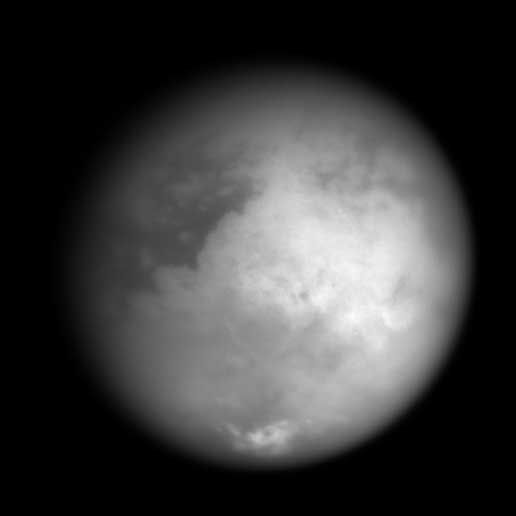
For the October encounter, mission controllers instructed Cassini to dive deep beneath the haze layer, bringing the spacecraft approximately 300 times closer than it had been in July. As Cassini zipped past the moon, its radar altimeter, cameras, and infrared spectrometers captured hundreds of images and detailed measurements. These instruments pierced the dense smog of organic aerosols, revealing a complex, active world that bore uncanny geological similarities to Earth, albeit operating at cryogenic temperatures hovering around minus 290 degrees Fahrenheit (minus 179 degrees Celsius).
Mapping Xanadu and Revealing an Alien Earth
The most striking revelation of the 2004 flyby was the discovery of a vast, continent-sized, highly reflective region near Titan’s equator, which scientists promptly named Xanadu. Spanning an area roughly the size of Australia, Xanadu emerged in the radar and infrared data as a rugged terrain featuring complex networks of mountains, vast river-like drainage channels, and smooth lowland plains.
Before Cassini’s arrival, planetary scientists hypothesized that Titan might be covered entirely by a global ocean of liquid hydrocarbons, such as methane and ethane. However, the high-resolution images of Xanadu and surrounding regions painted a far more dynamic picture. The data hinted at geological processes driven by methane rain, cryovolcanism (ice volcanoes), and wind-blown dunes of organic sand.
Crucially, the atmospheric data gathered during the flyby allowed scientists to accurately model the density, temperature profile, and composition of Titan’s troposphere and stratosphere. This information was vital for mission planners, who needed precise atmospheric metrics to ensure the structural integrity and stable parachute deployment of the Huygens lander.
The Huygens Descent and the Grand Finale
The success of the October 2004 flyby set the stage for the mission’s next major milestone: the separation and landing of the Huygens probe. On December 25, 2004, Cassini released Huygens on a targeted trajectory toward Titan. Three weeks later, on January 15, 2005, the European probe plunged into Titan’s atmosphere, successfully parachuting down to the surface and transmitting data for over an hour from an alien landscape strewn with rounded, ice-rich pebbles.
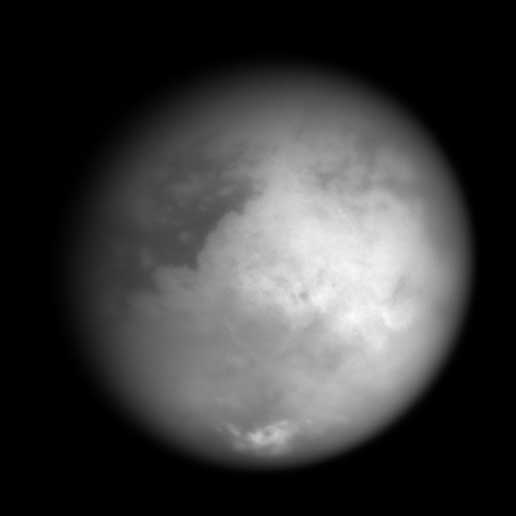
Over the next 13 years, Cassini performed 127 targeted flybys of Titan, progressively mapping its shifting dune fields, discovering massive hydrocarbon seas and lakes in the polar regions, and measuring seasonal weather changes. The mission culminated in September 2017 with the "Grand Finale," a dramatic series of orbits where Cassini intentionally dove into Saturn’s upper atmosphere to prevent any accidental biological contamination of Titan or Enceladus—worlds possessing environments potentially favorable to prebiotic chemistry.
Scientific Implications and Legacy
Two decades after Cassini’s initial close-up views, the legacy of the October 26, 2004, flyby continues to resonate throughout the planetary science community. Titan is now recognized as one of the premier ocean worlds in the solar system, possessing a subsurface liquid water ocean beneath its crust of water ice, layered beneath an atmosphere rich in organic chemistry.
The discoveries made possible by Cassini transformed Titan from a fuzzy astronomical curiosity into a primary laboratory for astrobiology. By studying Titan’s dense, nitrogen-methane atmosphere, researchers gain invaluable insights into atmospheric photochemistry and prebiotic chemical pathways that may mirror conditions on early Earth before the rise of oxygenic photosynthesis.
Furthermore, the methodologies developed during Cassini’s Titan campaign have informed future exploration concepts. NASA’s upcoming Dragonfly mission, scheduled to launch in the late 2020s, will dispatch a nuclear-powered rotorcraft to hop across Titan’s organic dunes and impact craters, directly sampling surface materials to search for the chemical building blocks of life.
As the scientific community reflects on the 20th anniversary of that historic October day in 2004, Cassini’s first close-up look at Titan stands as a testament to human ingenuity and the enduring drive to explore the unknown. What began as a daring gravitational dance through a smog-shrouded fog opened a window onto an entire world, permanently expanding our understanding of planetary diversity within our solar system.