Google Android Bench update reveals Gemini 4 Argon struggles against industry-leading AI models in coding performance

The landscape of artificial intelligence-assisted software development underwent a significant recalibration this week as Google released the October 26 update to its Android Bench, a specialized testing framework designed to evaluate the efficacy of Large Language Models (LLMs) in the context of Android-specific coding tasks. The latest data reveals a challenging reality for Google’s own internal efforts, as the newly released Gemini 4 Argon model faces stiff competition from Anthropic’s Claude and OpenAI’s GPT series, ultimately landing in fifth place.
Android Bench was introduced earlier this year as a direct response to the proliferation of generative AI in software engineering. Unlike general-purpose benchmarks that test basic logic or broad coding proficiency, Android Bench is specifically calibrated to measure how well an AI understands the unique constraints, APIs, and architectural best practices required for modern Android development. By incorporating factors such as syntax accuracy, adherence to Material Design principles, and efficient resource management, the benchmark serves as a critical scorecard for developers seeking to optimize their workflows through AI integration.
The October 26 Benchmark Data Breakdown
The latest update to the benchmark provides the most comprehensive look at the state of AI coding assistance to date. In addition to raw pass and completion rates, Google has introduced "reasoning levels" to the dataset—a metric intended to help developers understand the depth of logical processing applied by a model when tackling complex architectural challenges.
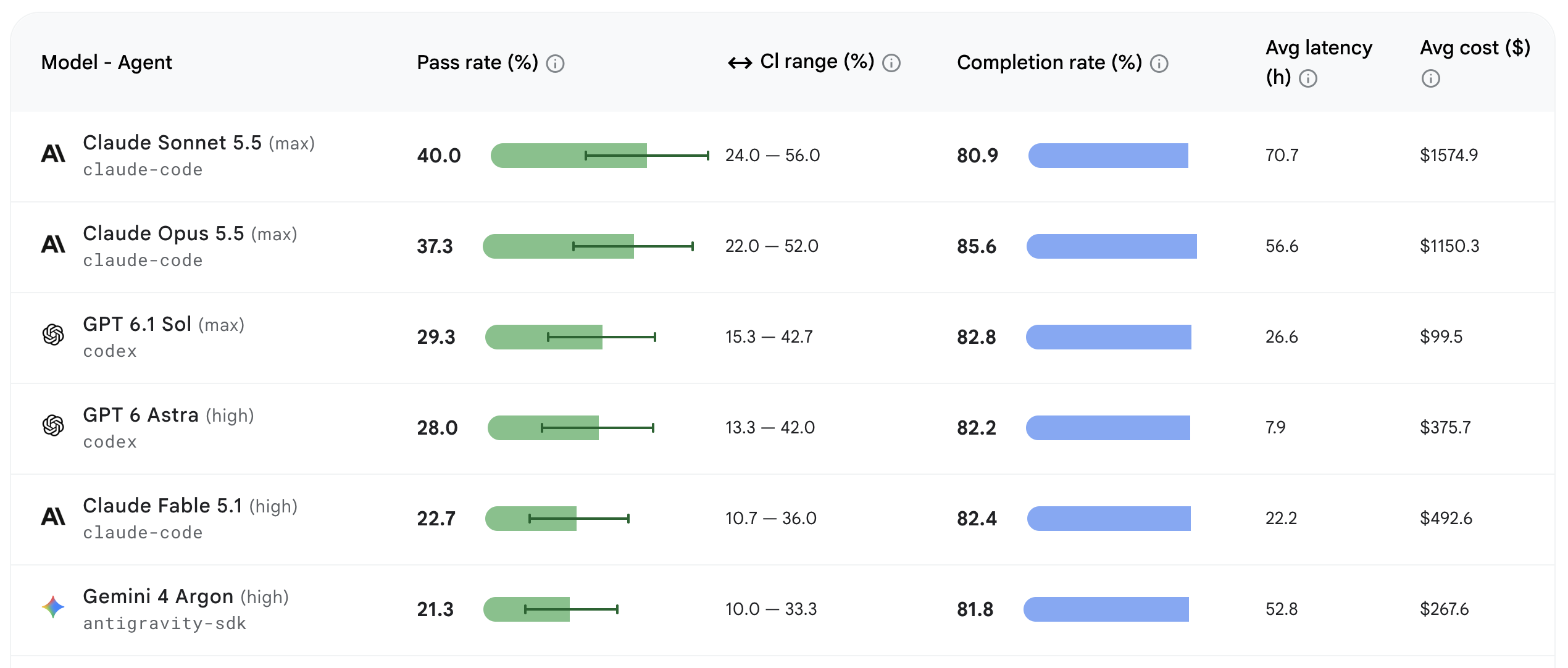
According to the updated figures, Anthropic’s Claude Sonnet 5.5 has solidified its position as the industry leader, achieving a 40% pass rate and an 80.9% completion rate. Close behind is the Claude Opus 5.5, which has maintained a strong foothold since its introduction in early October.
Perhaps most striking in the current dataset is the performance of OpenAI’s GPT-6.1 Sol. While its 29.3% pass rate and 82.8% completion rate technically trail the top-tier Claude models, its economic profile is significantly more attractive for enterprise environments. The model operates at a cost of $99.50 per unit of evaluation, a stark contrast to the $1,574.90 associated with the top-performing Claude models. This disparity underscores a growing trend in the developer community: the search for a balance between high-fidelity code generation and cost-effective scalability.
Gemini 4 Argon’s Underwhelming Debut
The performance of Gemini 4 Argon has become the focal point of industry scrutiny. Debuting in fifth place, the model failed to surpass its primary rivals, registering a 21.3% pass rate and an 81.8% completion rate. With an average cost of $267.70, the model currently struggles to provide a competitive advantage in both performance and price relative to its peers.
This result follows a period of internal and external skepticism regarding the model’s capabilities. Immediately following the initial announcement of Gemini 4 Argon on September 30, reports surfaced suggesting that the model faced difficulties with specific, nuanced coding tasks—particularly those involving legacy codebases or complex multi-module Android projects. At the time, Google issued statements defending the architectural integrity of the model, maintaining that its capabilities were optimized for a broad spectrum of enterprise needs rather than just niche coding benchmarks.
Chronology of AI Integration in Android Development
The development of the Android Bench reflects the broader, rapid evolution of AI-integrated development environments (IDEs).
- Q1 2026: Google officially launches the Android Bench initiative, aiming to standardize how developers evaluate AI tools for their specific platform needs.
- Early October 2026: Anthropic updates its portfolio with the Claude 5.5 series, which quickly jumps to the top of the leaderboard.
- October 26, 2026: Google releases the latest iteration of the Android Bench, adding reasoning levels and integrating OpenAI’s GPT-6 and GPT-6.1 Sol models into the testing suite.
- Current Status: Developers are increasingly shifting toward a "multi-model" approach, utilizing high-cost models like Claude for complex architectural tasks and lower-cost models like GPT-6.1 Sol for boilerplate code generation.
Implications for the Android Ecosystem
The disparity in model performance has profound implications for the Android developer community. As Google pushes to make Android the primary platform for AI-integrated development, the performance of its own native models becomes a matter of strategic importance. If Gemini 4 Argon cannot match the coding efficacy of its competitors, it risks losing market share to third-party providers integrated into popular IDEs like Android Studio.
Furthermore, the addition of the "average cost" metric to the benchmark indicates that Google is pivoting toward a more holistic view of AI development. For many firms, the limiting factor in AI adoption is not the quality of the output, but the prohibitive cost of running thousands of tokens through high-reasoning models. The current performance gap suggests that while frontier models are becoming more intelligent, they are also becoming increasingly expensive to maintain, potentially creating a "premium tier" of AI-assisted development that may be inaccessible to smaller studios or independent developers.
Analyzing the "Reasoning Level" Metric
The introduction of reasoning levels in the October 26 update is a sophisticated addition. By categorizing how models solve problems—ranging from straightforward pattern matching to complex multi-step logical deduction—Google is providing developers with a roadmap for model selection. Models with higher reasoning levels are expected to perform better on non-trivial architectural changes, such as migrating a legacy View-based layout to Jetpack Compose.

However, the data shows a recurring trend: models with higher reasoning capabilities often exhibit higher costs and lower completion speeds. This trade-off is the primary hurdle for the next generation of AI coding tools. As companies like Google, OpenAI, and Anthropic race to balance these metrics, developers are the ones navigating a volatile landscape where the "best" model changes almost monthly.
Official Stance and Future Outlook
Google has remained largely silent on the specific comparative performance of Gemini 4 Argon since the latest benchmark data was published. In previous internal communications, leadership emphasized that Gemini models are designed for long-term scalability across Google’s entire ecosystem, not just for narrow coding tasks. Nevertheless, the underperformance of Argon in a benchmark designed by Google itself suggests a period of internal pressure to optimize the model’s logical pathways.
For the wider developer community, the takeaway is clear: the era of relying on a single, "one-size-fits-all" AI model for software engineering is ending. As the Android Bench data suggests, the future of development involves leveraging different models for different tasks—using the raw reasoning power of high-end models for architectural decisions and the cost-efficiency of mid-tier models for routine implementation.
As the industry looks toward the next update, all eyes will be on whether Google can bridge the performance gap with a future iteration of the Gemini architecture, or if the current competitive landscape will force a strategic shift in how Google promotes its AI offerings to the developer public. For now, the Android Bench stands as an objective, albeit sobering, reminder that in the hyper-competitive world of generative AI, technical superiority is a moving target that requires constant innovation to maintain.
Related posts: