Trump Proposes First-Ever US Space Academy, Threatening to Blur Lines Between Civilian Exploration and Military Defense

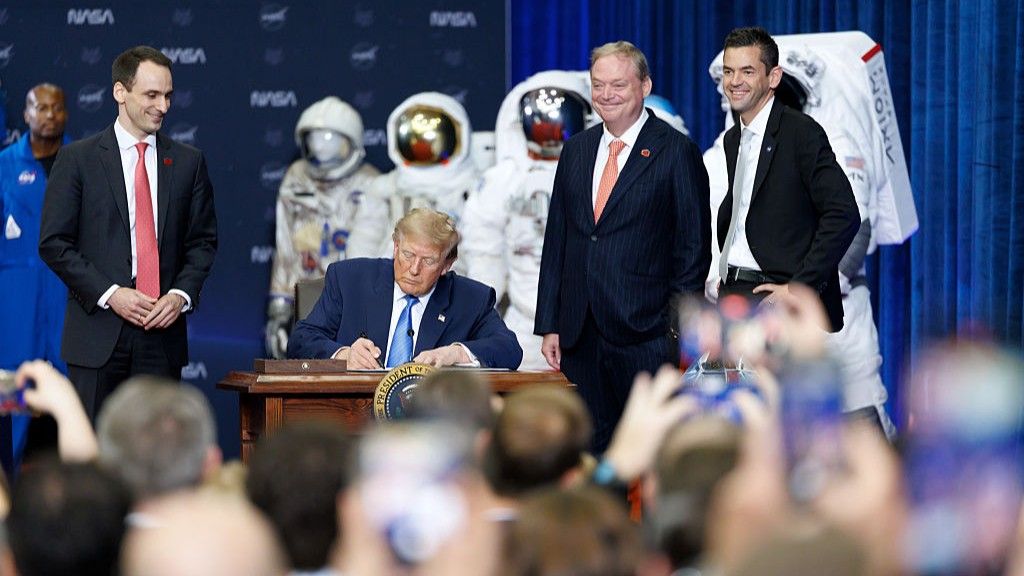
The United States space enterprise stands at a historic and potentially contentious crossroads following an executive order signed by President Donald Trump at NASA’s Johnson Space Center in Houston. The directive initiates the formal planning process for a United States Space Academy—a federally funded, NASA-led institution designed to train the next generation of aerospace engineers, scientists, and spacecraft operators. While proponents view the initiative as a bold and necessary step to secure American dominance in an increasingly crowded orbital domain, policy experts, former space agency leaders, and lawmakers have immediately raised critical questions. The proposal threatens to dismantle a foundational tenet of modern American space policy: the strict institutional separation between civilian exploration and national security operations.
The Announcement and Immediate Framework
Under the terms of the executive order, the White House is not immediately breaking ground on a physical campus. Instead, the directive establishes a high-level commission tasked with evaluating the feasibility, curriculum, structural requirements, and potential locations for the academy. The commission is mandated to deliver a comprehensive report within 120 days.
Leadership of this exploratory panel falls to NASA Administrator Jared Isaacman, a prominent figure in commercial spaceflight with deep ties to modern aerospace initiatives. The commission’s roster reflects a deliberate convergence of civilian science and national security interests, featuring heavyweights such as the Secretary of Defense, the National Security Adviser, and the Director of the Office of Management and Budget.
According to the administration’s initial framing, the proposed academy is envisioned to "develop a professional corps of civically grounded leaders prepared to advance American interests within the space domain." President Trump has explicitly compared the prospective institution to venerable military service academies such as West Point, the U.S. Air Force Academy, and the U.S. Naval Academy. However, administration officials have simultaneously insisted that the school will serve a dual purpose, supporting both the U.S. Space Force and civilian entities like NASA and the commercial spaceflight sector. This dual mandate is precisely what has ignited immediate debate across Washington and the broader aerospace community.
Chronology of Modern U.S. Space Militarization and Governance
To understand the weight of the current Space Academy proposal, it is necessary to examine the evolution of American space policy over the past seven decades. Since the dawn of the Space Age in the 1950s, United States policy has sought to draw a sharp boundary between peaceful, civilian-led scientific exploration and classified, military-driven space operations.
In 1958, Congress passed the National Aeronautics and Space Act, establishing NASA as a civilian agency explicitly tasked with peaceful space exploration and scientific discovery. While the U.S. military maintained its own independent space programs—primarily focused on reconnaissance, communications, and missile warning—the overarching national narrative maintained that NASA’s rockets flew for science and humanity, whereas military payloads defended the nation.
This dividing line experienced its first major structural shift during President Trump’s first term in office. In late 2017, Trump formally signed Space Policy Directive-1, refocusing NASA’s mission on returning astronauts to the Moon through the Artemis program, ultimately aiming for crewed missions to Mars. Shortly thereafter, the administration championed a much more radical institutional transformation: the creation of an entirely new branch of the armed forces dedicated exclusively to warfare and defense beyond Earth’s atmosphere.
By December 2019, the United States Space Force became a reality through the enactment of the National Defense Authorization Act, making it the first new branch of the U.S. military since the Air Force was established in 1947. Given this historical precedent, Trump’s renewed focus on space education during his second term aligns seamlessly with his administration’s previous efforts to institutionalize and accelerate American power projection in the cosmos.
Weighing the Financial and Bureaucratic Hurdles
Even if the exploratory commission issues a glowing endorsement of the Space Academy within its mandated 120-day window, the project faces formidable political and financial hurdles before it can become reality. Under the U.S. Constitution, new federal bureaucratic organizations cannot be conjured solely by executive order; they require explicit legislative authorization and sustained annual funding from Congress.
Securing congressional buy-in will be no small feat. Existing federal service academies, such as West Point and the Naval Academy, are remarkably resource-intensive institutions. Defense analysts and lawmakers estimate that operating a single traditional military service academy costs approximately $1 billion annually. Building an entirely new academy from scratch—complete with specialized laboratories, flight simulators, research facilities, and faculty housing—would require an initial capital investment that dwarfs standard operational budgets.
Furthermore, tying the academy’s leadership structure to NASA introduces unique budgetary vulnerabilities. Unlike the Department of Defense, which enjoys broad, bipartisan support for guaranteed baseline funding, NASA’s budget is entirely discretionary. Historically, when fiscal pressures mount in Washington, NASA is frequently among the first federal agencies targeted for budget reductions. Funding a multi-billion-dollar federal academy out of a constrained civilian space agency budget could spark fierce battles on Capitol Hill, pitting scientific missions and planetary exploration against institutional overhead.
Conflicting Visions: West Point for Space or Starfleet Academy?
The central paradox of the proposed U.S. Space Academy lies in its identity. President Trump and various media outlets have repeatedly invoked comparisons to West Point, utilizing terminology that strongly suggests a military-style institution. Yet, the executive order explicitly designates NASA—a civilian agency—as the lead entity.
This duality has prompted sharp pushback from former NASA officials, policy scholars, and members of Congress. Critics argue that conflating civilian and military training undermines decades of international diplomacy and norms designed to keep space peaceful. Since the Outer Space Treaty of 1967, the international community has largely adhered to the principle that celestial bodies and space exploration should be reserved for peaceful purposes, even as satellite networks have become increasingly militarized for communications and reconnaissance.
If the academy adopts a military structure, graduates could face mandatory service obligations within the Space Force, transforming what is ostensibly a civilian educational pipeline into a feeder system for the armed forces. Conversely, if the curriculum focuses heavily on civilian scientific research, commercial engineering, and deep-space exploration, the justification for a rigid, service-academy-style hierarchy becomes less clear, particularly when top-tier universities across the United States already offer world-class aerospace engineering and science programs.
The debate has even drawn comparisons to science fiction, with some observers drawing parallels to Starfleet Academy from the Star Trek universe—an institution dedicated to scientific exploration, diplomacy, and defense operating under a unified banner. However, real-world geopolitics are far more complex than television scripts.
Broader Implications for Global Security and the Space Economy
The timing of this proposal coincides with an unprecedented boom in global space activity. The orbital environment is no longer the exclusive playground of two superpowers. Instead, it is a bustling, highly commercialized arena. Low Earth orbit is crowded with tens of thousands of commercial satellites, such as SpaceX’s Starlink constellation, which provide vital global internet connectivity. Simultaneously, the Global Positioning System (GPS) and other space-based assets form the invisible backbone of the worldwide economy, managing everything from international banking transactions to agricultural logistics.
At the same time, geopolitical tensions between the United States and strategic competitors like China and Russia have escalated dramatically within the space domain. Analysts frequently warn of the potential for orbital conflict, anti-satellite weapon testing, and cyber warfare targeting critical space infrastructure.
In this high-stakes environment, proponents of the Space Academy argue that the United States urgently needs a specialized cadre of professionals who understand the intricate intersection of engineering, policy, national security, and commercial enterprise. As space becomes increasingly vital to everyday life on Earth, training experts who can navigate these multi-faceted challenges is an undeniable necessity.
However, international relations experts caution that blurring the lines between civilian and military space programs could carry unintended diplomatic consequences. Adversaries may view a NASA-led, military-styled academy as proof of a deepening U.S. intent to weaponize all aspects of space exploration. Maintaining a clear rhetorical and structural distinction between civilian scientific endeavors—such as searching for extraterrestrial life or studying climate change from orbit—and military defense operations is crucial for preventing miscalculations and international escalation.
Path Forward and Unanswered Questions
As Administrator Jared Isaacman and the newly formed commission begin their 120-day review, a multitude of practical questions remains unanswered. Beyond the foundational debate over civilian-military integration, the commission must determine how students will be selected, whether attendance will be tuition-free in exchange for service commitments, where the physical campus will be built, and what specific undergraduate and graduate degrees will be conferred.
Furthermore, the role of the booming commercial space sector in this initiative remains entirely undefined. With private companies routinely outpacing traditional government timelines in rocket development and satellite deployment, any modern space academy would arguably be remiss to ignore private-sector partnerships.
Ultimately, the U.S. Space Academy proposal represents a profound ideological shift in how the United States views its future beyond the atmosphere. Whether the initiative ultimately materializes as a physical campus or fades into the annals of bureaucratic policy proposals, it has already forced a long-overdue national conversation about the identity, purpose, and governance of humanity’s expansion into the stars.