Unveiling the Yin-Yang Moon: How Giovanni Cassini’s 1671 Discovery of Iapetus Rewrote Our Understanding of the Saturnian System

On October 25, 1671, Italian-born astronomer Giovanni Domenico Cassini peered through his long-focus telescope at the Royal Observatory in Paris and documented a faint, elusive speck of light gliding near the planet Saturn. With this meticulous observation, Cassini discovered Iapetus, the second moon ever found orbiting the gas giant and the inaugural entry in a prolific series of celestial discoveries that would fundamentally reshape humanity’s understanding of the outer solar system.
Long before modern space probes, digital imaging, and deep-space telemetry, seventeenth-century astronomers relied on raw patience, precision optics, and relentless mathematical tracking to map the heavens. Cassini’s landmark sighting of Iapetus did more than simply add another body to the roster of known planetary satellites; it initiated a centuries-long scientific puzzle regarding the moon’s starkly contrasting surface, a mystery that would finally be unraveled by a NASA spacecraft bearing the astronomer’s own name more than three hundred years later.
The Historical Context of 17th-Century Saturnian Astronomy
To understand the magnitude of Cassini’s 1671 discovery, one must examine the technological limitations and astronomical paradigms of the late seventeenth century. Telescopes were primitive by modern standards, plagued by chromatic aberration, distortion, and limited light-gathering capabilities. Despite these hurdles, a golden age of planetary discovery was underway, fueled by the fierce scientific competition among European observatories.
Just six years prior to Cassini’s breakthrough, Dutch polymath Christiaan Huygens discovered Titan, Saturn’s largest moon, in 1655 using an innovative, highly sophisticated refracting telescope of his own design. Huygens also correctly interpreted Saturn’s enigmatic appearance, identifying the celestial halo as a flat, solid ring that never actually touches the planet.
Buoyed by these advances, King Louis XIV of France invited Cassini—already renowned for his precise observations of Jupiter’s moons and the rotation periods of planetary bodies—to serve as the first director of the newly established Paris Observatory in 1669. It was from this prestigious institution that Cassini embarked on a systematic survey of the Saturnian system, leading directly to the October night when Iapetus stepped into the historical record. Following his identification of Iapetus, Cassini’s observational prowess continued to yield results; he subsequently discovered three more Saturnian moons: Rhea in 1672, and Tethys and Dione in 1684.
The Mystery of the Vanishing Moon
Upon its initial discovery, Iapetus immediately confounded its discoverer through an erratic behavior pattern that defied contemporary astronomical models. When Cassini first spotted the moon on October 25, 1671, it was positioned on the western side of Saturn, shining with typical telescopic brightness.
Based on his preliminary calculations of its orbital period, Cassini predicted that the moon would complete its circuit and reappear on the eastern side of Saturn approximately 39 days later. However, when the calculated date arrived, Cassini trained his telescope on the eastern quadrant, only to find empty space. The moon had seemingly vanished.
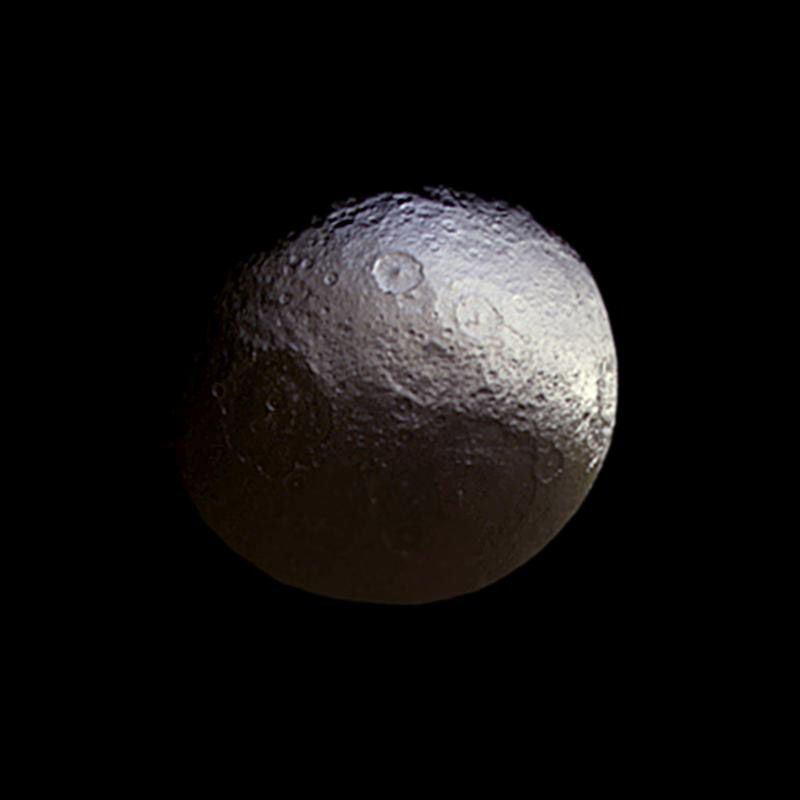
Weeks later, the elusive satellite reappeared—not on the eastern side where expected, but unexpectedly visible once again when it swung back to the western elongation. This baffling cosmic disappearing act forced Cassini to deduce a radical conclusion: Iapetus could not be uniformly colored. Instead, he hypothesized that the moon possessed a profoundly asymmetrical albedo, meaning one hemisphere was significantly darker than the other.
When the bright hemisphere faced Earth, the moon was easily visible through seventeenth-century optics. When the dark hemisphere rotated into view, it absorbed the meager sunlight reflected toward Earth, effectively rendering the moon invisible to the telescopes of the era. This brilliant deduction by Cassini predated modern planetary photometery by centuries and correctly identified the core physical characteristic that defines Iapetus to this day.
Chronology of Exploration: From Paris to the Cassini-Huygens Mission
The true nature of the asymmetry observed by Giovanni Cassini remained an impenetrable enigma for over three centuries. While astronomers steadily improved their telescope technology, capturing blurred glimpses of a dark leading hemisphere and a bright trailing hemisphere, detailed surface morphology remained out of reach.
The breakthrough arrived in the late twentieth and early twenty-first centuries through robotic space exploration. A timeline of key milestones in the exploration of Iapetus highlights the transition from terrestrial observation to direct in-situ analysis:
- October 25, 1671: Giovanni Cassini discovers Iapetus at the Paris Observatory.
- November 1980: NASA’s Voyager 1 spacecraft flies past Saturn, capturing the first medium-resolution images of Iapetus, confirming that the dark material covers its leading hemisphere while a bright, icy terrain dominates its trailing side.
- September 2004: The joint NASA/ESA/ASI Cassini-Huygens spacecraft successfully enters orbit around Saturn, initiating a multi-year, comprehensive tour of the planetary system.
- September 2007: The Cassini spacecraft executes a historic close flyby of Iapetus, plunging to within 1,234 kilometers of the moon’s surface and capturing ultra-high-resolution imagery and scientific data that reveal its complex topography, equatorial ridge, and stark yin-yang coloration.
The Yin-Yang Moon and the Physics of Asymmetry
When the Cassini spacecraft beamed back high-definition photographs of Iapetus, scientists were greeted with one of the most visually striking landscapes in the solar system. The moon’s surface was neatly divided into two distinct regions: a stark white trailing hemisphere and a jet-black leading hemisphere, separated by a sharp, dramatic contrast that immediately earned the world its modern moniker: the "yin-yang moon."
Planetary scientists spent years investigating the mechanism behind this bicolored phenomenon. Current consensus points to a combination of exogenous (external) and endogenous (internal) processes. The leading hemisphere of Iapetus—the side that constantly faces forward into the direction of the moon’s orbit—is coated in a reddish-dark dust. This material is believed to be remnants of dark debris swept up from Phoebe, a distant, retrograde outer moon of Saturn, or dust knocked off Phoebe by micrometeoroid impacts and pulled inward by orbital dynamics.
Once this dark dust coats the leading side of Iapetus, a thermal feedback loop accelerates the darkening process. Dark material absorbs significantly more sunlight than pristine white ice, causing the surface temperature to rise slightly. This minuscule temperature increase is sufficient to cause water ice to sublime (transition directly from solid to gas) from the dark regions. The escaping water vapor then migrates across the globe and refreezes onto the colder, darker trailing hemisphere, creating a runaway albedo effect that maintains the stark, high-contrast division over geological timescales.
Beyond its coloration, Iapetus features another astonishing geological anomaly: an equatorial ridge that towers up to 20 kilometers (12 miles) high and stretches nearly halfway around the moon’s circumference. This towering mountain range gives Iapetus the distinct physical appearance of a giant walnut, presenting planetary geologists with continuous structural puzzles regarding the moon’s formation and thermal evolution.

Broader Impact: Rewriting the Timeline of the Saturnian System
The study of Iapetus, alongside data gathered from other distant satellites like Titan, has fundamentally altered modern astrophysics and planetary cosmogony, particularly concerning the age and origin of Saturn’s iconic ring system and inner moons.
For decades, scientists debated whether Saturn’s rings were primordial features formed alongside the planet 4.5 billion years ago, or if they were relatively recent additions. By utilizing data from the Cassini mission in advanced computer simulations, researchers have been able to model the gravitational interactions and orbital histories of the Saturnian system.
Astrophysical analyses indicate that the inner moons of Saturn—such as Mimas, Enceladus, Tethys, Dione, and Rhea—along with the glittering ice rings themselves, are astonishingly young compared to the solar system as a whole, potentially having formed less than 100 million years ago, well after the age of the dinosaurs. However, distant outer satellites like Titan and Iapetus possess vastly different orbital characteristics and thermal histories, indicating they formed through entirely separate evolutionary pathways.
According to leading dynamic models, Saturn likely possessed an earlier, distinct generation of inner moons that were ultimately destabilized by orbital resonances driven by the planet’s gravitational interaction with the sun. As these orbits crossed, catastrophic collisions occurred among the neighboring bodies. The resulting debris field of pulverized ice and rock eventually accreted into the modern ring system and the current family of inner moons, while ancient outliers like Iapetus largely weathered the epoch in stable, distant orbits.
Legacy of Discovery
The observation recorded by Giovanni Cassini on a crisp autumn evening in 1671 transcends a simple entry in a historical logbook. It represents a foundational leap in planetary science, demonstrating how meticulous human observation can unlock the secrets of distant worlds long before humanity possesses the technology to visit them.
Today, as planetary scientists continue to analyze archival data from the Cassini mission—which concluded its historic mission in September 2017 by plunging into Saturn’s atmosphere—the legacy of Iapetus endures. From a tiny, baffling speck of light that mysteriously vanished in the seventeenth century to a fully mapped, geologically complex world with a yin-yang countenance, Iapetus remains a testament to the enduring human drive to explore, measure, and understand the cosmos.