NASA’s Near-Earth Object Surveyor mission reaches major milestone with the completion of critical sunshade structure

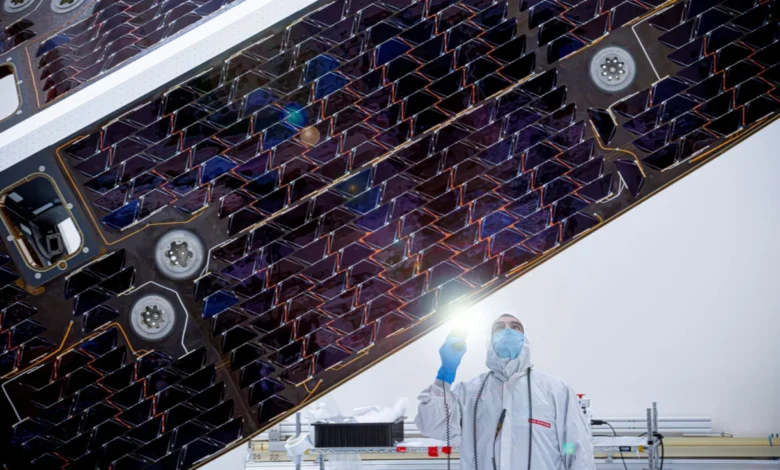
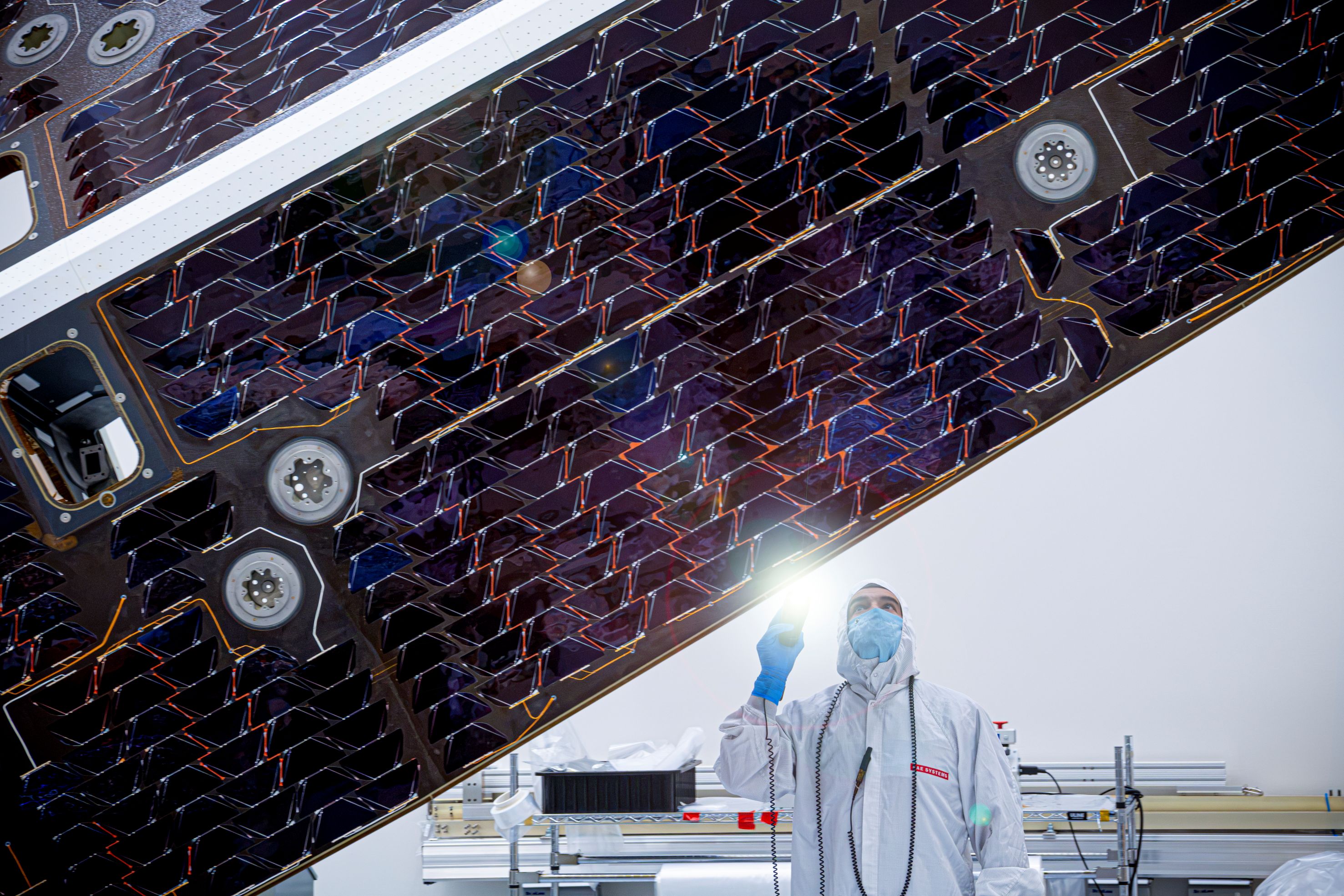
The Near-Earth Object (NEO) Surveyor mission, a cornerstone of NASA’s planetary defense strategy, has achieved a critical engineering milestone with the completion and inspection of its sophisticated sunshade assembly. This primary component, which stands 20 feet tall and measures 8 feet at its base, is essential for the thermal management and operational success of the infrared space telescope. As the agency prepares for the upcoming launch window, the successful integration of this hardware signals that the mission is advancing steadily toward its objective of cataloging the most elusive celestial objects in our solar system.
Engineering the Guardian of the Infrared Eye
The sunshade structure, fabricated by BAE Systems Space & Mission Systems, is far more than a simple canopy; it is an integrated thermal and electrical subsystem. In the harsh, high-radiation environment of space, the infrared sensors required to detect small, dark asteroids are extremely sensitive to heat. Infrared telescopes operate by detecting the thermal signatures emitted by objects against the cold background of space. If the telescope were to experience interference from the intense heat of the Sun, the sensors would be blinded, rendering the mission ineffective.
The sunshade serves a dual purpose: it acts as a thermal barrier, maintaining the cryogenic environment necessary for the telescope’s focal plane arrays to operate, while simultaneously housing the solar panels that provide the spacecraft with its primary electrical power. By positioning the sensitive optics in the permanent shadow of the sunshade, the mission can peer into the glare of the Sun—a region of the sky where traditional ground-based optical telescopes are frequently hindered by the intensity of daylight.
The Strategic Necessity of NEO Surveyor
The primary goal of the NEO Surveyor is to identify and characterize the population of near-Earth objects that measure larger than 140 meters (460 feet) in diameter. According to current estimates from NASA’s Planetary Defense Coordination Office, the majority of objects of this size that could cause significant regional damage remain undetected.
Ground-based optical observatories rely on visible light, which makes them highly effective at tracking objects when they are in the night sky. However, asteroids approaching Earth from the direction of the Sun often escape detection because their light is lost in the brilliance of the solar disk. NEO Surveyor addresses this "blind spot" by utilizing infrared light, which detects the heat emission of an asteroid rather than its reflected sunlight. By operating from a stable gravitational vantage point known as the Sun-Earth Lagrange point 1 (L1), the telescope will provide a constant, unobstructed view of the inner solar system.
A Chronology of Planetary Defense
The development of NEO Surveyor is the latest chapter in a long-term commitment to planetary defense. The chronology of the mission reflects a decades-long evolution in space-based surveillance:
- 1998: NASA establishes the Near-Earth Object Observations Program, with a goal to detect 90% of all near-Earth objects larger than 1 kilometer in diameter.
- 2005: The George E. Brown, Jr. Near-Earth Object Survey Act directs NASA to detect 90% of near-Earth objects 140 meters or larger by 2020.
- 2019: The mission, originally known as NEOCam, is formally moved into the formulation phase as a dedicated mission under the Planetary Science Division.
- 2021: NASA officially names the project NEO Surveyor, solidifying its role as the agency’s primary space-based infrared survey mission.
- 2026 (October): The sunshade structure is finalized and cleared for integration, marking a major physical construction milestone.
- Late 2020s: Anticipated launch of the spacecraft to its operational orbit.
Technical Data and Operational Constraints
The precision required for this mission is unprecedented. The telescope must maintain a cryogenic temperature of approximately 40 Kelvin (around -388 degrees Fahrenheit) to prevent internal thermal noise from interfering with the faint signals of distant, cold asteroids. The 20-foot sunshade is engineered to be lightweight yet structurally rigid, capable of withstanding the vibrations of launch while deploying precisely upon reaching its destination.
The telescope itself is designed to perform a continuous survey of the sky, scanning the region of the solar system closest to Earth’s orbit. Data collected will be relayed to ground stations, where advanced algorithms will process the imagery to identify moving objects against the fixed background of distant stars. These data are then cross-referenced with existing catalogs to determine whether an object is a known celestial body or a newly discovered asteroid or comet.
Official Perspectives and Agency Integration
While NASA’s Headquarters team has managed the oversight of the mission, the collaboration between private aerospace contractors and government scientists has been pivotal. Industry partners, including BAE Systems, have noted that the construction of the sunshade required unique material science advancements to ensure that the structure does not outgas or degrade when exposed to the vacuum of space for an extended duration.
Within the scientific community, the consensus is that the NEO Surveyor is a "game-changer." Dr. Amy Mainzer, the principal investigator for the mission, has frequently emphasized that the mission is not merely about scientific discovery, but about national and global safety. By providing years of lead time before any potential impact, the mission gives humanity the window required to develop and deploy deflection technologies, such as the DART (Double Asteroid Redirection Test) mission successfully demonstrated in 2022.
Broader Implications for Global Security
The implications of the successful deployment of the NEO Surveyor extend well beyond astronomy. As global reliance on space-based infrastructure increases—spanning telecommunications, GPS, and weather forecasting—the risk posed by the impact of even a relatively small asteroid is non-negligible. A 140-meter object, while not a global "extinction-level" threat, possesses sufficient kinetic energy to devastate a major metropolitan area.
The mission is also expected to provide a wealth of data on the composition and origin of the solar system. By studying the distribution and physical characteristics of near-Earth objects, scientists can gain insights into the early history of planetary formation. The infrared data will reveal the thermal properties of these rocks, helping researchers determine whether they are solid, dense bodies or "rubble piles" held together by gravity—information that is critical for designing future asteroid mitigation strategies.
Future Outlook and Mission Trajectory
With the sunshade now ready for integration, the assembly phase for the rest of the spacecraft will accelerate. The integration and testing phase is arguably the most rigorous period for any space mission, as engineers must ensure that every electronic component, mechanical actuator, and software protocol functions in harmony.
The successful inspection of the sunshade in October 2026 acts as a vital proof-of-concept for the hardware’s durability. As the mission moves toward its final integration and launch, the global community will be watching closely. For NASA, NEO Surveyor represents the fulfillment of a long-standing mandate to look upward and protect the planet from threats that have, for most of human history, remained invisible.
The mission remains on track to close the most significant remaining gap in our planetary defense architecture. By systematically cataloging the "dark" asteroids that have eluded detection for generations, NEO Surveyor ensures that the next surprise from space will not be a catastrophe, but a well-documented and predictable scientific event. As the sunshade structure awaits its integration with the telescope’s core, the mission stands as a testament to the power of precise engineering in the service of planetary safety.
Related posts: