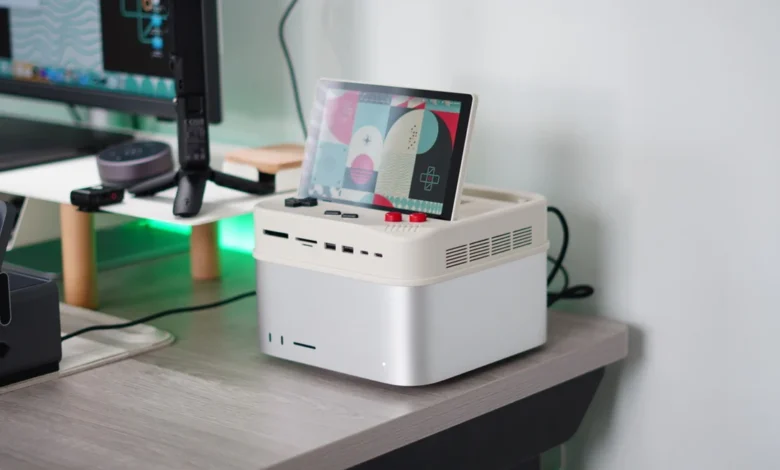
In a significant expansion of the desktop peripheral market, manufacturer Wokyis has officially unveiled its latest series of high-performance docking stations: the G5 and G7. Designed specifically to complement the aesthetic and functional requirements of the Apple Mac mini and Mac Studio, these devices aim to bridge the gap between high-speed enterprise-grade connectivity and the growing consumer demand for customizable, retro-inspired hardware. The launch, coinciding with a busy week of hardware updates in the Apple ecosystem, introduces a 16-in-1 modular solution that emphasizes both professional utility and a distinctive industrial design language reminiscent of the original 1984 Macintosh.
![This unique retro dock adds a flip-up display, Thunderbolt 5, & 8TB storage to your Mac [Video]](https://9to5mac.com/wp-content/uploads/sites/6/2026/09/1CEFFF5C-94EE-4C5A-8F65-B99038804E62_1_105_c.jpeg?quality=82&strip=all&w=800)
Evolution of the Desktop Ecosystem
The modern desktop workspace has undergone a radical shift toward minimalism. Apple’s current lineup of compact, powerful computing units—the Mac mini and Mac Studio—prioritizes a sleek, unobtrusive silver chassis. While this design language is lauded for its elegance, it has created a secondary market for "docking enclosures" that allow users to regain access to legacy ports, expanded storage, and secondary display interfaces without compromising desk real estate.
![This unique retro dock adds a flip-up display, Thunderbolt 5, & 8TB storage to your Mac [Video]](https://9to5mac.com/wp-content/uploads/sites/6/2026/09/99559A04-E0E2-4336-91EE-1AB2B68D3340_1_105_c1.jpeg?quality=82&strip=all)
The Wokyis G5 and G7 represent the second generation of the company’s "Retro Dock" project. Last year’s initial release established a proof-of-concept by integrating NVMe storage and a 5-inch display into a chassis that mirrored the vintage Macintosh form factor. The 2026 iteration, however, represents a substantial technical upgrade, incorporating Thunderbolt 5 technology, larger displays, and improved I/O throughput to support the professional-grade silicon now common in Apple’s workstation lineup.
![This unique retro dock adds a flip-up display, Thunderbolt 5, & 8TB storage to your Mac [Video]](https://9to5mac.com/wp-content/uploads/sites/6/2026/09/B8F9A0A2-AF4A-4BAA-9EF7-9F4FE3609C78_1_105_c.jpeg?quality=82&strip=all&w=800)
Technical Specifications and Connectivity
The G7 dock, intended for the more powerful Mac Studio, functions as a high-bandwidth hub. The standout feature of the flagship 80 Gbps model is its implementation of Thunderbolt 5, a standard that provides significantly higher data transfer rates than its predecessors. This bandwidth is crucial for professionals who rely on external NVMe SSDs for high-resolution video editing, as it allows for throughput speeds that rival internal drive performance, effectively bypassing the premium pricing tiers associated with Apple’s factory-installed storage configurations.
![This unique retro dock adds a flip-up display, Thunderbolt 5, & 8TB storage to your Mac [Video]](https://9to5mac.com/wp-content/uploads/sites/6/2026/09/3C4CABCF-CE9C-411A-A4F7-BD3438C699D1_1_105_c.jpeg?quality=82&strip=all&w=800)
The technical architecture of the units includes:
![This unique retro dock adds a flip-up display, Thunderbolt 5, & 8TB storage to your Mac [Video]](https://9to5mac.com/wp-content/uploads/sites/6/2026/09/326D4586-0642-483C-8FE2-098FC82AE742_1_105_c.jpeg?quality=82&strip=all&w=800)
- Integrated Display: The G7 features a 7-inch IPS panel with a resolution of 1280 x 800. The display functions as a secondary monitor within the macOS environment, allowing for the offloading of secondary tasks such as system monitoring, color grading scopes, or communication widgets.
- Port Density: Both units offer a 16-in-1 configuration. This includes specialized slots for CFexpress cards, microSD card readers, and multiple 10 Gbps USB-C ports, addressing the needs of creators who typically require a collection of disparate dongles.
- Tactile Controls: Moving away from purely software-based interactions, the chassis includes physical, remappable buttons for media playback, screenshot triggers, and brightness adjustment, providing a more tactile interaction model for power users.
- NVMe Support: The internal M.2 enclosure supports high-capacity drives, allowing users to build a high-performance external boot drive or dedicated media scratch disk.
The Role of Retro-Futurism in Tech Hardware
The aesthetic choices of the Wokyis G5 and G7—characterized by a beige, matte-finished housing and a distinct front-facing "gamer-inspired" control scheme—serve a dual purpose. Beyond the obvious nostalgic appeal, the design addresses the "sterile" appearance of contemporary workstation hardware.
![This unique retro dock adds a flip-up display, Thunderbolt 5, & 8TB storage to your Mac [Video]](https://9to5mac.com/wp-content/uploads/sites/6/2026/09/BEE45C0E-E3F3-49E8-87C8-6D5412BFD649_1_105_c.jpeg?quality=82&strip=all&w=800)
Industry analysts note that this trend, often categorized as "tech-nostalgia," is gaining traction as computing hardware becomes increasingly commoditized. By allowing users to customize their workspace with functional, high-design peripherals, manufacturers like Wokyis are tapping into a desire for personalization that is otherwise limited by Apple’s closed-hardware ecosystem. While the design is stylized, the integration remains strictly functional; the dock is fully compatible with any USB-C equipped computer, though it is physically engineered to sit flush with the footprints of the Mac Studio and the M4 Mac mini.
![This unique retro dock adds a flip-up display, Thunderbolt 5, & 8TB storage to your Mac [Video]](https://9to5mac.com/wp-content/uploads/sites/6/2026/09/C5283C8B-C1FE-4689-9C2D-E2667B594B92_1_105_c.jpeg?quality=82&strip=all&w=800)
Economic and Market Implications
The decision to launch via a crowdfunding platform—specifically Kickstarter, with shipping projected for October 2026—is a strategic move to gauge consumer demand and secure early-adopter capital. Early-bird pricing for the units is significantly lower than the projected retail MSRP, which will reach $369 for the high-end 80 Gbps G7 model.
![This unique retro dock adds a flip-up display, Thunderbolt 5, & 8TB storage to your Mac [Video]](https://9to5mac.com/wp-content/uploads/sites/6/2026/09/E225836E-DD3C-4359-BEF3-C99AA9449F7F_1_105_c.jpeg?quality=82&strip=all&w=800)
From a financial perspective, the utility of these docks is driven by the cost of storage. With NVMe SSD prices remaining competitive compared to the substantial premiums Apple charges for integrated storage upgrades, these docks offer a high-performance, cost-effective alternative for professional users. The G7, in particular, provides a "pro-sumer" solution that aggregates several distinct workflows—storage, monitoring, and I/O expansion—into a single physical point of entry.
![This unique retro dock adds a flip-up display, Thunderbolt 5, & 8TB storage to your Mac [Video]](https://9to5mac.com/wp-content/uploads/sites/6/2026/09/wokyis-screenshot-05.jpg?quality=82&strip=all&w=800)
A Look Toward Future Utility
As Apple continues to push the performance boundaries of its M-series chips, the bottleneck for many professionals is no longer the raw processing power of the CPU, but the connectivity and storage limitations inherent in a compact, unified-memory architecture. The Wokyis G5 and G7 provide a bridge for these users.
![This unique retro dock adds a flip-up display, Thunderbolt 5, & 8TB storage to your Mac [Video]](https://9to5mac.com/wp-content/uploads/sites/6/2026/09/wokyis-screenshot-04.jpg?quality=82&strip=all&w=800)
Furthermore, the company has indicated that it is currently developing a proprietary software utility. This software is expected to further optimize the use of the 7-inch integrated display, moving it from a standard secondary screen to a dedicated system-monitoring console that can display real-time CPU thermals, memory usage, and background application notifications.
![This unique retro dock adds a flip-up display, Thunderbolt 5, & 8TB storage to your Mac [Video]](https://9to5mac.com/wp-content/uploads/sites/6/2026/09/wokyis-screenshot-03.jpg?quality=82&strip=all&w=800)
Conclusion
The release of the Wokyis G5 and G7 signals a continued shift in the peripheral market. As desktop computers become smaller and more integrated, the role of the "dock" is evolving from a simple port-multiplier into a central command station. By blending the high-bandwidth requirements of modern Thunderbolt 5 hardware with a distinct, user-focused design language, Wokyis has positioned itself as a notable player in the accessory space. For professionals, the value proposition lies in the ability to reclaim desk space while significantly expanding the capabilities of their Mac hardware, all while maintaining a unique, personalized aesthetic that deviates from the standard industry aesthetic. The success of the project will ultimately depend on the reliability of the throughput and the continued support of the promised software ecosystem, but the initial hardware offering represents a sophisticated step forward for workstation peripherals.