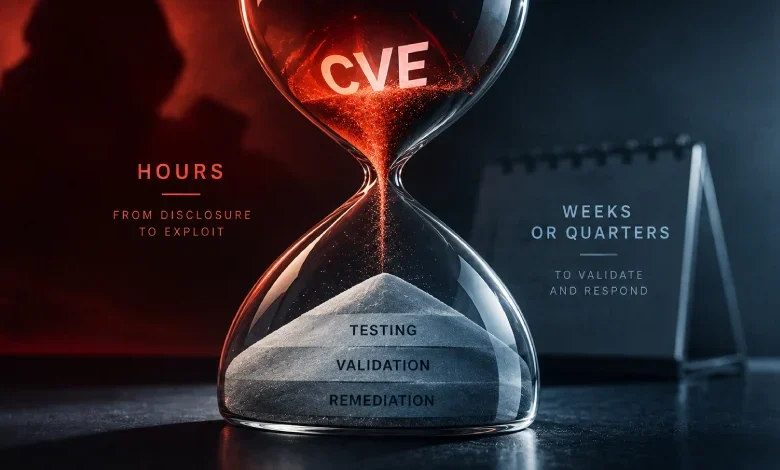
In the modern cybersecurity landscape, the emergence of "Mythos-class" artificial intelligence has fundamentally altered the threat profile for enterprises worldwide. This evolution in threat actor capabilities has compressed the timeline between the disclosure of a Common Vulnerability and Exposure (CVE) and the development of functional, weaponized exploits. As these AI-driven systems automate the discovery and utilization of security gaps, traditional vulnerability management programs—often operating on weekly or quarterly assessment cycles—are finding themselves increasingly outpaced. The core challenge facing security operations (SecOps) teams today is not merely identifying a vulnerability, but accurately and rapidly determining its exploitability within a specific, live production environment.
The Erosion of the Severity-Based Paradigm
For decades, the industry standard for vulnerability prioritization has been the Common Vulnerability Scoring System (CVSS). While a high CVSS score provides a baseline indicator of potential danger, it remains an inherently static metric. A score of 9.8 or 10.0 reflects the technical severity of a flaw, but it does not account for the specific context of an organization’s defense-in-depth architecture. In an era where AI-augmented attackers can pivot from disclosure to exploitation in a matter of hours, relying solely on severity scores is no longer a viable security posture.
The "dangerous gap" identified by industry experts is defined by time. When a new CVE is announced, the race begins between the security team attempting to patch and the adversary attempting to weaponize. If the validation of that vulnerability—the process of determining whether an attacker can successfully compromise a specific asset—takes days or weeks, the vulnerability window remains wide open. This delay is where the Mythos-class threat excels, exploiting the latency between a security team’s awareness and their actionable intelligence.
Chronology of a Vulnerability Lifecycle
To understand the current crisis, one must examine the typical chronology of a vulnerability from disclosure to remediation. The process begins with the public release of a CVE identifier by a governing body, such as MITRE. Following this, security scanners—both network-based and agent-based—crawl the enterprise environment to map the footprint of the affected software.
In a traditional workflow, this discovery phase is followed by a lengthy triage process. Security analysts must cross-reference the scanner’s output with asset criticality, compensating controls, and business impact. This manual or semi-automated triage can consume days. Only after this, the patch management cycle begins, involving testing, scheduling, and deployment.
Under the pressure of Mythos-class attacks, this timeline is increasingly being compressed into a near-real-time window. Adversaries are now utilizing generative AI to scan for newly disclosed vulnerabilities, reverse-engineer patches to understand the underlying flaw, and generate functional exploit scripts. This acceleration renders legacy, slow-moving validation processes obsolete. The shift required is a move from passive, scanner-driven reporting to proactive, validation-driven defense.
The Validation Loop: Bridging the Gap
The necessity of a "validation loop" has become the focal point for security architects. Ishak Celikkanat, a Solutions Architect Lead, emphasizes that the ability to prove whether a vulnerability is reachable and exploitable is the only way to effectively prioritize remediation efforts. This methodology involves more than just checking if a vulnerable version of software exists; it requires testing the security controls—such as Web Application Firewalls (WAFs), Intrusion Prevention Systems (IPS), and Endpoint Detection and Response (EDR) agents—against the actual techniques that would be used to exploit that vulnerability.
This validation process addresses a critical pain point: the danger of testing in production. Many organizations fear that running live exploits will crash critical services or corrupt sensitive databases. Consequently, they avoid validation entirely, choosing to "patch blindly." However, modern validation frameworks allow for the simulation of attack techniques against these controls without requiring the actual exploitation of production systems. By mapping a CVE to the specific MITRE ATT&CK techniques associated with it, defenders can verify that their existing security infrastructure is capable of blocking the attempt, even if the vulnerability itself remains unpatched for a brief period.

Supporting Data and Industry Context
Recent industry reports suggest that the mean time to exploit (MTTE) for high-profile vulnerabilities has dropped significantly. In 2020, it often took weeks for an exploit to appear for a newly disclosed CVE. As of 2026, researchers have observed instances where functional exploits are available within hours of a CVE being assigned.
Furthermore, the rise of AI-as-a-service models for cybercriminals has lowered the barrier to entry for lower-skilled actors. These actors can now subscribe to "exploit-gen" services that provide tailored code based on the latest NVD (National Vulnerability Database) feeds. This democratization of high-level attack capabilities means that the "Mythos-class" threat is not limited to state-sponsored actors, but is now present in the broader criminal ecosystem.
The economic implications are equally significant. The cost of a breach is no longer just the recovery of data; it includes the operational downtime associated with rapid, emergency patching. Organizations that can validate their exposure levels in real-time can optimize their resources, focusing on the vulnerabilities that are truly reachable, rather than wasting personnel hours on theoretical risks that are mitigated by existing, invisible layers of defense.
Implications for Future Security Operations
The shift toward proactive, validation-centric security requires a fundamental change in organizational culture. It moves the focus away from "checking boxes" for compliance toward "proving readiness" for an attack. This is a move toward Continuous Threat Exposure Management (CTEM).
In this new model, security teams are encouraged to adopt a mindset of perpetual testing. If the environment changes within minutes—through cloud auto-scaling, software updates, or configuration drift—then the validation process must be equally fluid. The reliance on quarterly vulnerability assessments is increasingly viewed as a failure of governance, leaving too large an attack surface for too long.
Moreover, the role of the security professional is evolving. The future of the SecOps role is shifting toward orchestrating these validation workflows, using AI to manage the complexity of testing thousands of potential exploit paths simultaneously. By replacing assumptions—"we think we are safe because we patched"—with evidence—"we know we are safe because we validated our controls against the exploit"—organizations can establish a defensible and resilient security posture.
Conclusion: Moving Beyond Severity
The core message for the security community is clear: a severity score is only the beginning of the conversation. In the era of Mythos-class threats, the ability to validate exposure is the only metric that truly matters. By integrating real-time validation into the vulnerability management lifecycle, enterprises can replace the panic of reactive patching with the confidence of verified defense.
As security professionals prepare for the next wave of disclosures, the focus must remain on agility. The gap between discovery and exploitation is closing, and the only way to remain secure is to ensure that the time between discovery and validation closes even faster. The future of security will be defined not by the number of vulnerabilities identified, but by the speed and accuracy with which those vulnerabilities are proven, controlled, and neutralized. Through the strategic use of automated validation loops and a rigorous commitment to evidence-based security, organizations can maintain the upper hand in an increasingly dangerous and automated digital landscape.
Related posts: