The Shifting Landscape of Information: How Social Media Dominates News Consumption and Sparks a Global Debate Over Content Moderation

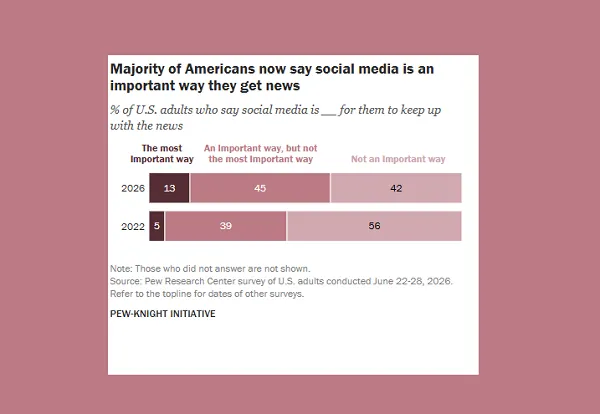
Social media platforms have officially cemented their status as a primary conduit for news and information in the United States, fundamentally altering how citizens engage with public affairs, elections, and breaking current events. According to a comprehensive report published by Pew Research on October 23, more than half of all American adults now turn to social networks as an essential source of news. This milestone reflects a dramatic upward trajectory in digital consumption habits, intensifying ongoing debates regarding platform algorithms, political polarization, free speech, and the delicate balance between open discourse and the spread of misinformation.
The Evolution of Digital News Consumption
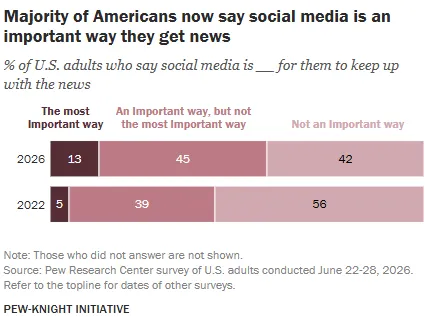
The Pew Research report, based on a nationally representative survey of over 3,500 U.S. adults conducted in June, reveals that 58% of Americans consider social media to be an important connector to current events. Within that demographic, 13% of respondents identify social applications as their single most important source of news and information. When applied to the broader U.S. adult population—estimated at approximately 270 million by the Annie E. Casey Foundation—these figures suggest that roughly 35 million Americans rely heavily on social apps to keep them informed on a daily basis.
This reliance marks a substantial leap from previous tracking data. When Pew Research conducted a similar study in 2022, 43% of U.S. adults reported that social media was an important news vehicle, while only 5% designated it as their primary resource. This rapid expansion underscores the profound influence that digital platforms wield over the public consciousness, elevating the role of tech executives, software engineers, and community guidelines to the forefront of modern democracy.
Chronology of Content Moderation and Political Friction
The debate surrounding content moderation, algorithmic amplification, and the stewardship of online speech is not new, but it has undergone a dramatic evolution over the past half-decade. Understanding the current regulatory and corporate landscape requires examining key milestones that have shaped digital platforms:
- 2021: Meta founder Mark Zuckerberg publishes a widely read note addressing the mechanics of engagement on social networks. He outlines the inherent dangers of unchecked sensationalism, warning that algorithms designed to maximize user engagement frequently reward provocative, polarizing, and borderline content, ultimately undermining the quality of public discourse.
- October 2022: Elon Musk completes his high-profile acquisition of Twitter (subsequently rebranded as X) for $44 billion. Musk justifies the purchase partly on concerns that previous management teams engaged in viewpoint discrimination and democratic interference by suppressing specific narratives and engineering algorithmic outcomes.
- December 2024: U.S. Secretary of State Marco Rubio announces formal State Department actions aimed at combating what the administration terms the "censorship-industrial complex." The initiative targets external advocacy groups and civil society actors accused of orchestrating campaigns to pressure private tech companies into censoring, demonetizing, or suppressing viewpoints they oppose.
- January 2025: In a sharp pivot from his 2021 stance, Mark Zuckerberg announces a major strategic shift for Meta. The company moves away from third-party fact-checking programs, explicitly stating an obligation to facilitate broader discussion on contentious topics and relaxing rules that previously restricted conversations surrounding sensitive issues like immigration and gender identity.
The Tug-of-War Over Free Expression and Misinformation
As social media firms evolve into the de facto town squares of the modern era, they find themselves caught between competing philosophical imperatives: protecting open, unhindered free expression versus safeguarding the public from coordinated disinformation campaigns and harmful narratives.
Historically, major platforms adopted active moderation strategies, deploying human moderators and automated tools to flag, demote, or remove content deemed misleading, hateful, or harmful. However, these policies frequently drew fierce criticism from political conservatives and free-speech advocates who argued that content moderation was routinely weaponized to silence dissenting political opinions.
This friction catalyzed the formation of the political and ideological resistance against what critics describe as the censorship-industrial complex. The December 2024 announcements by the U.S. State Department represented a formal government acknowledgment of these concerns, framing coordinated pressure campaigns against tech platforms as a threat to fundamental constitutional rights. Secretary of State Marco Rubio emphasized that American foreign policy and domestic governance must actively protect citizens from ideological gatekeeping orchestrated by elite coalitions.
Algorithmic Design and the Paradox of Engagement
Despite government pressures to open up digital platforms to all perspectives, platform architecture presents an inherent systemic challenge: engagement economics. Social media business models rely heavily on advertising revenue, which in turn depends on user attention and active engagement metrics.
Decades of behavioral research—and admissions from tech leaders themselves—demonstrate that human psychology is naturally drawn toward sensationalism, outrage, and provocative claims. Algorithms designed to maximize session times and click-through rates inevitably amplify content that triggers strong emotional reactions. Consequently, borderline claims, conspiracy theories, and highly polarizing debates frequently achieve significantly greater reach than nuanced, thoroughly verified journalistic reporting.
This reality places executives like Mark Zuckerberg in a difficult conceptual paradox. In his 2021 commentary, Zuckerberg explicitly acknowledged that leaving social networks unchecked leads to disproportionate engagement with sensationalist material, mirroring the historical trajectory of tabloids and sensational cable news, which ultimately degrades public discourse. Yet, by January 2025, Meta pivoted toward a policy of "more speech, fewer mistakes," rolling back fact-checking mechanisms and easing restrictions on controversial socio-political topics.
Industry analysts and political scientists point out a stark contradiction in this recent shift: by Zuckerberg’s own previously stated logic, relaxing moderation standards on sensitive topics will inevitably heighten societal polarization and exacerbate online harm. The pressing question facing the tech industry is why major platform architects have chosen to lean into this vulnerability precisely at a time when their networks have achieved unprecedented dominance as primary news sources.
Broader Implications for Democracy and Society
The reality that over half of American adults turn to social networks for current events carries profound consequences for civic life, journalism, and institutional trust.
First, the decentralization of news distribution has disrupted traditional journalistic gatekeeping. While legacy media outlets once served as primary filters for fact-checking and editorial rigor, social algorithms distribute information democratically and indiscriminately. A thoroughly researched investigative report from a reputable newsroom can sit side-by-side in a user’s feed with an unverified, algorithmically boosted claim generated by an anonymous account.
Second, the shifting policies of platform giants directly impact electoral integrity and public health crises. When platforms alter their stance on fact-checking, political ads, or content restrictions ahead of election cycles, the information ecosystem shifts immediately. Voters consuming news via TikTok, X, Meta properties, or YouTube are increasingly subjected to information environments shaped by corporate policy adjustments rather than traditional journalistic ethics.
Finally, the regulatory spotlight will likely intensify. As long as social media companies operate as vital public utilities while maintaining private corporate governance, lawmakers from across the political spectrum will continue to scrutinize their methodologies. Whether future interventions take the form of antitrust actions, transparency mandates, or civil liability reforms, the governance of digital speech remains one of the most volatile and consequential battlegrounds of the twenty-first century.
Ultimately, as the data from Pew Research demonstrates, social media is no longer an auxiliary tool or a passing technological novelty for news consumption. It is the central infrastructure through which modern society understands itself. How platforms balance the demands of free expression, algorithmic profitability, and civic responsibility will define the health of global public discourse for generations to come.
Related posts: