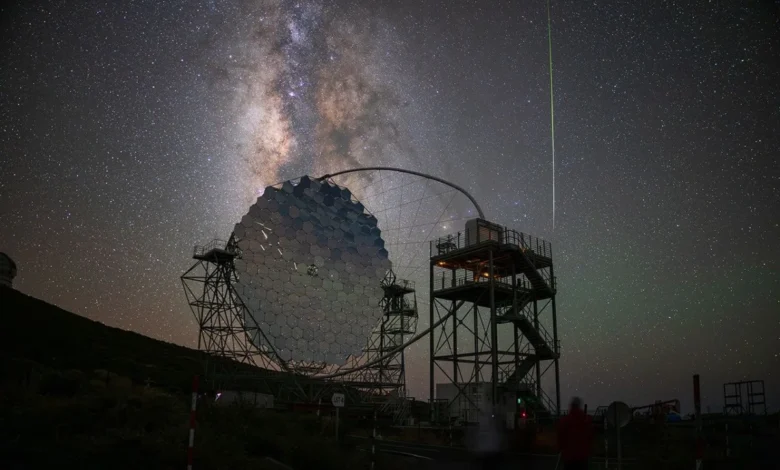
The image recently featured by NASA’s Astronomy Picture of the Day (APOD) serves as a profound visual intersection between humanity’s quest to understand the violent high-energy universe and the ephemeral beauty of the solar system. Captured on August 15, 2026, over the Observatorio del Roque de los Muchachos on the island of La Palma, Spain, the photograph depicts a brilliant Perseid meteor streaking across the star-dusted backdrop of the Milky Way, framed by the imposing 23-meter mirror of the Large-Sized Telescope (LST-1). This juxtaposition highlights not only the aesthetic wonder of the night sky but also the technical ambition behind the Cherenkov Telescope Array Observatory (CTAO), a global initiative designed to map the most extreme corners of the cosmos.
The Mechanics of the Perseid Meteor Shower
The Perseid meteor shower is one of the most reliable and prolific annual celestial events, occurring as Earth passes through the debris trail left by Comet 109P/Swift-Tuttle. This comet, which orbits the Sun every 133 years, leaves a dense stream of dust and ice particles along its path. When these particles—often no larger than a grain of sand—enter Earth’s atmosphere at velocities exceeding 59 kilometers per second (approximately 132,000 miles per hour), they undergo rapid kinetic heating.
The resulting trail of ionized gas, which glows as it dissipates, is what observers identify as a meteor. The event captured in the APOD image on August 15, 2026, was a particularly luminous example of this phenomenon. The streak was intense enough to be reflected in the individual hexagonal mirror segments of the LST-1, providing a rare moment where the ground-based instrument, designed to catch the faintest hints of cosmic gamma rays, became a participant in the local light show of our own atmosphere.
Engineering the Future: The LST-1 Telescope
The centerpiece of the image, the LST-1, is far more than a mere backdrop for night sky photography. It is the prototype for the next generation of gamma-ray astronomy. Located at an altitude of 2,200 meters, the telescope is part of the CTAO—a project involving over 1,500 scientists and engineers from 31 countries.
The LST-1 utilizes a primary mirror measuring 23 meters in diameter, comprised of 198 individual hexagonal segments. This massive surface area is required to capture the extremely faint, brief flashes of Cherenkov radiation. When a high-energy gamma ray from a distant source, such as an active galactic nucleus or a gamma-ray burst, hits the Earth’s upper atmosphere, it creates an "extensive air shower" of secondary charged particles. These particles travel faster than the speed of light in air, producing a faint, bluish glow known as Cherenkov light. This flash lasts only a few billionths of a second.
The LST-1 is engineered with a high-efficiency, pixelized camera capable of resolving these nanosecond-scale events. By focusing this light, the telescope allows researchers to reconstruct the trajectory and energy of the original gamma ray, effectively mapping the most energetic processes in the universe.
Chronology of the LST-1 Development
The development of the LST-1 represents a multi-year effort to push the boundaries of ground-based astronomy:
- 2014: The CTAO project enters the design and prototyping phase, with the LST-1 identified as the primary instrument for low-energy gamma-ray detection.
- 2018: The structural completion of the LST-1 at La Palma is marked, setting a milestone for the observatory’s northern hemisphere site.
- 2019-2022: A rigorous commissioning period follows, where the telescope’s optical systems and high-speed electronics are tested against known calibration sources, such as the Crab Nebula.
- 2023-2025: The integration of the LST-1 into the broader CTAO data pipeline begins, allowing for coordinated observations with other telescopes in the array.
- August 2026: The telescope is fully operational and integrated, during which time it captured the incidental reflection of the Perseid meteor, showcasing the high sensitivity of its reflective surfaces.
Scientific Implications of High-Energy Observations
The study of gamma rays provides a unique window into the "non-thermal" universe. Unlike traditional optical astronomy, which relies on the heat signature of stars and galaxies, gamma-ray astronomy observes the universe in its most violent states.

By detecting gamma rays from distant active galaxies, researchers can probe the environments surrounding supermassive black holes. These objects often launch relativistic jets of particles that span thousands of light-years, accelerating matter to energies far beyond what can be achieved in man-made particle accelerators like the Large Hadron Collider. Understanding these mechanisms is crucial to answering fundamental questions about the evolution of galaxies and the distribution of dark matter in the cosmos.
Furthermore, the ability of the LST-1 to observe transient events—like the gamma-ray bursts that occur when a massive star collapses or two neutron stars collide—offers a real-time look at the formation of heavy elements and the creation of extreme gravitational conditions.
Official Perspectives and Observatory Management
Representatives from the Cherenkov Telescope Array Observatory have noted that the site selection at La Palma was strategic. The location offers excellent atmospheric transparency, low light pollution, and high stability, which are critical for the sensitive measurements required for gamma-ray detection.
"The LST-1 serves as the proof-of-concept for the entire array," noted a spokesperson for the project during a recent technical update. "While our primary goal is the detection of cosmic gamma rays, the telescope’s sensitivity to light—as evidenced by the reflection of the Perseid meteor—confirms that our optical systems are functioning at peak efficiency. It is a reminder that even when looking at the most distant objects in the universe, we remain tethered to the rhythmic cycles of our own solar system."
Broader Impacts on Astronomy Communication
The inclusion of this specific image in the APOD archive underscores the importance of public engagement in large-scale scientific infrastructure projects. Astronomy Picture of the Day has served for decades as a bridge between professional researchers and the public. By moving its primary hosting to the science.nasa.gov portal, the initiative ensures that its archive of over 10,000 images remains accessible to students, educators, and the global scientific community.
The transition to the new site reflects broader trends in digital science communication, where the focus is shifting toward integrated platforms that link raw data, observational records, and educational resources. For the CTAO, which relies on public funding and international cooperation, the visibility afforded by such features is vital. It translates complex, high-energy physics into an accessible format, fostering public support for the next generation of "Big Science" projects.
Conclusion: A Convergence of Scales
The photograph of the LST-1 mirror reflecting a Perseid meteor is more than a scenic shot; it is a synthesis of scales. On one hand, we see the transient, local event of a meteoroid disintegrating in our atmosphere—a process occurring at a distance of approximately 100 kilometers. On the other hand, we see a massive instrument built to detect photons that have traveled billions of light-years across the intergalactic void.
As the Cherenkov Telescope Array Observatory continues to expand, adding more LSTs and smaller telescopes to its array, the capacity to perform this kind of high-resolution, high-energy mapping will only increase. Future observations will likely provide unprecedented insights into the life cycles of stars and the fundamental forces that govern the cosmos. Until then, images like the one from August 2026 stand as a testament to the fact that while we look to the furthest reaches of the universe for answers, the tools we use are still grounded in the wonder of our own night sky.
Related posts: