NASA’s ESCAPADE Mission Captures Striking Images of Earth and Moon During Deep Space Transit

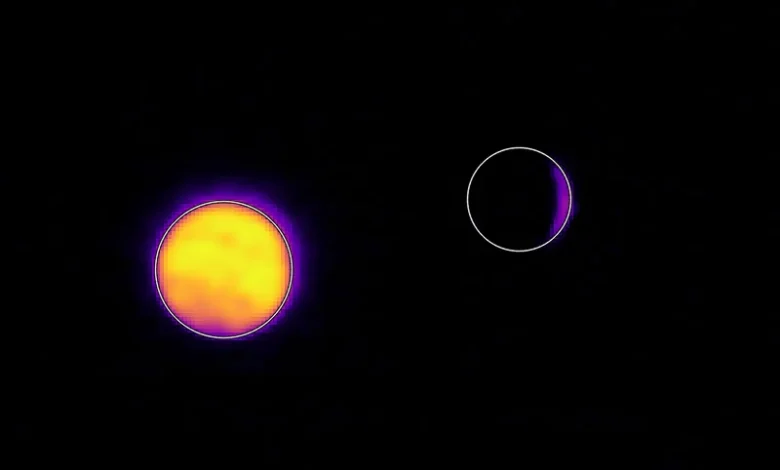
On July 3, 2024, one of the two spacecraft comprising NASA’s Escape and Plasma Acceleration and Dynamics Explorers (ESCAPADE) mission achieved a significant technical milestone by capturing high-resolution visible and thermal infrared images of the Earth-Moon system. This event occurred while the twin spacecraft were positioned deep in space, providing a unique vantage point that allowed for a dramatic perspective on our home planet and its natural satellite. At the moment of capture, the spacecraft was situated approximately 363,250 miles (584,600 kilometers) from Earth and 115,600 miles (186,100 kilometers) from the Moon. This proximity to the Moon relative to the Earth caused the lunar body to appear uncharacteristically large in the frame, offering scientists a rare opportunity to test the mission’s sophisticated imaging hardware against well-known celestial targets.
A Study in Light and Heat: Visible vs. Thermal Infrared
The images released by NASA highlight the stark contrast between how celestial bodies appear in the visible spectrum versus the thermal infrared spectrum. In the visible light images, both the Earth and the Moon appear as slender crescents. At the time of the photography, the Sun was positioned such that it illuminated only about 8% of the visible faces of both bodies. This thin sliver of light emphasizes the vastness of the shadows covering the remainder of the spheres.
However, the thermal infrared imagery tells a much more complex story. Unlike visible light, which relies on reflected solar radiation, thermal infrared imaging detects the heat emitted by the objects themselves. In these frames, the shadowed portion of the Earth remains clearly visible, glowing with the internal heat of the planet. Despite being obscured from the Sun, the Earth’s atmosphere and surface emit thermal radiation, maintaining temperatures ranging from minus 10 to minus 44 degrees Fahrenheit (approximately 250 to 280 Kelvin). This "glow" is a direct result of Earth’s thick atmosphere and its vast oceans, which act as a thermal reservoir, trapping and redistributing heat even on the night side of the planet.
In contrast, the Moon’s far side appears significantly darker and colder in the thermal infrared spectrum. Lacking an insulating atmosphere or liquid water to retain heat, the lunar surface sheds its temperature rapidly once it rotates out of direct sunlight. The thermal images recorded the Moon’s shadowed surface at a frigid minus 280 degrees Fahrenheit (100 Kelvin). This stark temperature differential between the two bodies provides essential data for the mission’s scientists, serving as a real-world demonstration of planetary thermodynamics.
The VIROS System: More Than a Camera
The images were captured using the Visible and Infrared Observation System (VIROS), a suite of specialized cameras developed by Northern Arizona University in Flagstaff. While the photos are visually stunning, their primary purpose is scientific and technical. For the ESCAPADE team, these images serve as a critical "calibration check." Because the radiance and thermal signatures of the Earth and Moon are well-documented by decades of satellite observation, they provide a "standard candle" against which the new VIROS instruments can be measured.
Rob Lillis, the mission’s principal investigator at the University of California, Berkeley’s Space Sciences Laboratory, emphasized the importance of this milestone. "We are thrilled that ESCAPADE was able to accommodate these excellent space-qualified cameras which will search for visible Martian aurora and investigate thermal properties of the Martian surface and atmosphere," Lillis stated. "Since Earth and the Moon are well-known targets, imaging them provides an important calibration check for ESCAPADE’s cameras."
By confirming that the cameras can accurately detect the subtle thermal variations of Earth and the harsh cold of the Moon, the team ensures that the instruments will be ready to perform their primary task: analyzing the thin, tenuous atmosphere of Mars and the mysterious glows of Martian auroras.
The ESCAPADE Mission: Objectives and Design
ESCAPADE is a dual-spacecraft mission—the two identical satellites are colloquially known as "Blue" and "Gold," a nod to the colors of UC Berkeley. The mission is part of NASA’s Small Innovative Missions for Planetary Exploration (SIMPLEx) program, which aims to conduct high-quality planetary science using low-cost, small-scale spacecraft.
The primary scientific goal of ESCAPADE is to understand the "space weather" around Mars. Unlike Earth, Mars does not have a global magnetic field to protect it from the solar wind—a constant stream of charged particles (plasma) flowing from the Sun at speeds exceeding one million miles per hour. Scientists believe that over billions of years, this solar wind has stripped away the Martian atmosphere, transforming it from a potentially habitable world with liquid water into the arid desert it is today.
By using two spacecraft instead of one, ESCAPADE will be able to perform "multipoint" measurements. This allows scientists to see how the solar wind changes in both time and space simultaneously. One spacecraft can measure the incoming solar wind while the other measures the response of the Martian ionosphere, providing a 3D perspective on how the planet loses its atmosphere to space.
Spacecraft Heritage and Current Status
The ESCAPADE spacecraft were designed and built by Rocket Lab, utilizing their versatile "Photon" satellite bus. The Photon platform is designed for deep-space missions, providing the necessary power, propulsion, and communication systems to sustain a multi-year journey to the Red Planet.
Currently, the two spacecraft are in what mission controllers call a "loiter" orbit. They are positioned near Lagrange point 2 (L2), a gravitationally stable point in space located about one million miles from Earth. This parking orbit allows the mission team to conduct thorough checkouts of all onboard systems, including the VIROS cameras and the plasma-sensing instruments, while waiting for the optimal planetary alignment for the journey to Mars.
The Road to the Red Planet: Timeline and Trajectory
The journey to Mars is a complex orbital ballet that requires precise timing. The current mission timeline is as follows:
- July 2024: Completion of initial instrument calibration and deep-space imaging of the Earth-Moon system.
- Present – November 2026: Continued operations in the loiter orbit at L2, performing system health checks and monitoring the deep-space environment.
- November 2026: The spacecraft will execute a critical maneuver to leave their loiter orbit and return toward Earth. They will perform a gravity-assist flyby, using Earth’s gravitational pull as a "slingshot" to gain the necessary velocity to reach Mars.
- September 2027: The twin spacecraft are scheduled to arrive at Mars. Upon arrival, they will enter a highly elliptical orbit, which will eventually be circularized to allow for consistent scientific observations.
- 2027 – 2028: Primary science mission begins, focusing on the interaction between the solar wind and the Martian magnetosphere.
Collaborative Innovation in Planetary Science
The ESCAPADE mission represents a broad collaboration between academic institutions, government agencies, and private aerospace companies. While the University of California, Berkeley’s Space Sciences Laboratory leads the mission, it is supported by a robust network of partners:
- Rocket Lab: Responsible for the design, manufacture, and operation of the two Photon spacecraft.
- NASA Goddard Space Flight Center: Provides mission management and technical oversight.
- Northern Arizona University: Developed the VIROS imaging system.
- Embry-Riddle Aeronautical University: Contributes to the scientific analysis of plasma data.
- Blue Origin: Designated as the launch provider, with the mission slated to be one of the early payloads for the New Glenn heavy-lift rocket.
- Advanced Space: Assists with navigation and trajectory design.
The mission is funded by NASA’s Heliophysics Division, reflecting the cross-disciplinary nature of the research. While the destination is another planet, the science is rooted in understanding the Sun’s influence on the solar system.
Implications for Future Exploration
The success of the ESCAPADE calibration maneuvers bodes well for the future of "SmallSat" planetary exploration. Historically, Mars missions have been massive, multi-billion-dollar endeavors. ESCAPADE demonstrates that focused, high-impact science can be achieved with smaller, more agile spacecraft.
Understanding atmospheric loss on Mars has direct implications for our understanding of planetary habitability. If scientists can pinpoint the exact mechanisms by which the solar wind strips away an atmosphere, they can better predict the life cycles of exoplanets orbiting other stars. Furthermore, as NASA prepares for the human exploration of Mars via the Artemis and Moon to Mars programs, understanding the radiation and plasma environment of the Red Planet is essential for the safety of future astronauts.
As "Blue" and "Gold" continue their silent vigil at the L2 point, these first images of home serve as a poignant reminder of the mission’s origin. The thin crescents of the Earth and Moon, captured in both the light we see and the heat we feel, are the first steps in a journey that promises to unlock the ancient secrets of the Martian atmosphere. With the VIROS cameras now proven and calibrated, the ESCAPADE team looks forward to 2026, when the spacecraft will finally turn their gaze away from Earth and begin their long-awaited sprint toward the Red Planet.
Related posts: