NASA Twin ESCAPADE Spacecraft Successfully Complete Powered Earth Flybys and Set Course for Mars

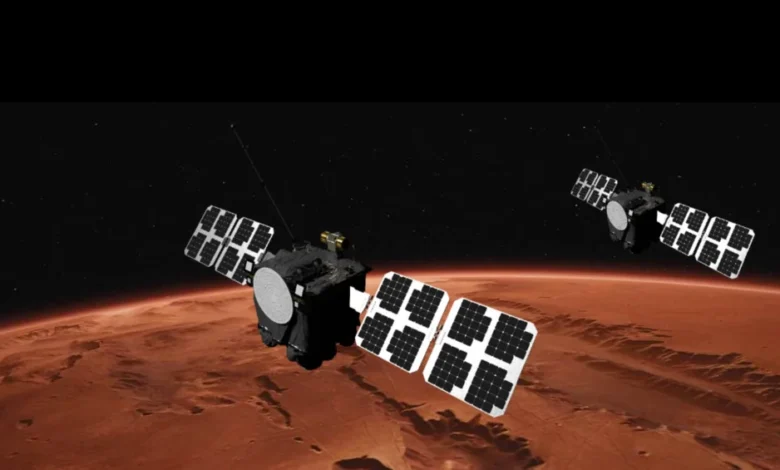
In a historic milestone for interplanetary navigation, NASA’s twin ESCAPADE spacecraft are officially hurtling toward Mars following a pair of flawless, high-stakes Earth flybys. The maneuvers, which utilized an advanced rocket science principle to maximize velocity, mark the first time the United States space agency has ever used a powered Earth flyby to propel hardware on a trajectory to the Red Planet.
The successful completions of these gravity-assisted velocity boosts bring an innovative, low-cost mission architecture closer to fruition. They also offer a potential blueprint for future interplanetary smallsat missions that seek to break free from the traditional, rigid launch windows that have constrained deep-space exploration for decades.
High-Speed Encounters: The Journey of Blue and Gold
The twin spacecraft—collectively known as ESCAPADE, which stands for Escape and Plasma Acceleration and Dynamics Explorers—executed their respective planetary close approaches in early November, nearly a full year after lifting off from Earth.
The second of the twin probes, nicknamed "Gold" and built by aerospace manufacturer Rocket Lab, swept past Earth at approximately 6:00 a.m. Eastern Time on November 9. Plunging into the upper reaches of the terrestrial atmosphere’s gravitational well, Gold reached a periapsis of roughly 1,050 kilometers above the planet’s surface.
This dramatic flyby occurred just over 48 hours after its sibling spacecraft, "Blue," executed a similar orbital dance. On November 7, Blue skimmed past Earth at a slightly higher altitude of approximately 1,600 kilometers.
During both encounters, the spacecraft executed critical main-engine burns at the precise point of closest approach. By firing their propulsion systems deep within Earth’s gravity well, the spacecraft leveraged the Oberth effect—a physical phenomenon where a rocket engine operating at high speed (and thus high kinetic energy) yields vastly more useful mechanical energy than the same engine operating at lower speeds.
For the flight control and navigation teams overseeing the mission, these burns were as nerve-wracking as they were vital. Because of the extreme precision required to sling the spacecraft toward an intercept course with Mars, any deviation in the burn duration or trajectory vector could have doomed the mission.
"This is the first time NASA has used a powered Earth flyby to propel a spacecraft toward Mars, and we’ve now executed this maneuver twice, flawlessly, in just two days," remarked Asal Naseri, acting associate flight director in NASA’s heliophysics division, in an official agency statement.

Rob Lillis, the principal investigator for ESCAPADE at the University of California, Berkeley Space Sciences Lab, echoed this sentiment during a presentation to the Mars Exploration Program Analysis Group. "These burns were critical in the same way a Mars orbit insertion burn is," Lillis noted. "I’m happy to report that they went well. They were executed perfectly."
A Nontraditional Trajectory: Breaking Free from Rigid Launch Windows
The success of the ESCAPADE flybys validates a revolutionary approach to interplanetary mission design. Historically, missions to Mars have been shackled by the geometry of planetary alignments. Because Earth and Mars revolve around the sun at different speeds and orbital radii, optimal launch windows—when the planets are properly positioned to minimize the fuel required for a direct transit—open up only once every 26 months, or roughly every two years. Missing one of these windows means waiting years for another opportunity.
To circumvent this limitation, the trajectory design team at Advanced Space devised an unconventional path for ESCAPADE. Instead of launching directly toward Mars during a traditional window, the twin spacecraft launched on November of the previous year aboard the second flight of Blue Origin’s heavy-lift New Glenn rocket.
Rather than heading immediately to the Red Planet, the smallsats entered a prolonged cruise phase, loitering near the Earth-Sun Lagrange Point 2 (L2)—a gravitationally stable point located roughly 1.5 million kilometers away from Earth in the direction opposite the sun. There, the probes spent nearly a year in a holding pattern before executing the orbital mechanics required to swing back toward Earth for their November gravity assists.
This multi-year, loitering trajectory paradigm was deliberately engineered to unlock new flexibility. "This method provides the flexibility to launch almost anytime and then use Earth’s gravity to get a boost to Mars, rather than waiting every two years to launch there directly when the planets are aligned," explained Jeff Parker of Advanced Space. By decoupling Mars missions from strict two-year synodic periods, space agencies and commercial providers can plan interplanetary architectures with far greater frequency and resilience.
Timeline and Upcoming Milestones
With the Earth flybys now successfully behind them, the ESCAPADE twins are firmly established on their interplanetary highways. The spacecraft are currently projected to arrive at Mars in September 2027, touching down on their destination’s doorstep just two days apart.
Upon arrival, each spacecraft will be required to execute another high-stakes, 11-minute main-engine burn to brake against the Martian gravitational field and slip into orbit. Following successful orbit insertion, the probes will spend additional weeks trimming their trajectories to reach their final, highly coordinated science orbits.
Once stationed around Mars, the twin spacecraft will embark on their primary scientific mission: investigating space weather in the Martian environment. Specifically, the mission aims to study how the relentless stream of charged particles known as the solar wind interacts with the planet’s tenuous, localized magnetic fields and upper atmosphere.
During the initial phase of observations, both spacecraft will operate within the same orbital plane, trailing one another by up to 30 minutes. This synchronized tandem flight will allow scientists to measure temporal variations in space weather, distinguishing between spatial changes and changes occurring over time. Later in the mission, the twins will shift into complementary, independent orbits. One spacecraft will act as a sentinel positioned to monitor the incoming, undisturbed solar wind, while the other will measure the direct atmospheric and magnetic consequences of that solar wind hitting Mars. Researchers hope these insights will help explain how Mars lost much of its primordial atmosphere and water over billions of years.

Context, Challenges, and the Future of the SIMPLEx Program
Despite the triumphant execution of the Earth flybys, the path to this juncture has not been without turbulence. ESCAPADE represents the final surviving mission within a class of planetary exploration initiatives known as SIMPLEx, or Small Innovative Missions for Planetary Exploration.
Launched by NASA to foster low-cost, high-frequency planetary science investigations using small satellite platforms, the SIMPLEx program has faced severe headwinds. NASA originally selected ESCAPADE for development in 2019, bundling it alongside two other distinct missions: the Janus asteroid flyby smallsat and the Lunar Trailblazer lunar orbiter.
However, the broader portfolio has suffered a cascade of programmatic setbacks. In 2023, NASA was forced to formally cancel the Janus mission. Janus had originally been designed as a secondary rideshare payload attached to the launch of the Psyche asteroid mission; when Psyche experienced persistent launch delays, Janus missed its narrow window to perform its scheduled deep-space asteroid flybys.
The bad luck continued into 2025. The Lunar Trailblazer orbiter—designed to map water ice on the Moon—suffered a critical spacecraft bus malfunction shortly after its launch in February 2025. Despite months of exhaustive troubleshooting and telemetry recovery efforts by engineers on the ground, the mission could not be saved, and NASA formally wrote off Lunar Trailblazer five months after launch.
These high-profile losses compound earlier failures within the cubesat tier of the SIMPLEx program, such as the LunaH-Map and Q-PACE missions, both of which suffered debilitating post-launch anomalies. Caught in an era of tightening fiscal constraints and competing budgetary priorities within NASA’s Planetary Science Division, agency officials have suspended new solicitations for future SIMPLEx mission classes, leaving open questions about the future pipeline for dedicated low-cost planetary smallsats.
Broader Implications for Deep Space Exploration
Against the backdrop of a struggling smallsat portfolio, the success of the ESCAPADE flybys shines as a beacon of engineering resilience. By proving that twin, cost-effective spacecraft can utilize complex, multi-year, powered gravity-assist trajectories to reach another planet outside of traditional windows, the mission provides a vital proof-of-concept.
If ESCAPADE successfully completes its orbital insertion in late 2027 and delivers its expected haul of heliophysics data, the mission may permanently alter how mission architects design interplanetary missions. The ability to launch payloads into deep-space holding patterns and wait for optimal Earth-return gravity assists could democratize access to the outer and inner solar system. For commercial launch providers like Blue Origin and innovative navigation designers like Advanced Space, the triumphant maneuvers over Earth signal that a new, more flexible era of deep-space logistics has officially begun.