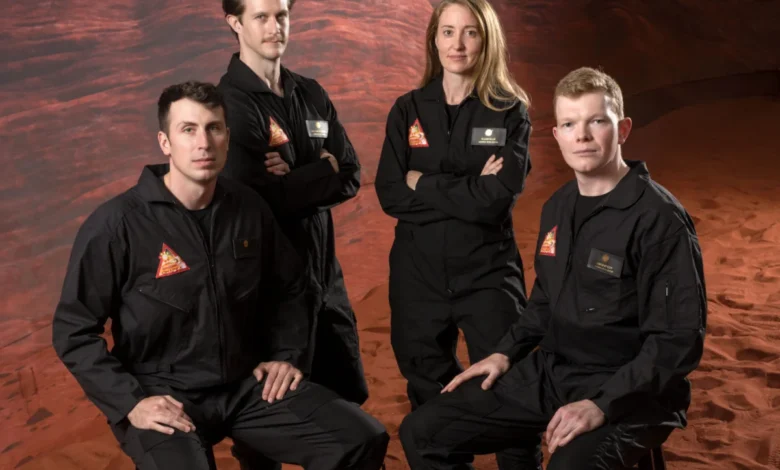
On Saturday, October 31, a cohort of four volunteers will emerge from the Crew Health and Performance Exploration Analog (CHAPEA) facility in Houston, marking the conclusion of a rigorous 378-day isolation experiment. This milestone represents a critical step in NASA’s ongoing efforts to prepare human explorers for the physiological and psychological rigors of long-duration missions to Mars. The crew—Ross Elder, Ellen Ellis, James Spicer, and Matthew Montgomery—have spent over a year within the confines of a 1,700-square-foot, 3D-printed habitat, simulating the isolation, resource constraints, and operational challenges inherent in deep space exploration.
The CHAPEA Mission Framework
The CHAPEA program is designed to provide NASA with high-fidelity data regarding how small crews adapt to the extreme conditions of planetary surface operations. By replicating the stressors of a Mars environment, the agency can stress-test its systems and, more importantly, its support protocols. The current mission, which commenced on October 19, 2025, serves as the second iteration of these analogs.
The facility itself is a marvel of modern engineering, constructed using 3D-printing technology to mimic the potential for building habitats on other worlds using local materials. Inside, the crew engaged in a daily routine that mirrored a true Martian expedition: they conducted simulated spacewalks, managed complex life-support maintenance, cultivated experimental crops, and adhered to strict dietary and exercise regimens. Throughout their stay, they operated under significant communication delays—up to 20 minutes each way—to mirror the light-speed lag between Earth and Mars, forcing the crew to rely on autonomy and pre-programmed operational protocols.
Chronology of the 378-Day Odyssey
The trajectory of the CHAPEA Mission 2 mission was carefully calibrated to simulate the full arc of a deep-space expedition.
- October 19, 2025: The four crew members entered the CHAPEA habitat, initiating the 378-day isolation period.
- Months 1–6 (The Adjustment Phase): The initial months were dedicated to establishing a baseline for metabolic, cognitive, and social health. The crew acclimated to the artificial environment, focusing on habitat maintenance and the initial setup of indoor agricultural experiments.
- Months 7–10 (The Stress-Testing Phase): As the mission progressed, mission control introduced “off-nominal” events—simulated equipment failures, medical emergencies, and unexpected logistical hurdles. These scenarios were designed to test the resilience of the crew’s decision-making processes under sustained pressure.
- October 31, 2026 (The Extraction): Following over a year of total separation from the outside world, the crew will transition back to terrestrial life, providing researchers with the final set of longitudinal data regarding their health and performance.
Scientific Objectives and Data Collection
The primary objective of the CHAPEA mission is to collect data that cannot be simulated through mathematical models alone. NASA researchers are particularly interested in the "human factor"—the intersection of physical health, cognitive endurance, and interpersonal dynamics in a confined space.
"The data collected from these missions is the bedrock upon which we build our safety standards for Artemis and future crewed Mars missions," says a representative from the NASA Johnson Space Center. By monitoring the crew’s food intake, exercise efficiency, and psychological markers, medical teams are refining the "Spaceflight Human System Standard." These standards govern everything from the caloric density of space rations to the frequency and type of psychological support required for long-duration missions.
One significant area of analysis is the "Deep Space Network" (DSN) bandwidth utilization. By simulating the constraints of interplanetary communication, NASA is learning how to better prioritize data packets, ensuring that critical telemetry and mission-essential information take precedence over crew personal communications during high-latency periods.
The Significance of the Artemis Connection
While the CHAPEA mission is explicitly focused on a Martian paradigm, the implications for the Artemis program are immediate. Artemis aims to establish a permanent human presence on the Moon, which will serve as a training ground for the eventual transit to the Red Planet.
The logistical lessons learned—such as how to efficiently manage waste, recycle water, and maintain complex hardware without external parts—are directly applicable to the Lunar Gateway and the lunar base camps planned for the next decade. If the crew can survive for 378 days in a 1,700-square-foot facility in Houston, the confidence in their ability to endure a multi-year Mars transit increases exponentially.
Official Procedures for Mission Conclusion
NASA has scheduled a public exit ceremony beginning at 3:00 p.m. EDT on October 31. The event will feature remarks from Johnson Space Center Director Vanessa Wyche and NASA astronaut Jack Hathaway. The crew members themselves will provide a debrief on their experiences, offering a human perspective on the data points that have defined their year.
For the media, this conclusion offers a rare look at the immediate transition of human subjects from a simulated planetary environment back to the terrestrial biosphere. Subject matter experts will be on-site to discuss the physiological shifts—such as changes in bone density, muscle atrophy, and circadian rhythm disruptions—that researchers monitored throughout the duration of the mission.
Behavioral and Psychological Implications
Psychologists monitoring the CHAPEA mission have been particularly focused on "third-quarter phenomenon," a common observation in long-duration isolation where motivation and interpersonal harmony can dip after the novelty of the mission wears off and the end is not yet in sight. Understanding these fluctuations is vital for flight surgeons and behavioral health specialists.
The findings from this mission will likely lead to new protocols for pre-flight psychological screening and in-mission support. If, for instance, the data shows that specific types of lighting or exercise intervals correlate with improved mood and cognitive performance, those findings will be codified into the standard operating procedures for all future deep-space missions.
Looking Toward the Horizon
As the CHAPEA Mission 2 crew prepares to step outside, the broader scientific community acknowledges that their sacrifice has provided a roadmap for the next generation of space exploration. The data gathered here serves as a bridge between the theoretical challenges of interplanetary travel and the practical, gritty reality of living off-world.
The information gathered from this year of isolation will be processed and integrated into mission architectures over the coming years. Whether it is optimizing the food system to minimize waste or refining the behavioral support systems that keep crews cohesive, the CHAPEA mission has proved that human performance in space is not just about the hardware—it is about the human spirit’s capacity to adapt, endure, and persist in the most unforgiving environments imaginable.
For those interested in the ongoing results of these studies, NASA continues to provide updates and technical documentation through its dedicated CHAPEA portal. As the doors open on October 31, the world will watch four individuals step back into the light, having spent a year in the dark, all for the sake of ensuring that the next time humans walk on a foreign surface, they do so with the full support and knowledge of a civilization standing behind them.
Related posts: