NASA Psyche Mission Successfully Navigates Mars Gravity Assist and Validates Science Instruments Ahead of 2029 Asteroid Rendezvous

The National Aeronautics and Space Administration’s Psyche mission has reached a pivotal milestone in its multi-year journey to the outer main asteroid belt, successfully completing a high-stakes gravity-assist maneuver at Mars. This orbital "slingshot" not only accelerated the spacecraft toward its ultimate destination—the metal-rich asteroid 16 Psyche—but also served as a critical live-fire test for the probe’s sophisticated suite of scientific instruments. After months of meticulous data downlink and analysis following the May encounter, mission scientists have confirmed that the spacecraft is in peak health, with its sensors performing exactly as designed.
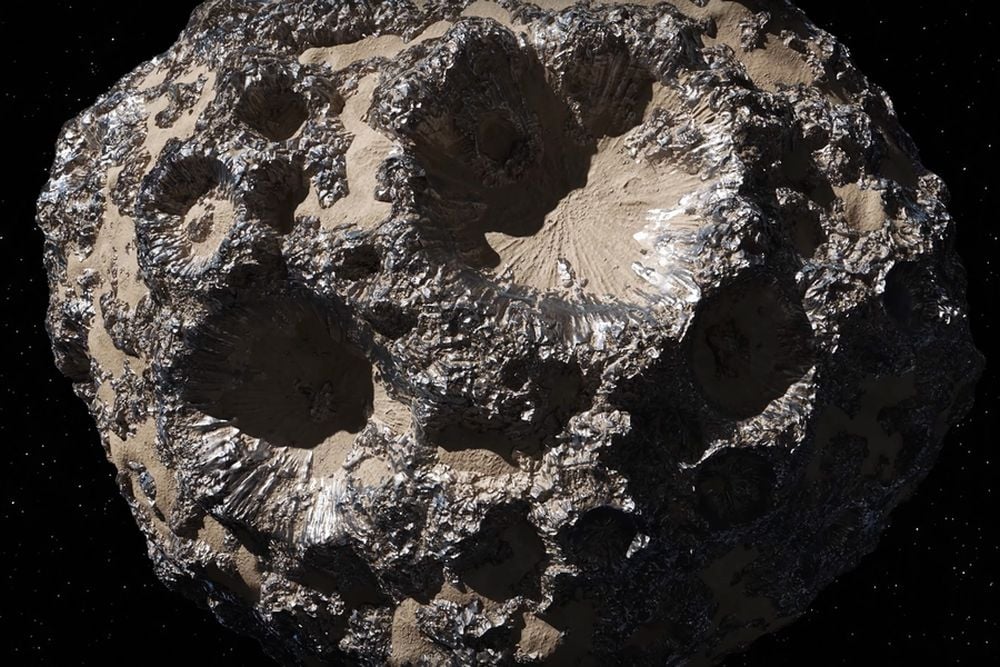
Launched in October 2023 from the Kennedy Space Center atop a SpaceX Falcon Heavy rocket, the Psyche mission represents a journey to a unique world. Unlike most asteroids that are composed primarily of rock or ice, 16 Psyche is believed to be composed largely of metal, specifically iron and nickel. This composition has led planetary scientists to hypothesize that the asteroid may be the exposed metallic core of a "protoplanet"—a building block of a planet that had its outer rocky layers stripped away by violent collisions during the chaotic early days of the solar system’s formation. By studying 16 Psyche, NASA aims to gain a proxy view into the inaccessible cores of terrestrial planets like Earth, Mars, and Venus.
The Mars Gravity Assist: Precision in Deep Space
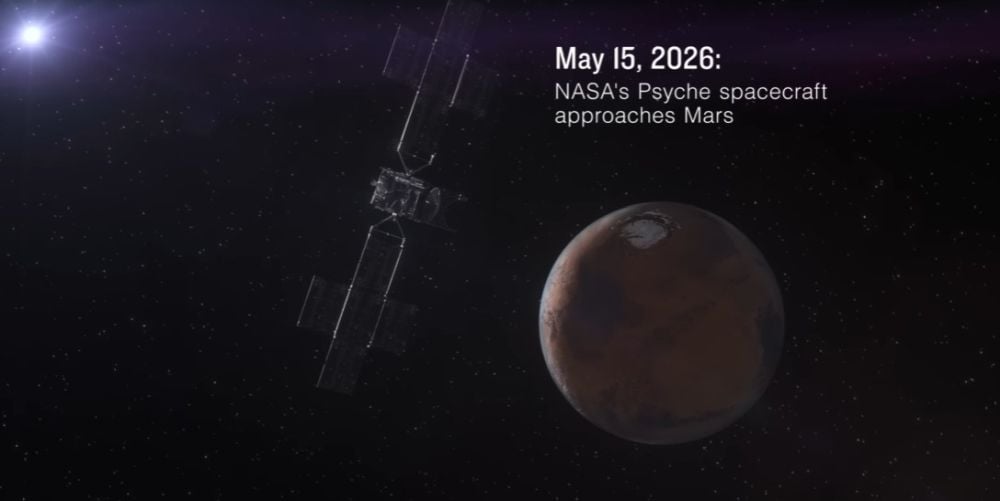
The trajectory required to reach the main asteroid belt, located between Mars and Jupiter, necessitates immense velocity. To achieve this without carrying an prohibitive amount of chemical fuel, mission navigators utilized the gravitational pull of the Red Planet. On its closest approach in May, the Psyche spacecraft swept within approximately 3,500 kilometers (2,200 miles) of the Martian surface.
This maneuver served two primary purposes: it provided a significant "kick" to the spacecraft’s speed and subtly altered its flight path to align with the orbit of 16 Psyche. "This gravity assist was years in the making, and the navigation team nailed it," stated Bob Mase, Psyche’s project manager at NASA’s Jet Propulsion Laboratory (JPL) in Southern California. "Psyche flew by Mars on exactly the trajectory we needed to set us on a path to rendezvous with the asteroid in the summer of 2029."
Beyond the navigational benefits, the flyby offered the mission team their first opportunity to activate and calibrate the spacecraft’s instruments against a known planetary body. While the primary mission objective is an asteroid, the data collected at Mars provides a baseline for comparison, ensuring that when the probe arrives at its target in five years, its measurements will be accurate and reliable.
Validating the Magnetometer: Mapping the Martian Bow Shock
One of the most critical components of the Psyche payload is its magnetometer. Because 16 Psyche is suspected to be a remnant core, it may possess a "frozen" magnetic field—remnant magnetism trapped in the metal as the core cooled billions of years ago. Detecting this field would provide definitive proof of the asteroid’s protoplanetary origins.
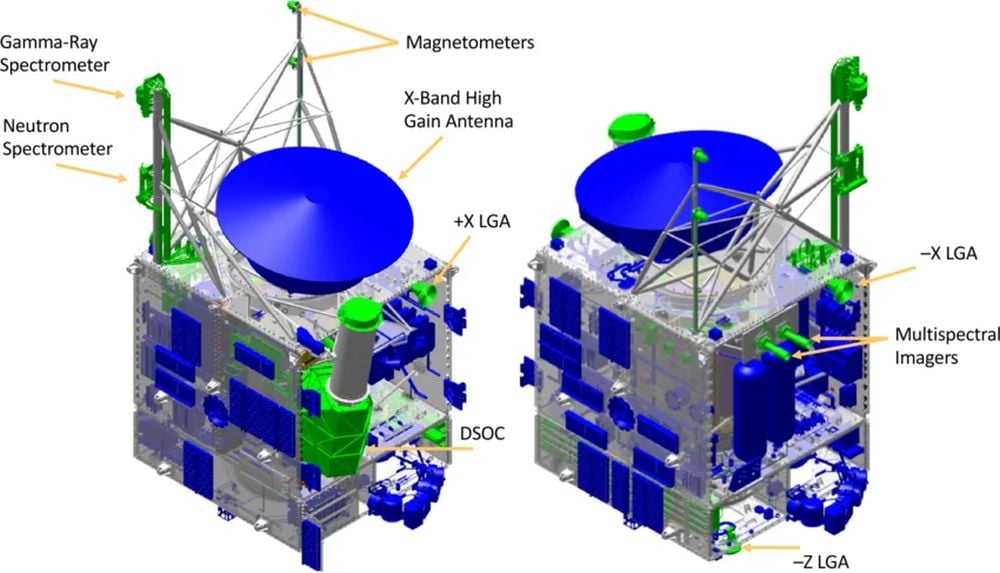
The magnetometer on Psyche is a highly specialized "gradiometer" system. It consists of two identical, high-sensitivity sensors mounted on a 2.15-meter (7-foot) boom. This dual-sensor configuration is essential for deep-space missions; by placing one sensor closer to the spacecraft and the other further away, the mission team can subtract the magnetic "noise" generated by the spacecraft itself, leaving only the pure magnetic signature of the target body.
During the Mars flyby, the magnetometer was put to the test as the spacecraft passed through the Martian "bow shock"—the region where the solar wind, a stream of charged particles from the sun, first interacts with the planet’s magnetic environment. "As the spacecraft passed close to Mars, the magnetometer saw an intense uptick in magnetic field corresponding to the bow shock region," explained Ben Weiss, Psyche’s deputy principal investigator and the magnetometry lead at the Massachusetts Institute of Technology (MIT). "This flyby calibration effort validated the instrument’s performance under dynamic conditions while also revealing the fascinating physics of planetary magnetism."
Multispectral Imaging: From Mars Craters to Asteroid Moonlets
While the magnetometer probed the invisible fields around Mars, the mission’s multispectral imager was busy capturing high-resolution data of the planet’s surface. The imager is designed to take photos in various wavelengths of light, allowing scientists to distinguish between metallic and silicate (rocky) materials. This capability will be vital at 16 Psyche to map the distribution of metals and minerals across the asteroid’s surface.
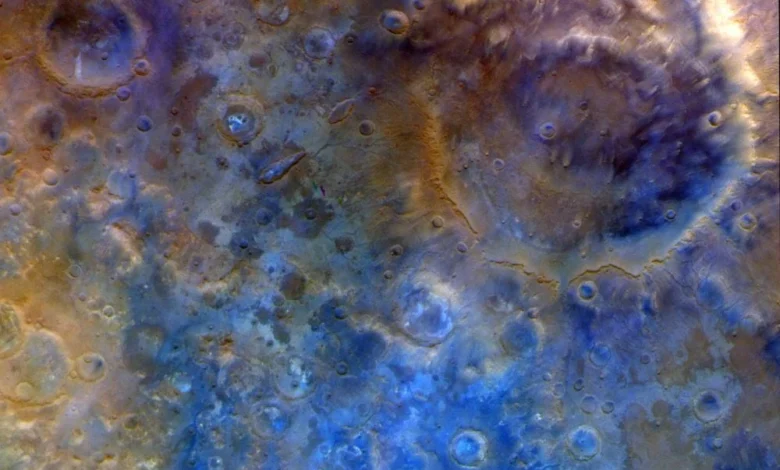
During the flyby, the imager captured stunning views of the Huygens crater, a massive 450-kilometer-wide impact basin characterized by its double-ringed structure. The images revealed subtle color variations that indicate different rock compositions within the Martian crust.
Crucially, the team also used the encounter to practice searching for "moonlets"—small natural satellites that might be orbiting 16 Psyche. Using Mars’ moons, Phobos and Deimos, as test subjects, the imager team proved they could identify small, dim objects against the backdrop of space even from great distances.
"The imager performed brilliantly, delivering some rarely seen views of the Red Planet," said Jim Bell, the Psyche imager instrument lead at Arizona State University. "Besides the obvious beauty of the photos, we were also able to fully test its calibration and sensitivity to scattered light, including picking out the Martian moons Phobos and Deimos from very far away as a part of a practice for the satellite search."
The Gamma-Ray and Neutron Spectrometer (GRNS)
Rounding out the primary science suite is the Gamma-Ray and Neutron Spectrometer. This instrument is designed to detect the elemental composition of the asteroid’s surface. When cosmic rays hit an asteroid, they cause the surface to emit gamma rays and neutrons. By analyzing the energy of these emissions, the GRNS can identify the specific atoms present, such as iron, nickel, silicon, and potassium.
While Mars has been extensively mapped by previous missions, the Psyche GRNS team used the flyby to ensure the instrument could successfully filter out the "background noise" of the spacecraft and capture clear signals from a planetary body. Lindy Elkins-Tanton, principal investigator for Psyche at Arizona State University (formerly at UC Berkeley), noted that while the team didn’t expect to make groundbreaking new discoveries about Mars, the data collected provided a "unique perspective" that complements existing Martian science.
Chronology of the Psyche Mission
The road to 16 Psyche has been a decade-long endeavor, marked by technical challenges and a rigorous flight schedule:
- January 2017: NASA selects the Psyche mission as part of its Discovery Program.
- 2017–2022: Design and fabrication phases. The mission faced a one-year delay in 2022 due to software testing issues.
- October 13, 2023: Successful launch from Kennedy Space Center on a SpaceX Falcon Heavy.
- Late 2023 – Early 2024: Initial checkout phase and testing of the Deep Space Optical Communications (DSOC) technology, a laser-based communication system.
- May 2024: Mars gravity assist and instrument calibration phase.
- Fall 2024: Resumption of sustained thrusting using the spacecraft’s Solar Electric Propulsion (SEP) system.
- 2024–2029: Long-duration cruise through the main asteroid belt.
- August 2029: Arrival at 16 Psyche and start of orbital operations.
- 2029–2031: Primary science mission, orbiting the asteroid at progressively lower altitudes.
Scientific Analysis: Why 16 Psyche Matters
The scientific community remains divided on the true nature of 16 Psyche. While the "exposed core" hypothesis is the most prominent, recent ground-based observations using the Atacama Large Millimeter/submillimeter Array (ALMA) and other telescopes have suggested alternative possibilities. Some researchers argue that the asteroid might be a "rubble pile"—a collection of metallic and rocky fragments held together by gravity—or perhaps a world that experienced "ferrovolcanism," where molten iron erupted from a cooling interior.
The density of the asteroid is a key metric in this debate. Current estimates suggest 16 Psyche contains about 1% of the total mass of the entire asteroid belt. If it were pure solid metal, its density would be much higher than what has been observed. This suggests the asteroid may have significant porosity or a mix of metal and silicate materials.
"We are going to a world that humans have never seen up close," Elkins-Tanton remarked. "The data we are collecting now during the cruise and the Mars flyby is the foundation upon which we will build our understanding of how planets are born."
Future Outlook: The Long Cruise to 2029
With the Mars flyby successfully concluded, the Psyche spacecraft is entering a "sustained thrust" phase. Unlike traditional rockets that burn fuel in short, powerful bursts, Psyche utilizes Hall-effect thrusters—a form of solar-electric propulsion. These thrusters use electricity generated by the spacecraft’s massive solar arrays to ionize xenon gas, creating a gentle but constant stream of thrust. Over years, this efficient propulsion system will accelerate the probe to the high speeds necessary to catch the asteroid.
The spacecraft is currently reported to be in "great shape," with all systems functioning within nominal parameters. As it moves further from the sun, the team will continue to monitor the degradation of the solar panels and the health of the onboard computers.
The successful validation of the magnetometer and imager at Mars has provided a significant boost in confidence for the mission teams. The data analyzed over the last several months confirms that the spacecraft’s "eyes" and "ears" are ready for the dark, metal-rich environment of the main belt. When Psyche finally enters orbit in 2029, it will descend to within 75 kilometers of the surface, providing humanity with its first detailed look at a world made of metal—a journey that is as much about understanding our own planet’s deep interior as it is about exploring the reaches of space.
Related posts: