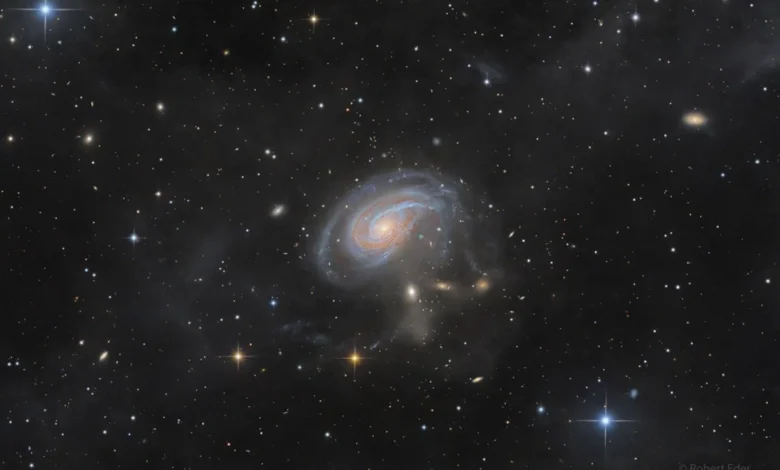
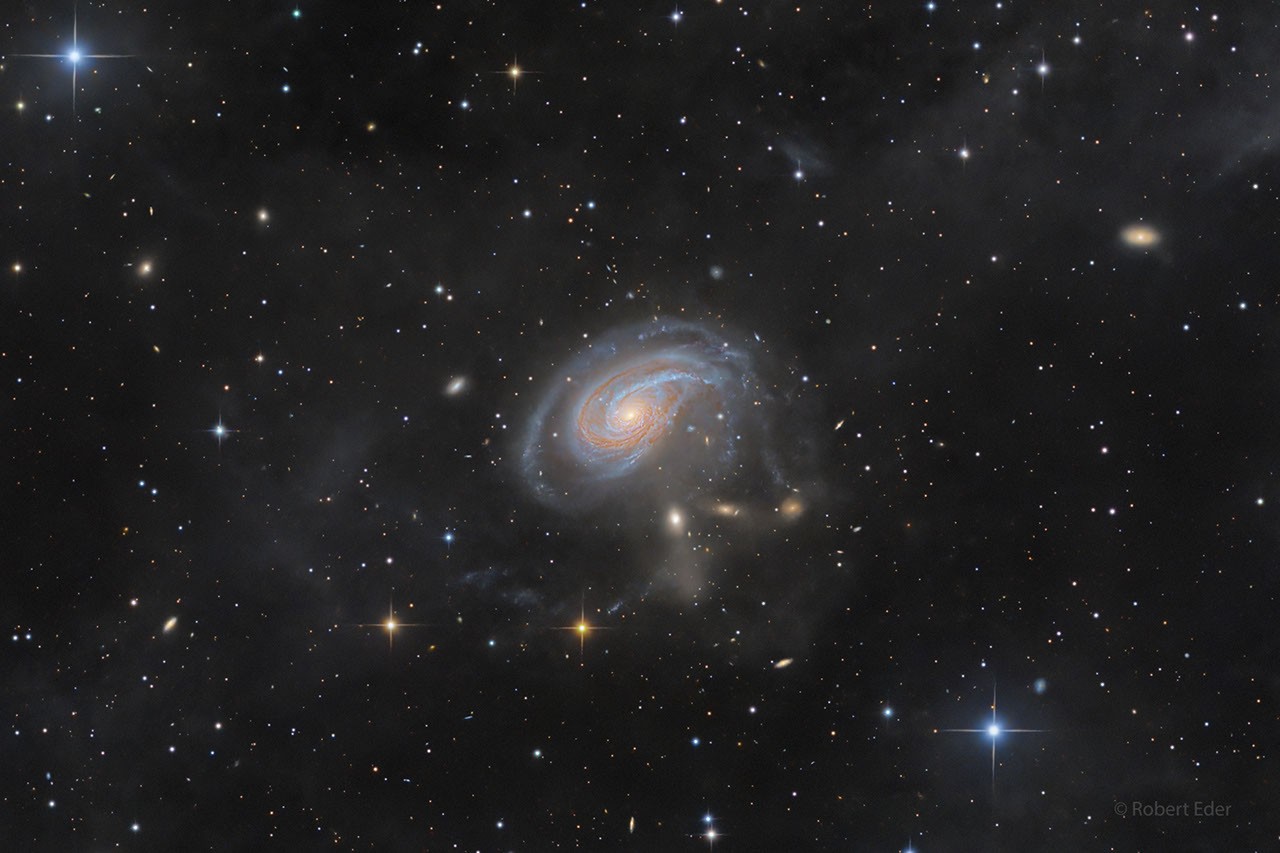
Deep within the celestial boundaries of the constellation Aries, a cosmic drama of immense proportions is unfolding, captured in high resolution by astrophotographer Robert Eder. Known to astronomers as Arp 78, or NGC 772, this peculiar spiral galaxy serves as a stark reminder of the dynamic, often violent nature of the universe. Located approximately 100 million light-years from our own Milky Way, this island universe spans an impressive 200,000 light-years—nearly double the diameter of our own galaxy—and offers a masterclass in the effects of gravitational interaction on galactic structure.
The image, featured recently by NASA’s Astronomy Picture of the Day (APOD), highlights the striking asymmetry of NGC 772. While most spiral galaxies exhibit a degree of symmetry, Arp 78 is defined by a prominent, overdeveloped spiral arm that reaches out into the void, a feature brought into sharp relief by sweeping lanes of dark dust and the brilliant, youthful glow of blue star clusters.
The Physics of Galactic Interaction
The primary driver behind the irregular appearance of NGC 772 is a phenomenon known as tidal interaction. Galaxies are not static structures; they exist in a perpetual state of gravitational influence. In the case of Arp 78, the primary culprit is its smaller, more compact companion, NGC 770.
Located directly below the larger spiral in the telescopic field, NGC 770 presents a stark contrast to its neighbor. While NGC 772 is a sprawling, active spiral, NGC 770 appears as a fuzzy, elliptical galaxy. The gravitational tether between these two bodies has pulled material away from the larger galaxy, stretching it into the distorted, extended arm seen in current imaging. This process is not merely a visual curiosity; it is a fundamental driver of galactic evolution.
Tidal forces occur when the gravitational pull of a nearby object is strong enough to create a differential force across the body of another galaxy. As NGC 770 passes near NGC 772, the side of the larger galaxy closer to the companion experiences a stronger pull than the side further away. This differential strain effectively rips gas and stars from the disk of the larger galaxy, creating the tidal tails and warped spiral arms that define the "peculiar" classification in the Arp (Atlas of Peculiar Galaxies) catalog.
A Chronology of Cosmic Discovery
The study of NGC 772 is part of a broader history of deep-sky observation that began in the 18th century. Astronomer William Herschel first cataloged the object, noting its unique shape. However, it was not until the mid-20th century, with the publication of Halton Arp’s Atlas of Peculiar Galaxies in 1966, that the scientific community began to categorize these "deformed" galaxies systematically.
Arp 78 was selected for this catalog specifically because it challenged the then-standard models of galactic morphology. Throughout the 1970s and 80s, as radio astronomy and infrared imaging matured, researchers began to realize that the peculiar shapes identified by Arp were often the signatures of ongoing mergers or near-misses.
In recent years, the Hubble Space Telescope and ground-based observatories, such as those operated by NOIRLab, have provided the data necessary to map the star formation rates within these tidal arms. Analysis shows that the compression of gas triggered by these tidal interactions leads to "starburst" events—periods of intense star formation. The blue clusters visible in the current imagery are the direct result of this compressed interstellar medium, proving that the destruction of one structure serves as the nursery for new stellar generations.
Quantitative Context and Scale
To understand the scale of this event, one must consider the sheer distance and mass involved. At 100 million light-years away, the light captured in this image began its journey toward Earth during the mid-Cretaceous period, long before the extinction of the dinosaurs.
The 200,000 light-year span of NGC 772 is significant. By comparison, the Milky Way is estimated to be roughly 100,000 to 120,000 light-years in diameter. Arp 78 is a behemoth, and its interaction with NGC 770 provides a high-fidelity look at the mechanics of galactic cannibalism.
Supporting data from recent spectroscopic surveys indicate that the interaction has induced a high degree of star formation in the outer regions of the galaxy. While the core of NGC 772 remains relatively stable, the outer disk is a region of high entropy. This provides researchers with a laboratory to test theories of dark matter, as the rotation curves of these distorted galaxies often deviate from those of isolated spirals, suggesting that invisible mass plays a crucial role in how these galaxies maintain their integrity during collisions.
Official Responses and Scientific Significance
Professional astronomers utilize these images for more than their aesthetic value. Dr. Robert Eder’s capture has been cited in several amateur-to-professional collaboration papers, which utilize deep-field images to identify faint "star streams"—remnants of smaller galaxies that have already been absorbed by the larger NGC 772 system.
According to researchers at the Infrared Processing and Analysis Center (IPAC), the study of Arp 78 is vital to understanding the "hierarchical clustering" model of the universe. In this model, galaxies grow not by internal evolution alone, but by the continuous accretion and merger of smaller structures. NGC 770 is currently in the process of being "processed" by NGC 772; in several hundred million years, the two may merge into a single, massive elliptical galaxy, losing the spiral structure that currently makes Arp 78 such a fascinating subject for study.
Broader Implications for Galactic Evolution
The image of Arp 78 serves as a preview of the Milky Way’s own future. Astronomers have long predicted that our galaxy, along with the Andromeda galaxy, will undergo a similar gravitational collision in approximately 4.5 billion years. The resulting interaction will likely strip both galaxies of their current spiral arms and trigger massive bursts of star formation, eventually settling into a larger, more featureless elliptical galaxy.
By observing NGC 772, we are essentially viewing a long-range forecast for our own local group. The "peculiar" classification is merely a label for a transient state. In the vast timeframe of the universe, these interactions are the standard method of growth and reorganization.
The Role of APOD in Public Outreach
The Astronomy Picture of the Day (APOD) project, hosted by NASA, continues to be a cornerstone of scientific literacy. Since its inception, the platform has provided a bridge between complex astrophysical data and the general public. By featuring high-resolution captures like that of Arp 78, NASA enables a global audience to participate in the excitement of discovery.
The recent update to the APOD submission process reflects the growing interest in citizen science. As high-end camera equipment becomes more accessible to the public, amateur astronomers are contributing an increasing volume of data that can be used to monitor transient events or, as in this case, provide stunning visual evidence of long-term cosmic processes.
The image of NGC 772 is not just a photograph; it is a snapshot of the ongoing, slow-motion reconstruction of the universe. From the faint, wispy star streams that hint at the past history of the galaxy to the brilliant blue clusters that define its current active state, Arp 78 stands as a testament to the power of gravity and the relentless evolution of the cosmos. As we look toward the future of space exploration, these images remain essential, reminding us that while our night sky may appear permanent, it is, in reality, a living, breathing, and ever-changing landscape.
Related posts: