Intel’s next-gen Nova Lake CPU hits 5.2GHz, and it could be seriously power-hungry

Emerging Specifications and Early Benchmarking
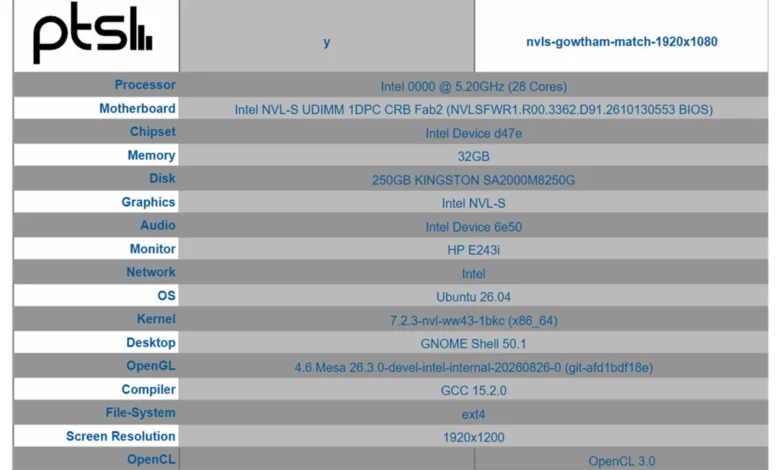
The most notable discovery involves an unidentified desktop processor, labeled simply as an "Intel 0000" engineering sample, which was logged operating at a base frequency of 5.2GHz. The test system, which utilized a Nova Lake-S reference motherboard paired with 32GB of memory, was running on the Ubuntu 26.04 operating system. While the database entry lacks comparative performance metrics, the architecture is expected to feature a hybrid design, likely utilizing a configuration of 8 performance cores (P-cores), 16 efficiency cores (E-cores), and four low-power efficiency cores (LPE-cores), totaling 28 cores.

Parallel to these desktop developments, technical documentation from Advantech regarding a Nova Lake-H mobile variant has surfaced, shedding light on the architectural scaling for portable devices. This laptop-focused silicon is configured with an 8P+4E+4LPE core structure. Unlike the desktop counterpart, the H-series chip is tuned for efficiency, operating at a maximum boost clock of 4.8GHz with a base P-core frequency of 2.0GHz. The integration of advanced memory support is perhaps the most significant feature of this mobile platform, as the hardware supports up to 128GB of DDR5-8000 RAM. Furthermore, the chip includes integrated Intel Arc graphics, boasting a clock speed of up to 2.3GHz, which suggests a substantial upgrade in mobile gaming and productivity capabilities for next-generation thin-and-light laptops.
The Power Delivery Conundrum
As Intel aims to regain dominance in the high-performance desktop market, the physical requirements of its processors are creating new challenges for the power supply and motherboard ecosystem. Recent product disclosures from SilverStone have highlighted the necessity for more robust power delivery systems. The company’s new HELA 1350Rz, a 1350W power supply, incorporates a unique configuration of three 4+4-pin CPU power connectors. In its technical literature, SilverStone explicitly references the high power demands of the upcoming Nova Lake-S platform as a primary driver for this design.

This development aligns with industry rumors suggesting that Intel is preparing to push the thermal design power (TDP) limits of its high-end desktop SKUs significantly higher than previous generations. Analysts have pointed to reports of a future 52-core variant of the Nova Lake-S series that could potentially reach power limits as high as 474W under heavy synthetic loads. While the 28-core engineering sample currently under observation is unlikely to hit such extreme ceilings, the necessity for a 1350W power supply in a standard consumer-facing unit signals a shift toward a "power-at-all-costs" philosophy for enthusiasts. This shift is expected to place increased pressure on motherboard manufacturers to improve voltage regulator module (VRM) cooling solutions and structural integrity to accommodate the heavier power draws.
Chronology and Development Timeline
The progression of the Nova Lake architecture follows a complex internal development cycle. Intel has been working to transition its manufacturing processes to more efficient nodes, aiming to address the thermal and efficiency criticisms leveled against its previous-generation desktop parts.

- Q3 2025: Initial architectural planning and internal tape-outs for the Nova Lake mobile (H-series) and desktop (S-series) variants.
- Q1 2026: Early engineering samples begin reaching internal validation labs and select partners, such as Advantech, for platform development.
- Q4 2026: Public sightings of Nova Lake-S samples in OpenBenchmarking databases indicate a transition toward late-stage validation.
- 2027 (Projected): Expected commercial release of the Core Ultra Series 4 family, coinciding with broader adoption of high-speed DDR5-8000 memory standards across the PC industry.
Technical Implications of DDR5-8000 Support
The inclusion of DDR5-8000 memory support in the Nova Lake-H mobile platform is a significant leap forward for Intel. Current mobile processors typically peak in the range of 6400MT/s to 7400MT/s, depending on the specific memory controller capabilities. By validating support for 8000MT/s speeds, Intel is addressing the bandwidth-heavy requirements of modern artificial intelligence tasks and high-resolution integrated graphics. This memory speed is particularly vital for the Arc integrated GPU, as iGPUs rely exclusively on system memory bandwidth to achieve competitive performance in rendering and AI-assisted workflows.
However, moving to such high-frequency memory presents technical hurdles for laptop manufacturers. Signal integrity becomes a primary concern at 8000MT/s, requiring higher-quality PCB materials and shorter trace lengths, which could impact the cost and design flexibility of future premium notebooks.

Market Context and Strategic Outlook
The trajectory of the Nova Lake series is emblematic of Intel’s response to heightened competition from rival architectures. By segmenting the lineup into high-efficiency mobile chips and high-performance, power-hungry desktop variants, Intel is attempting to satisfy two distinct market needs.
The focus on the "Core Ultra Series 4" branding suggests a continued emphasis on NPU (Neural Processing Unit) integration, as AI-based workloads become a cornerstone of the modern computing experience. Industry observers have noted that Intel’s strategy hinges on achieving a delicate balance: providing the raw performance required to maintain its market share against an increasingly aggressive field of competitors, while simultaneously managing the thermal and electrical overhead that has been a point of contention in recent years.

Official confirmation from Intel regarding the final specifications, SKU names, and the exact release date remains pending. Until the company holds its formal product launch, the specifications gleaned from database entries and partner documentation should be treated as developmental targets. Nevertheless, the hardware industry is already positioning itself for the arrival of these chips, with peripheral manufacturers such as SilverStone ensuring that the infrastructure—specifically power delivery—is ready to support the next generation of Intel’s desktop computing ambitions.
As the industry moves toward 2027, the focus will likely shift from pure clock speeds to how efficiently these 28-core configurations handle real-world multitasking and AI-specific instructions. If the performance gains match the increase in power requirements, Nova Lake could represent a return to form for Intel’s high-end computing segment. Conversely, if power consumption continues to climb without proportional gains in energy efficiency, the platform may face scrutiny from the growing segment of the market that prioritizes thermal management and power economy in high-performance workstations. The upcoming months will be critical as Intel continues its validation process and prepares for what is expected to be one of its most important product cycles in recent history.