Initial Geekbench 7 GPU Benchmarks Reveal Impressive Graphics Performance for Apple’s Upcoming M5 Ultra and M6 Silicon Chips

As the technology industry counts down the final days before Apple’s highly anticipated hardware refresh, early performance metrics are offering a vivid glimpse into the future of Mac computing. Fresh graphics processing unit (GPU) benchmark results have materialized within the Geekbench 7 database, casting a spotlight on the raw graphical capabilities of Apple’s forthcoming M5 Ultra and foundational M6 silicon. These preliminary findings arrive on the heels of earlier Central Processing Unit (CPU) leaks and precede the official commercial launch of the redesigned Mac Studio and Mac mini models, scheduled to hit store shelves and arrive on customer doorsteps next Tuesday.
The leak provides developers, enterprise users, and consumer enthusiasts alike with quantifiable data regarding how Apple’s next-generation architectures handle graphic-intensive workloads. While synthetic benchmarks rarely tell the entire story of day-to-day user experience, they remain an invaluable metric for charting generational performance leaps. The latest numbers underscore Apple’s aggressive push to narrow the performance gap with high-end desktop discrete graphics cards, a strategy that could further disrupt the professional workstation market.
Chronology of the Silicon Leaks
The trickle of performance data began earlier in the week when the first unverified benchmark entries for the M6 chip appeared in the Geekbench 7 repository on Tuesday, September 15, 2026. Shortly thereafter, separate benchmark filings revealed the capabilities of the high-end M5 Ultra processor, featuring a robust 36-core CPU architecture. These initial entries immediately drew attention from hardware analysts tracking Apple’s transition to cutting-edge manufacturing nodes.
By Friday, September 18, 2026, the database expanded to include comprehensive Grand GPU metrics. These latest entries illuminated the graphical prowess embedded within both the flagship desktop processor and the entry-to-mid-tier architecture destined for Apple’s compact desktop line. With the official product launch slated for the following Tuesday, these database listings serve as the final unconfirmed preview before independent reviewers publish comprehensive real-world evaluations.
Deep Dive into the M5 Ultra GPU Performance
At the pinnacle of Apple’s desktop silicon strategy sits the M5 Ultra, engineered specifically to power the upcoming Mac Studio. According to the newly discovered Geekbench 7 logs, the M5 Ultra has secured a Metal API graphics score of 366,744. When placed in historical context, this figure represents a staggering 59 percent generation-over-generation performance increase when compared against the average Metal score of 230,420 achieved by its predecessor, the M3 Ultra.
To contextualize this raw horsepower, the M5 Ultra’s OpenCL computational score places it roughly on par with NVIDIA’s formidable GeForce RTX 4080 desktop graphics card. Achieving parity with a high-end, dedicated desktop GPU of that caliber within a unified memory architecture highlights Apple’s continued optimization of thermal efficiency and die design. Professionals working in 3D rendering, video production, and complex simulation workflows stand to benefit immensely from such dramatic computational gains, particularly when dealing with uncompressed 8K video timelines and real-time ray tracing.
The M6 Chip and Next-Generation Efficiency
While the M5 Ultra targets heavy enterprise workloads and high-end creative studios, the M6 chip represents the cutting edge of Apple’s mainstream and ultra-portable roadmap. The upcoming Mac mini will serve as the inaugural host device for the M6 architecture, which is built on an advanced 2-nanometer manufacturing process.
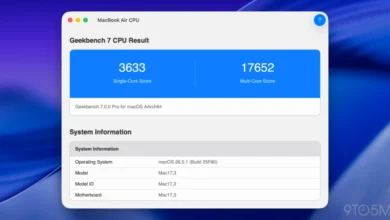
The early GPU benchmarks for the baseline M6 chip reveal a Metal score of 93,217. This translates to an approximate 34 percent performance improvement over the average M5 chip score of 69,563. When viewed alongside its previously leaked CPU metrics—which indicated single-core scores of 4,071 and multi-core scores of 22,783—the M6 demonstrates that Apple is continuing to extract substantial performance-per-watt efficiencies even as it transitions to denser node technologies.
Comprehensive Geekbench 7 Metal Score Hierarchy
To fully understand where these new processors sit within Apple’s broader silicon ecosystem, a comprehensive review of historical and current Geekbench 7 Metal scores provides a clear structural hierarchy:
- M5 Ultra: 366,744
- M3 Ultra: 230,420
- M5 Max: 225,606
- M2 Ultra: 201,144
- M4 Max: 189,301
- M1 Ultra: 150,098
- M3 Max: 146,550
- M5 Pro: 130,896
- M2 Max: 130,091
- M1 Max: 107,711
- M4 Pro: 107,354
- M6: 93,217
- M2 Pro: 77,176
- M3 Pro: 72,637
- M5: 69,563
- M1 Pro: 63,531
- M4: 51,818
- M3: 46,033
- M2: 40,529
- M1: 27,277
This extensive ranking demonstrates the compounding trajectory of Apple Silicon. Notably, the base M6 chip nearly doubles the graphical performance of the original M1 chip while rivaling legacy Pro-tier processors in certain computational tasks.
Industry Implications and Market Analysis
The surfacing of these benchmark numbers carries several important implications for the personal computer market. First, the M5 Ultra’s ability to rival dedicated NVIDIA desktop graphics hardware within the tight thermal constraints of a Mac Studio chassis reinforces the viability of unified memory systems for heavy computational tasks. Professionals who previously required bulky desktop towers equipped with power-hungry discrete graphics cards may find increasingly compelling reasons to migrate entirely to Apple’s ecosystem.
Second, the introduction of the 2nm M6 chip in the Mac mini signals Apple’s aggressive cadence in adopting cutting-edge semiconductor fabrication nodes. By pushing the boundaries of miniaturization, Apple continues to widen the efficiency gap between its proprietary silicon and traditional x86 architecture alternatives provided by Intel and AMD.
However, industry analysts maintain a degree of caution regarding synthetic benchmarks. While Geekbench 7 provides a standardized environment for testing raw mathematical and graphical throughput, real-world application performance is heavily influenced by software optimization, driver maturity, and thermal management under sustained loads. Applications optimized specifically for Metal and Apple’s Neural Engine will likely see the most pronounced benefits, whereas cross-platform ports may experience varying degrees of performance scaling.
As the launch date arrives next week, consumers and enterprise buyers will soon have access to independent, rigorous testing that will verify whether these early database leaks translate accurately to daily productivity, creative workflows, and gaming environments. Until then, the numbers suggest that Apple’s engineering teams have delivered yet another substantial generational leap in graphical processing power.