Court-Ordered Domain Seizure of Radaris.com Marks a Landmark Enforcement Action Under New Jersey Privacy Statute


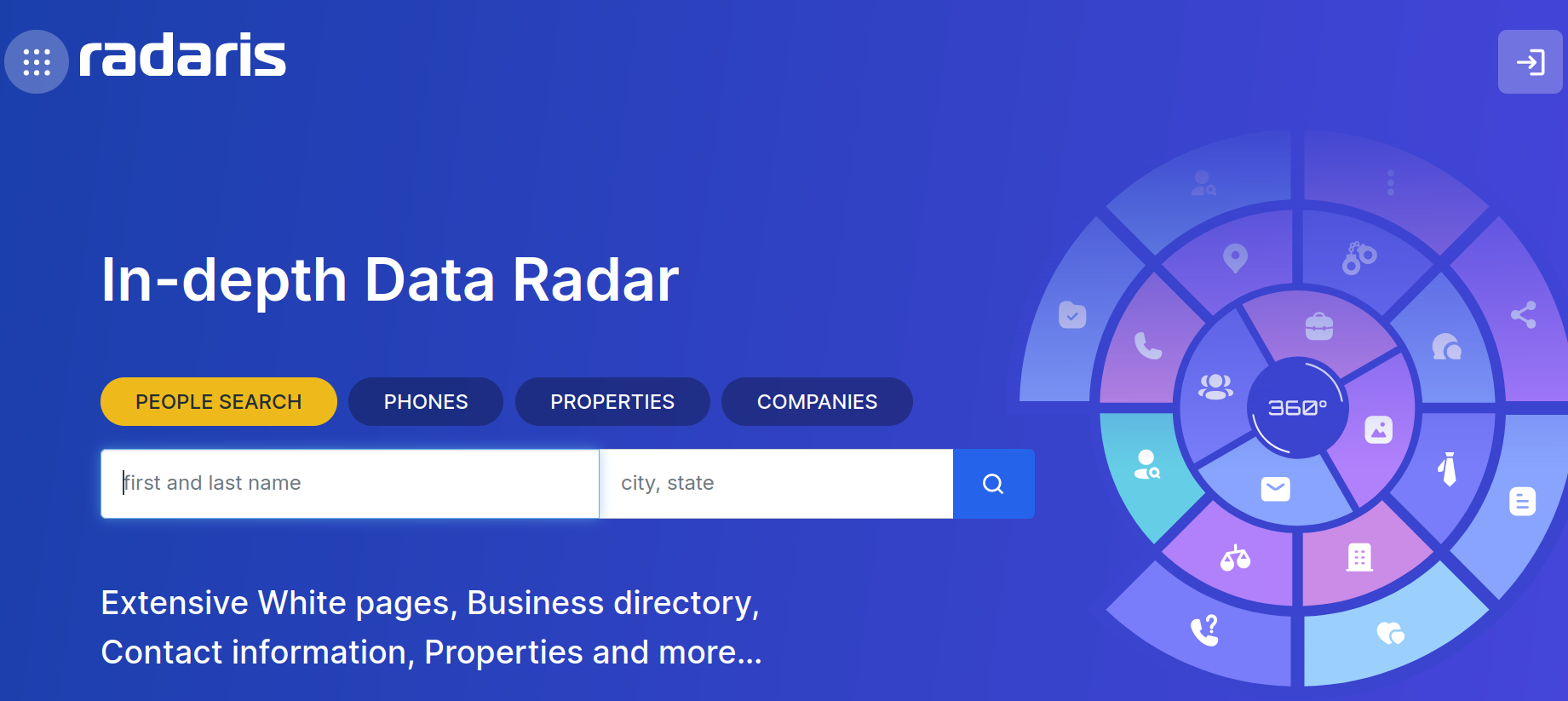
The digital landscape of consumer data brokerage experienced a seismic shift when a New Jersey court ordered the transfer of the high-traffic people-search domain Radaris.com, alongside more than a dozen associated properties, to a private data privacy corporation. This unprecedented judicial remedy stems from years of systemic non-compliance, alleged legal evasions, and repeated stonewalling by the entities operating the vast data harvesting empire. For over a decade, Radaris and its network of sister sites cultivated a reputation for ignoring consumer opt-out demands and disregarding regulatory mandates, operating behind a rotating facade of offshore holding companies and fictitious corporate officers.
The enforcement action highlights the growing friction between aggressive state-level privacy statutes designed to protect public officials and a multi-million-dollar data brokerage industry adept at exploiting jurisdictional loopholes. As the legal battle unfolds across state and federal courts, the implications extend far beyond a single domain transfer, igniting a national debate over constitutional protections, commercial free speech, and the glaring absence of comprehensive federal data privacy legislation in the United States.
Chronology of a Decade-Long Legal and Investigative Saga
The modern reckoning for Radaris began in earnest in February 2024, when Atlas Data Privacy Corp filed a lawsuit in New Jersey targeting the data broker for alleged violations of Daniel’s Law. Named in honor of Daniel Anderl—the son of U.S. District Judge Esther Salas, who was tragically murdered at her home in 2020 by an aggrieved litigant—the statute grants judges, law enforcement personnel, prosecutors, and their immediate families the right to have their personal information completely scrubbed from commercial people-search directories. Furthermore, the law imposes stringent penalties of $1,000 per violation on companies that knowingly fail to honor valid removal requests.
Almost immediately after the initial lawsuit was filed, investigative journalist Brian Krebs published an exhaustive profile of the masterminds behind the platform: Russian-born brothers Igor and Dmitry Lubarsky, Massachusetts residents who allegedly orchestrate a complex web of people-search engines, affiliate programs, and foreign-language dating services. In response to the investigative reporting, legal counsel for the Lubarskys threatened a defamation lawsuit, asserting that the reporting was inaccurate and claiming that the true owners of Radaris were Ukrainian nationals residing in Ukraine.
Subsequent investigative reporting dismantled these denials, demonstrating how the operators routinely employed fictitious executive personas—most notably a fake CEO named "Gary Norden"—to raise venture capital and project corporate legitimacy. When Atlas re-filed its complaint in June 2025 to expand the scope of targeted entities, the defendants allegedly reverted to a familiar corporate shell game. Court filings and defense strategies repeatedly shifted ownership claims across various jurisdictions, moving through corporate paper entities in Cyprus, the Marshall Islands, the British Virgin Islands, and the Seychelles.
Despite these procedural maneuvers, defense counsel ultimately failed to present a substantive defense on the merits of the Daniel’s Law violations. Consequently, the presiding New Jersey judge issued a default judgment and ordered the domain registry Verisign to transfer Radaris.com and 13 related domains to Atlas. Today, visitors attempting to access Radaris.com are met not with public records profiles, but with an official notice detailing the court-ordered transfer.
Unraveling the Corporate Web and Financial Ecosystem
Court documents and internal communications uncovered during discovery shed unprecedented light on the financial scale and operational mechanics of the Radaris empire. According to summaries provided by Atlas, legal teams extracted more than 10,000 internal emails and corporate documents that substantiate the connection between dozens of seemingly independent websites.
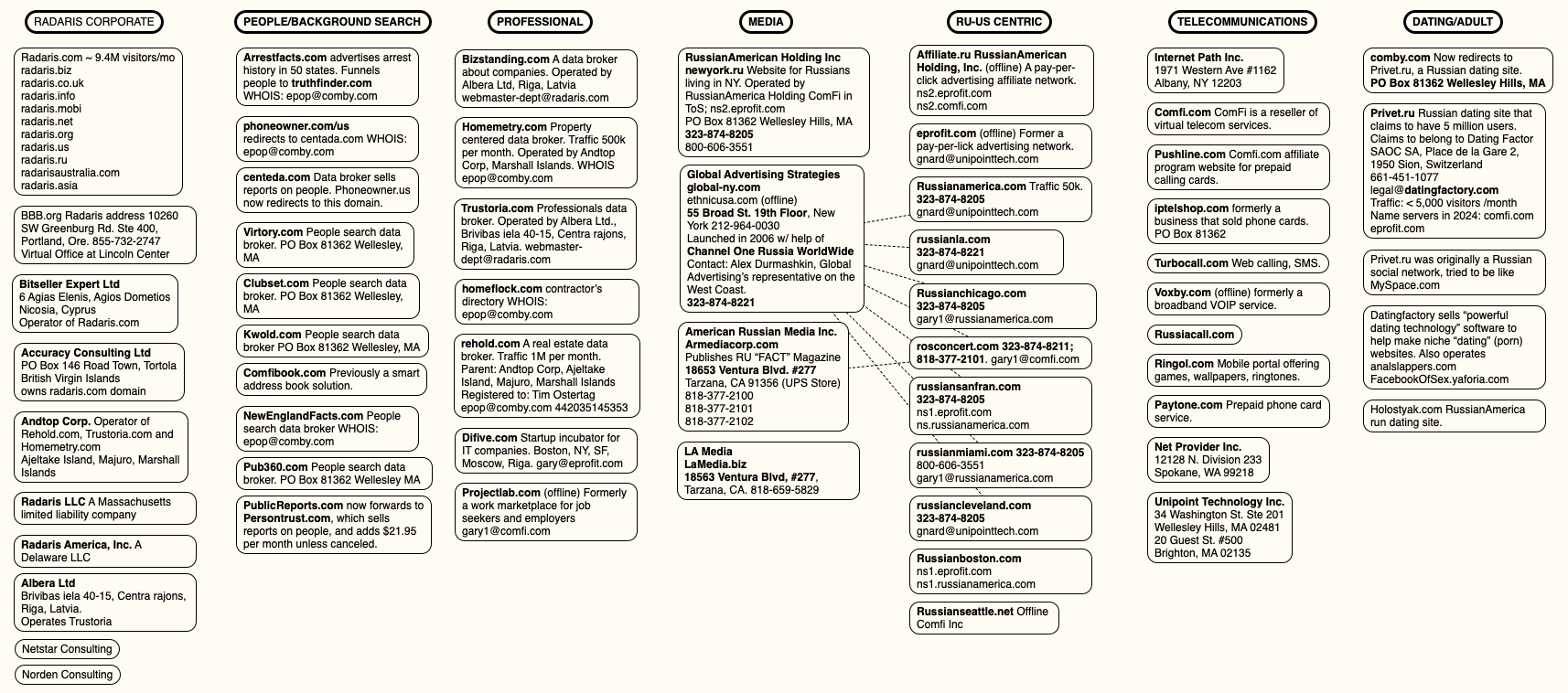
The evidence indicates that nominal corporate vehicles—including Radaris America Inc., Bitseller Expert Limited, Digital Orbit Corp, Core Solutions Group Inc., Lucky Solutions Inc., Virtura Corp, Veripages Inc., Nuform Solutions Inc., Growth Data Advisors Inc., and Property Experts Inc.—are in reality managed by a tight-knit cluster of administrators operating out of the Boston metropolitan area. These entities reportedly shared banking mechanisms, merchant payment accounts, virtual office locations, and technical infrastructure routed through specific administrative mail domains.
Financially, the operation generated substantial monthly revenue through direct consumer subscriptions, programmatic advertising, and lucrative corporate partnerships. Atlas data estimates that Radaris.com alone pulled in approximately $42,000 a month, while sister site Veripages.com earned roughly $45,000 monthly through commercial alignments with major data marketing firms such as the Lifetime Value Company—owner of consumer search brands like PeopleLooker, PeopleSmart, NumberGuru, and Bumper.

Additional revenue streams flowed from partnerships with companies like Onerep, a prominent privacy-management service that purportedly helps consumers remove their information from people-search databases, creating a cyclical market where data brokers profit simultaneously from publishing personal records and assisting users in taking them down.
Legal Defenses and Constitutional Challenges
The transfer of Radaris.com has triggered an aggressive pushback from defense attorneys representing the affected networks. Victor Worms, counsel for the defense, filed motions to vacate the default judgment, arguing that the ruling was legally void because "Radaris.com" is a domain name rather than a formally incorporated legal entity with the capacity to be sued. Defense teams also intend to pursue appellate relief, contending that the court-ordered forfeiture of domain assets infringes upon constitutional due process principles and property rights.
At a broader level, the legal strategy of the data broker industry has shifted toward an all-out constitutional challenge against Daniel’s Law itself. More than 150 consumer data brokers currently facing lawsuits under the statute have successfully transferred approximately 70 of those cases into federal court. The core argument rests on the assertion that state-level bans on publishing public records violate the First Amendment protections afforded to commercial speech.
While the U.S. Court of Appeals for the Third Circuit weighs the constitutionality of New Jersey’s framework, legal experts anticipate that the dispute will ultimately reach the Supreme Court of the United States. Similar constitutional pressure points have emerged nationwide; in August 2025, a federal district court ruled West Virginia’s iteration of Daniel’s Law facially unconstitutional under the First Amendment, demonstrating the volatile legal terrain surrounding state-level privacy interventions.
Broader Implications for 21st-Century Data Privacy
The Radaris enforcement action unfolds against a backdrop of increasing legislative fragmentation. At least 14 states have enacted statutes modeled after Daniel’s Law, while others weigh similar protections for public servants, judges, and law enforcement officers. However, privacy advocates and legal scholars emphasize that piecemeal state laws remain fundamentally insufficient to protect the general populace from ubiquitous digital surveillance.
Justin Sherman, a prominent privacy expert and author of the forthcoming book The Middlemen, notes that the structural vulnerability of consumer data is rooted in systemic loopholes found within virtually all state and federal regulatory frameworks. Most contemporary privacy laws deliberately exempt records classified as "public documents" or "government archives"—categories that encompass voter registries, property deeds, marriage licenses, motor vehicle filings, criminal histories, court files, and professional licenses. Consequently, people-search engines can legally scrape and aggregate these repositories to reconstruct comprehensive digital dossiers on nearly any citizen.
Furthermore, the commercial appetite for personal data continues to outpace regulatory oversight. While numerous states have implemented mandatory age-verification laws requiring users to submit government-issued identification to access certain online platforms, no federal statute governs how identity verification vendors collect, retain, or secure these sensitive files. This regulatory vacuum was starkly illustrated by a major security breach at IDScan.net, which exposed the driver’s license records of more than 153 million Americans after the sensitive information was briefly weaponized as an identity theft utility on the dark web.
As the legal battles surrounding Radaris, Daniel’s Law, and the broader data broker industry continue to evolve, experts argue that targeted measures protecting specific professional classes are merely palliative solutions to a systemic failure. Without comprehensive federal privacy legislation that addresses the underlying commercialization of public records, the data brokerage ecosystem will likely adapt its infrastructure, continuing to mine, aggregate, and monetize the digital footprints of everyday Americans.
Related posts: