Critical Click2Shell Vulnerability Discovered in WordPress Core Demands Immediate Security Patching

WordPress has issued an urgent security update, version 7.1.1, to address a high-severity vulnerability within its core software that could allow unauthorized individuals to force the installation of themes from the official WordPress.org directory. Discovered and documented by security researchers at pwn.ai, the exploit—dubbed "Click2Shell"—leverages a sophisticated mechanism to manipulate administrative sessions. By tricking a logged-in site administrator into clicking a specifically crafted web link, an attacker can bypass manual installation protocols, effectively automating the deployment of a theme without user consent. While the vulnerability primarily focuses on the installation process, researchers have demonstrated that when chained with a secondary, pre-existing flaw within a specific theme, it can facilitate full remote code execution (RCE) on the underlying server.
The Anatomy of the Click2Shell Attack
The technical foundation of the Click2Shell vulnerability lies in a discrepancy regarding how different components of the WordPress ecosystem interpret URL parameters. The WordPress.org repository typically treats input values as standard theme identifiers. However, the administrative interface of the WordPress core software exhibits a weakness where it inadvertently reuses raw input strings—including specific punctuation and character sequences—within its own internal execution scripts.
By appending malicious parameters to a legitimate URL, an attacker can force the browser to interpret the input as an instruction to trigger the "Install" button. Because the target is an administrator who is already authenticated, the browser automatically supplies the necessary security tokens and session permissions required for the action. The result is a silent, automated installation of a theme. The researchers noted that while the theme is installed, it remains in an "inactive" state, meaning the visual appearance of the website remains unchanged, which allows the malicious activity to persist without immediate detection by the site owner.

Chronology of the Discovery and Disclosure
The discovery of the Click2Shell vulnerability follows a series of rigorous security audits conducted by pwn.ai throughout the summer of 2026. The timeline of this incident reflects the rapid nature of modern web application security disclosures:
- August 2026: Security researchers at pwn.ai identified a similar, though distinct, pre-authentication cross-site scripting (XSS) vulnerability in the WordPress login screen, which also allowed for potential code execution.
- Early September 2026: The research team isolated the mechanism behind the Click2Shell exploit, determining that it could be weaponized if paired with vulnerable third-party themes.
- September 17, 2026: WordPress officially released version 7.1.1, incorporating patches to sanitize input handling and prevent the unauthorized triggering of theme installations.
- September 18, 2026: Full technical details were made public, emphasizing the need for administrators to update their installations immediately.
Understanding the Chain of Exploitation
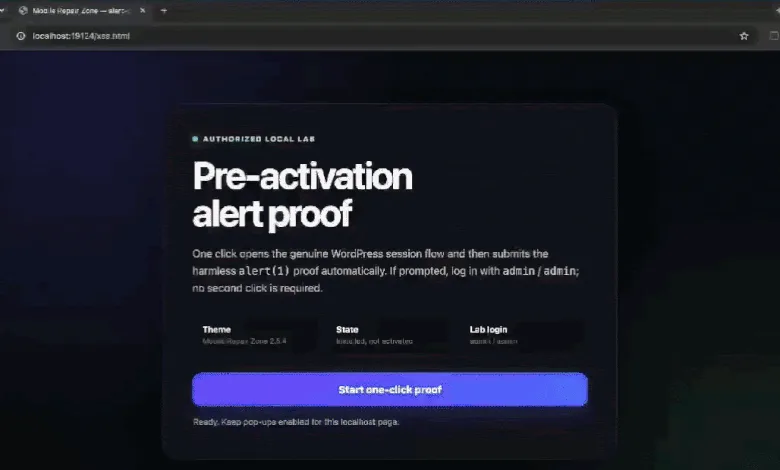
A critical aspect of this vulnerability is that the core flaw itself does not grant an attacker immediate control over the server. It functions as a "delivery vector" for a second-stage attack. The researchers demonstrated this using the "Mobile Repair Zone" theme, which contained a separate, independent vulnerability: an improperly secured background handler.
In the demonstration, once Click2Shell forced the installation of the theme, the attacker triggered the theme’s background handler. This handler was capable of fetching remote packages and executing arbitrary PHP code without requiring administrator privileges or valid security tokens. By chaining these two issues—the core’s forced installation and the theme’s insecure code handling—the researchers were able to achieve total compromise of the server. This highlights a growing trend in cybersecurity where attackers focus on "exploit chaining," where minor vulnerabilities in separate components are combined to create a catastrophic security failure.
Data-Driven Risk Assessment
The cybersecurity community has assigned varying levels of risk to this vulnerability, depending on the scope of the exploit. Pwn.ai has rated the standalone forced-install flaw as a 7.1 on the Common Vulnerability Scoring System (CVSS), characterizing it as a high-severity issue. However, when the vulnerability is successfully chained to achieve full remote code execution, the severity rating is upgraded to a critical 9.6.

While WordPress has not issued a specific CVE identifier at the time of the release, the company confirmed that the vulnerability affects all versions of WordPress from 6.0 through 7.1.0. Given that WordPress powers approximately 40% of the internet, the potential attack surface is massive. Despite the high risk, there is currently no evidence that the Click2Shell exploit has been utilized in malicious, real-world campaigns. This provides a narrow window of opportunity for administrators to secure their environments before active exploitation begins.
Official Response and Remediation Steps
The WordPress development team has responded to the discovery by implementing strict input validation within the core software. Version 7.1.1 is now available for download and serves as a mandatory security update. For the majority of users, this update will be applied automatically, as the WordPress platform is configured to receive security patches in the background.
Administrators are encouraged to follow these steps to ensure their site remains secure:
- Check Versioning: Verify that the current WordPress installation is running version 7.1.1 or later.
- Audit Plugins and Themes: Given that Click2Shell relies on secondary theme vulnerabilities, administrators should perform a comprehensive audit of all installed themes and plugins. Removing unused or abandoned themes significantly reduces the likelihood of such chains succeeding.
- Monitor Administrative Logs: Review access logs for suspicious activity, particularly any unexpected installation or activation of themes that were not explicitly initiated by an authorized user.
- Implement Principle of Least Privilege: Ensure that administrative accounts are limited to trusted personnel and use multi-factor authentication (MFA) to prevent unauthorized access to sessions that could be leveraged by such exploits.
Broader Implications for Web Security
The Click2Shell vulnerability serves as a stark reminder of the complexities inherent in maintaining the security of modular, open-source content management systems (CMS). The ability for an attacker to manipulate core functionality through a seemingly innocuous link highlights the danger of "confused deputy" problems, where a legitimate piece of software is tricked into performing an action it was not intended to do.

Furthermore, the recent string of vulnerabilities reported by pwn.ai—including the July "wp2shell" incident—demonstrates that the WordPress core is under constant scrutiny. While the wp2shell flaw was notably more dangerous because it did not require authentication or user interaction, the emergence of Click2Shell suggests that attackers are increasingly looking for ways to bypass security tokens and session management.
For the broader web development community, this event underscores the importance of the "Secure by Default" philosophy. As platforms become more integrated, the potential for interaction between core software and third-party extensions becomes a significant vector for compromise. Developers are increasingly urged to implement automated security testing, such as static application security testing (SAST) and dynamic analysis, to catch input handling errors before they reach production environments.
Ultimately, the responsibility for maintaining a secure web presence is shared between platform maintainers and site administrators. While WordPress continues to provide rapid updates to patch these holes, the speed at which an administrator applies these patches remains the most critical factor in preventing widespread data breaches. As the digital landscape continues to evolve, the ability to rapidly identify, disclose, and patch such vulnerabilities will remain the primary defense against increasingly sophisticated threat actors.
Related posts: