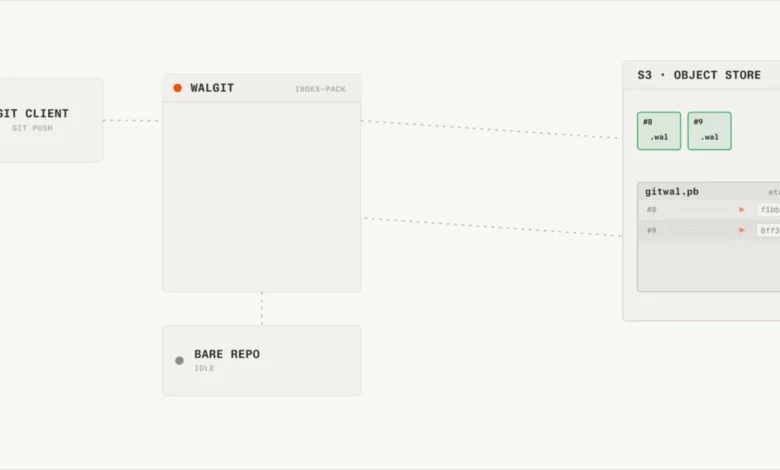
The landscape of large-scale software development is undergoing a paradigm shift as Cursor, the AI-integrated code editor provider, introduces Continuity—a novel Git storage architecture designed to move the source of truth from traditional replica coordination to an S3-backed write-ahead log (WAL). This departure from established models, such as GitHub’s Spokes architecture, promises to solve the throughput and consistency bottlenecks that have historically plagued massive repositories and the burgeoning volume of smaller, agent-generated codebases. By prioritizing durable object storage over synchronous replica state, Cursor is attempting to decouple read-scaling from write-coordination, signaling a potential new standard for version control infrastructure.
The Architectural Evolution of Git at Scale
For over a decade, the industry standard for scaling Git has relied heavily on local NVMe-based repositories and complex coordination mechanisms. GitHub’s Spokes architecture, a widely cited reference in distributed version control, utilizes a three-phase commit process to maintain consistency across multiple physical replicas. While effective, this model inherently faces diminishing returns as the number of replicas increases. Every write operation requires a multi-node handshake, introducing latency and coordination overhead that scales poorly when repositories grow into the hundreds of gigabytes or when the sheer frequency of pushes—driven by automated coding agents—surpasses human-scale activity.
Cursor’s Continuity architecture fundamentally alters this relationship. Instead of treating replicas as primary nodes that must achieve consensus, Continuity designates an S3-backed write-ahead log as the definitive source of truth. Under this model, local NVMe storage is demoted to a "warm cache," used for performance optimization rather than durability. This inversion allows for a more fluid distribution of data; when a local copy is unavailable or stale, it can be seamlessly materialized directly from the WAL.
Chronology and Operational Flow
The transition to this architecture follows a series of internal performance challenges at Cursor, particularly with its "everysphere" monorepo. As the team pushed the limits of Git, they identified that traditional replica synchronization was creating a hard ceiling on push frequency and read availability.
The operational flow of a push in Continuity is designed for high-concurrency environments. When a developer or agent initiates a push, the system writes the data directly to S3. Once the data is confirmed as persisted, the corresponding reference update is recorded in the WAL. Only then is the push acknowledged as successful. This ensures that durability is guaranteed before the client receives a confirmation. To mitigate the latency inherent in S3 PUT operations, Cursor employs batching strategies, which significantly improve throughput by amortizing the cost of object storage interaction over multiple Git operations.
For read operations, Cursor utilizes rendezvous hashing to select preferred nodes, while atomic compare-and-swap (CAS) operations on S3 allow any server in the cluster to accept a push, provided it can validate the state against the WAL. UDP gossip protocols are then employed to propagate these updates across the fleet. Crucially, even if the gossip fails or is delayed, the system remains consistent because the S3-backed WAL provides an immutable record of truth that any node can query. Cursor’s internal testing suggests that these conditional S3 reads occur in under 10 milliseconds, a negligible cost compared to the complexity of traditional replica reconciliation.
Benchmarking Performance and Throughput
The performance data released by Cursor highlights a stark improvement in throughput over conventional systems. In synthetic testing scenarios, Continuity demonstrated linear read scaling across as many as 100 replicas. When utilizing standard S3 storage, the architecture achieved a throughput of 120 pushes per second. However, by upgrading to S3 Express One Zone—a high-performance, low-latency storage tier—the system pushed past 300 operations per second.
These figures are particularly significant given the current trajectory of software engineering. As AI coding agents increasingly automate the creation and modification of files, repositories are experiencing a surge in small, frequent pushes. Traditional Git hosting models were optimized for human-scale interactions, where developers push intermittently. The Continuity model, conversely, is built for a future where automated systems interact with version control at machine speeds.
However, the architecture does introduce new bottlenecks. Cursor engineers noted that at high throughput, the primary constraint shifts from network coordination to Git compaction. In the Continuity model, only the primary node performs repository compaction—a CPU-intensive process. Once finished, the resulting packfiles are uploaded to S3, and replicas download them asynchronously. This approach effectively trades off bandwidth consumption for CPU efficiency, allowing the system to scale horizontally without forcing every replica to perform the same heavy computation.
Expert Perspectives and Technical Implications
The industry reaction to Continuity has been characterized by cautious interest, with experts noting that this shift represents a "database-first" approach to version control. Maksim Al Dandan, a senior software engineer, noted that the model effectively treats Git storage like a high-performance database. By moving to a WAL-based architecture, concepts that were historically difficult in Git—such as true point-in-time recovery and transactional force-pushes—become more manageable.
Casey Lee, CTO at Liatrio and a former AWS engineer, highlighted the gravity of the shift, noting that moving the consistency boundary from the replica layer to durable object storage is a significant architectural departure. "It is a fundamental trade-off," Lee observed. "You are swapping the complexity of synchronous replica coordination for a reliance on object storage validation and asynchronous propagation. It’s a design that favors the massive scale of cloud-native environments."
/filters:no_upscale()/news/2026/09/cursor-continuity-git-storage/en/resources/1cursorarch-1789844142232.jpeg)
Lee also cautioned that while the reported performance figures are impressive, they remain internal metrics. The real-world viability of this model across varied network conditions and repository sizes has yet to be independently verified by the broader infrastructure engineering community.
Future Outlook and Broader Impact
The implications of the Continuity architecture extend beyond just Cursor’s platform. If successful, this design could influence how large-scale enterprise Git providers approach their storage backends. The move toward S3-backed WALs mirrors the architecture of modern distributed databases like CockroachDB or TiDB, which have successfully moved away from monolithic state management.
For organizations managing monorepos that span millions of lines of code, the ability to spin up replicas on-demand—materializing state from S3 rather than syncing from a primary—could dramatically reduce the cost and operational complexity of maintaining high-availability CI/CD pipelines. Furthermore, the decoupling of compute and storage in Git hosting suggests a path forward for "serverless" version control, where repositories exist as durable objects in a bucket and are only "warmed up" into compute nodes when a developer or agent requests a clone or a push.
As Cursor continues to refine its storage engine, the industry will be watching to see if this "database-centric" view of Git can withstand the rigors of production environments. The shift is not merely an optimization; it is a conceptual realignment that recognizes the future of version control as an infrastructure-heavy, machine-driven process rather than a static repository of human-authored code. By betting on S3 and the WAL, Cursor is attempting to ensure that the tools of software development can keep pace with the velocity of the software they help produce.