Azure’s "Brain" system, an advanced AI-powered cloud reliability intelligence platform, is fundamentally reshaping how Microsoft operates its massive global cloud infrastructure. This sophisticated AIOps (Artificial Intelligence for IT Operations) system acts as an intelligent overlay, integrating platform telemetry, advanced AI and machine learning models, critical service dependencies, and real-time customer impact analysis into a unified, continuously updated view of Azure’s performance. Already instrumental in powering customer Azure resource health notifications, safeguarding deployments, and accelerating outage declarations, "Brain" represents the foundational layer for the emerging agentic AI that is set to revolutionize cloud operations. This comprehensive report delves into the intricacies of "Brain," its development, operational learnings at scale, and its future trajectory, marking the commencement of an in-depth series exploring this transformative technology.
The Genesis of Azure’s Digital Twin for Cloud Health
At its core, Azure now operates upon a dynamic, digital representation of its own operational health. "Brain" is the engine behind this digital twin, functioning as an intelligent layer that seamlessly integrates with Azure Resource Graph (ARG). Together, they construct a comprehensive, real-time model of Azure’s vast ecosystem. This integration is achieved through a meticulous fusion of platform telemetry, sophisticated AI/ML algorithms, and advanced data engineering practices. The objective is to maintain and continuously enrich a live, holistic view of how services, geographical regions, and customer workloads are performing across the entire Azure network. This unified perspective is progressively becoming the bedrock for a more automated and proactive reliability framework, capable of transforming raw data insights into decisive actions.
Currently, "Brain" is already actively contributing to critical reliability workflows within Azure. This includes providing immediate health notifications for customer resources, implementing robust safeguards during deployment processes, and facilitating swift and accurate outage declarations. For the millions of customers relying on Azure, "Brain" is already manifesting in tangible improvements across three key areas: enhanced resource health visibility, more secure and controlled deployments, and faster, more precise communication during service disruptions. This article aims to illuminate the mechanics of "Brain" and the transformative operational capabilities it enables.
The Imperative for Advanced Reliability Intelligence
The sheer scale of Azure presents an unparalleled operational challenge. The platform encompasses hundreds of distinct services, spanning over 80 Azure regions, more than 500 data centers, and an extensive network of over 800,000 kilometers of fiber optic and subsea cables. This vast global footprint is a testament to its world-leading position in the cloud computing landscape. However, the immense volume of activity generated, managed, and processed by Azure services worldwide means that, even on a seemingly stable day, the platform can sometimes learn about an issue from a customer before its own internal systems detect it. Such a scenario represents the most detrimental type of incident for a customer – one where they are forced to troubleshoot their own applications while unaware that the root cause lies within the underlying cloud infrastructure.
This disparity between what Azure measures and what it truly understands about its own health represents a significant bottleneck in achieving ultimate cloud reliability. The issue is not a deficiency in tooling; Azure possesses an extensive suite of diagnostic and monitoring tools. Instead, it is a fundamental problem of comprehension. The sheer volume of data signals generated by a hyperscale cloud environment has surpassed human capacity for real-time analysis. The conventional response—deploying more dashboards, triggering more alerts, and increasing on-call rotations—has proven to be an unsustainable treadmill rather than a viable solution. Each additional dashboard offers an operator yet another window to scrutinize, but what is critically missing is a system that can interpret the data presented, identify anomalies, and provide actionable intelligence in a timely manner.
Addressing this critical gap necessitated the development of a novel solution: not merely enhanced dashboards or more sophisticated alerts, but a continuously updated model of the platform’s health. This model must be capable of reasoning across every available signal in real-time and autonomously executing reliability actions at the immense scale demanded by the Azure platform.
"Brain": Azure’s Centralized AIOps Hub for Cloud Reliability
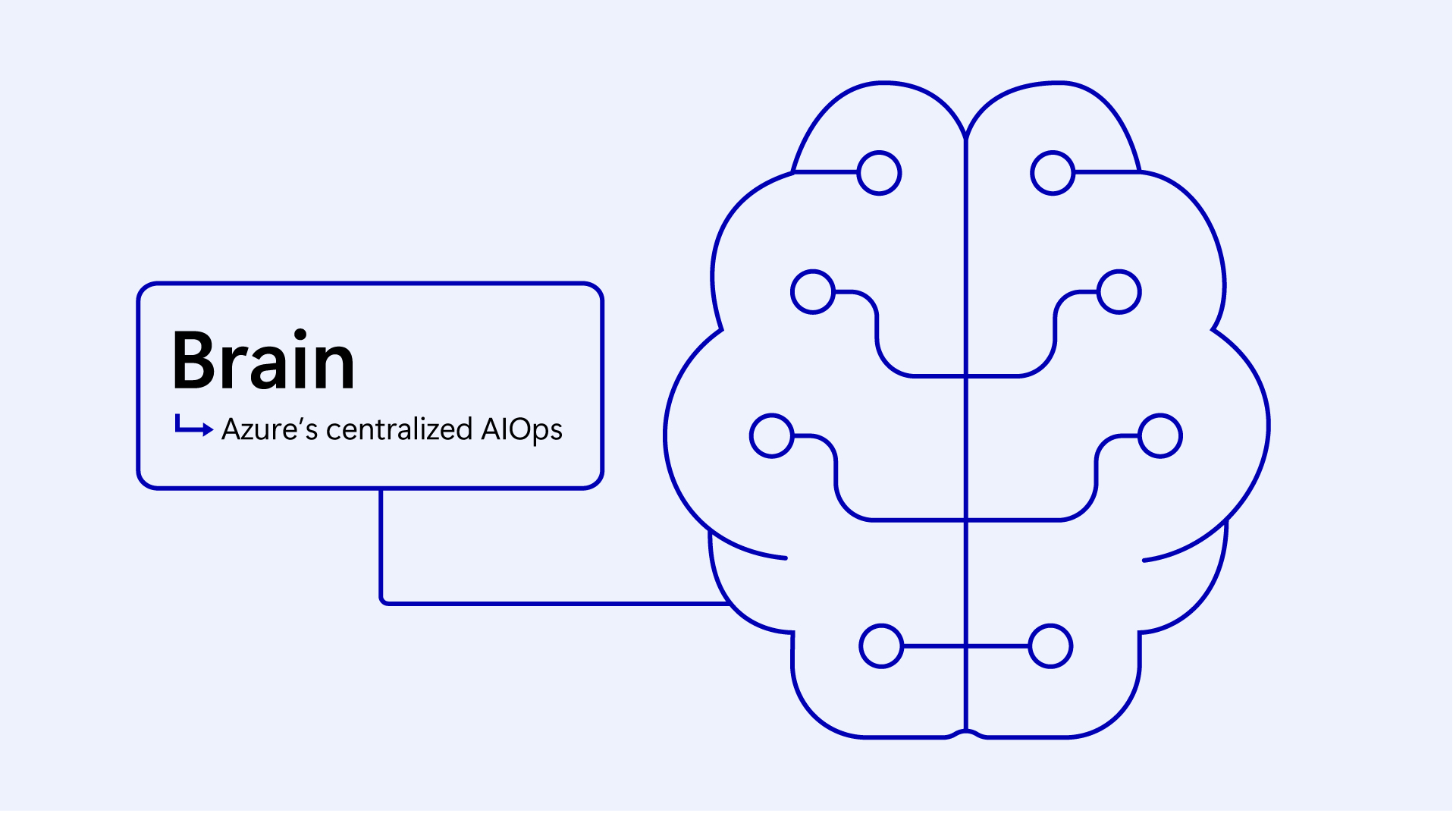
"Brain" is Azure’s centralized AIOps-powered cloud health intelligence system. It leverages cutting-edge AI/ML technologies, including agentic AI and sophisticated data engineering, to construct and maintain a dynamic model of Azure’s health. This model then enables the automatic initiation of reliability actions. The system has already been deployed in Azure production environments, contributing to resource health determinations across the platform.
At its fundamental level, "Brain" is shaped by three key components: the data it ingests, the processing it performs, and the actions its outputs drive.
The system ingests signals from three distinct classes of sources:
- Platform Telemetry: This encompasses a vast array of data points generated directly by Azure’s infrastructure. This includes performance metrics from compute, storage, and networking components, error logs, configuration changes, and operational events across all Azure services and regions. This constant stream of data provides an intrinsic view of the platform’s internal state.
- Service Dependencies and Topology: Understanding how different Azure services interact is crucial for diagnosing issues. "Brain" incorporates detailed information about the intricate web of dependencies between services, the network topology, and the logical structure of Azure deployments. This allows the system to trace the ripple effects of an issue across interconnected components.
- Customer Impact Data: This category includes information directly or indirectly related to customer experience. It can involve telemetry from customer applications running on Azure (with appropriate privacy controls), aggregated customer-reported incidents, and data from diagnostic tools that assess end-user experience. This feedback loop ensures that the system’s understanding of "health" is directly correlated with actual customer outcomes.
Each of these data streams serves a unique purpose, and their combined integration provides "Brain" with a comprehensive and nuanced understanding of Azure’s operational landscape, a feat unattainable by any single data source alone.
Regardless of the input, "Brain" evaluates every subject—whether it’s a specific service, a geographical region, a deployment unit, or an individual customer resource—and generates four critical outputs: its health state, the severity of any detected issues, the overall impact, and the specific reasoning behind its conclusion. These standardized outputs, presented in a consistent vocabulary, ensure that all downstream systems operate from a shared understanding. This eliminates the ambiguity and disconnect that can arise when different teams interpret terms like "impacted" in disparate ways.
The insights generated by "Brain" currently power a rapidly expanding set of automated reliability actions, including:
- Proactive Outage Detection and Declaration: Identifying service disruptions with greater speed and accuracy, leading to faster official declarations.
- Automated Deployment Rollback: Halting or reversing problematic deployments that show signs of negatively impacting system health or customer experience.
- Targeted Customer Notifications: Delivering precise and timely alerts to affected customers, detailing the nature of the issue and its expected resolution.
- Intelligent Incident Routing: Directing incident response efforts to the correct teams based on the diagnosed root cause and impact.
- Dynamic Resource Health Updates: Continuously updating the health status of customer resources in real-time, providing an accurate reflection of service availability.
- Predictive Failure Analysis: Identifying potential future issues based on subtle anomalies and historical patterns, enabling preventative measures.
- Automated Remediation Actions: Triggering predefined corrective actions for known issues, reducing manual intervention.
Foundations of Azure’s Unified Cloud Health Model
To truly grasp the distinction between an "intelligence system" and a mere "dashboard," it is essential to examine the foundational elements that underpin "Brain." Azure’s representation within this system incorporates, at a minimum, the following critical components:
- Service Topology and Dependencies: A detailed map illustrating how Azure services are interconnected, including upstream and downstream relationships.
- Runtime State and Configuration: Real-time data on the operational status, resource utilization, and active configurations of all Azure components.
- Deployment History and Intent: A record of all code deployments, infrastructure changes, and the intended state and functionality of each component.
- Historical Performance Patterns: Baseline performance metrics and historical data that establish norms and deviations.
- Customer-Side Telemetry and Impact: Aggregated and anonymized data reflecting how Azure services are performing from the perspective of end-users and customer applications.
- Geographic and Regional Context: Information about the specific data center, region, and network infrastructure associated with any given resource or service.
While none of these individual elements are novel in isolation—every cloud platform utilizes versions of them—"Brain" uniquely consolidates them into a single, unified, AI-driven representation. This stands in stark contrast to traditional approaches where these disparate data points are scattered across numerous dashboards within various tools, requiring operators to mentally synthesize them under intense time pressure during an incident.
When "Brain" asserts that a service is degrading, this statement is not merely a threshold being crossed. It is a sophisticated determination derived from a simultaneous reasoning process across topology, runtime state, deployment intent, historical performance patterns, and customer-side evidence. This signifies the intelligence system speaking, rather than a metric firing. Crucially, the speed of this determination, measured in seconds rather than the minutes a human would require to assemble the same picture from disparate tools, translates directly into an improved customer experience: shorter incident durations, more precise notifications, and faster incident response routing.
Operating in the Age of Cloud Intelligence Systems
The shift to operating against a cloud intelligence system like "Brain" represents a paradigm change for Azure customers and is a transformation that can be easily overlooked if the concept of a "digital twin" is perceived as merely a metaphor rather than a functional system.
Consider the typical resolution of a deployment-induced degradation in two distinct operational environments:
In a world lacking a unified intelligence system, the process is one of reconstruction. A software rollout is underway. The error rate in a particular region begins to drift upwards. The deployment system observes an increase in errors but lacks context about the downstream impact. The incident management system initiates an investigation, potentially creating duplicate tickets across multiple teams responsible for different components. Customer support begins receiving reports of service degradation, but without a clear understanding of the root cause, initial communication is often vague. Engineers scramble to correlate metrics from various dashboards, attempting to pinpoint the faulty deployment and its specific impact. This reactive approach is time-consuming, prone to misdiagnosis, and leads to extended downtime and customer frustration.
In stark contrast, in an environment equipped with an intelligence system like "Brain," the process shifts from reconstruction to consumption of pre-analyzed intelligence. The ongoing rollout is registered within the intelligence system. "Brain" is aware of its flight path, the specific changes it introduces, the regions it is reaching, and its intended functionality. The observed error-rate drift is also within the system. "Brain" correlates this drift directly to the ongoing rollout, analyzes it against the established dependency graph, and evaluates it against historical patterns to distinguish between minor fluctuations and genuine degradation.
Crucially, affected customers are also represented within the system. Their tenants are mapped to the specific platform resources experiencing impact due to upstream dependencies, which are themselves affected by the problematic rollout. "Brain" then generates a single, unambiguous determination: the current rollout is causing customer-visible impact in a specific region. The expected resolution requires an immediate pause of the rollout.
This determination then flows instantaneously to every system that needs to act upon it. The deployment system automatically pauses the rollout while the condition remains true, thereby preventing subsequent customers from experiencing the same negative impact. Simultaneously, the incident management system creates a single, consolidated incident, accurately identifying the upstream dependency responsible, rather than generating multiple duplicate tickets from confused teams. This ensures the right engineer addresses the right problem promptly. The customer communication system drafts a notification with the precise tenant scope and a clear, plain-English description of the issue, enabling affected customers to receive timely and actionable updates from Microsoft.
For Azure customers, the intricate coordination behind these automated actions remains invisible. What becomes apparent is a significantly shorter incident duration, a precisely targeted alert that triggers automated responses rather than manual intervention, and a diagnosis that is already established by the time their on-call engineer opens the incident bridge. In services where "Brain’s" resource health evaluation is fully operational, the precision of detection for service-impacting issues has seen a substantial increase, and the coverage of relevant incidents continues to expand.
Over the past year, a significant majority of outages integrated with "Brain" have been automatically communicated to affected customers, and in these instances, the time-to-notification has demonstrably improved compared to manually issued notifications.
Crucially, none of these downstream systems are engaged in their own independent investigations. They all consume the same determination from the central intelligence system, employing the same vocabulary and supported by the same underlying evidence. This is the essence of "operating against an intelligence system"—a fundamental prerequisite that paved the way for the agentic AI advancements that are now synonymous with Azure’s operational evolution. This approach not only enhances Azure’s inherent reliability but also directly benefits customers building their applications on the platform by offering unprecedented transparency into service health and delivering timely, relevant communications.
The Future Frontier: Agentic AI and Cloud Operations
A significant industry-wide conversation is currently underway concerning agentic AI—artificial intelligence systems capable of autonomous action, rather than mere observation. Microsoft is a key participant in this dialogue. However, this conversation often overlooks a critical asymmetry: agents require a robust and well-defined operational environment to act upon.
Agents need a context to be agentic about:
- A Unified View of Operational State: Agents require a single, authoritative source of truth regarding the current health, performance, and configuration of the systems they are designed to manage.
- Well-Defined Goals and Constraints: Agents must understand what constitutes success, what actions are permissible, and what limitations they must adhere to.
- A Mechanism for Action: Agents need a secure and reliable pathway to execute commands and trigger changes within the operational environment.
- Feedback Loops for Learning: Agents must be able to observe the outcomes of their actions and adapt their behavior accordingly.
This is precisely why the cloud health intelligence system, "Brain," has been established as "the digital twin"—it is the prerequisite, not a consequence, of agentic operations at this massive scale. If one were to build agents first, relying on fragmented data sources, the result would likely be a federation of confident but potentially conflicting systems operating in production. By building the intelligent model first, however, agents become inherently composable; they reason from the same, verifiable picture, fostering a more cohesive and auditable operational ecosystem.
This principle serves as the guiding throughline for the ongoing series exploring "Brain." "Brain" represents the cloud health intelligence system that the next generation of cloud agents will invariably require. For organizations exploring agentic AI for any operational function—whether managing their own cloud infrastructure, applications, or hybrid environments—the architectural pattern embodied by "Brain" warrants careful consideration. While agents may capture the headlines, the underlying intelligence system is where the foundational work is being done.
What Lies Ahead for Azure Reliability and "Brain"?
The system is in place, and it possesses the capability to make determinations. For instance, it can identify when a service in a specific region is degrading. However, critical questions remain to be answered to further advance this capability. Degrading compared to what established baseline? Healthy by whose precise definition? When two independent teams hold differing opinions on whether their respective services are healthy, which perspective takes precedence? And in situations where the platform is exhibiting signs of degradation, but no individual customer is yet impacted, what is the true operational state?
These are not abstract philosophical inquiries; they represent the next frontier of engineering challenges that must be addressed. A sophisticated system cannot make definitive determinations until the individuals developing it reach a consensus on what those determinations fundamentally signify. For too long, the industry as a whole has grappled with this challenge, often with suboptimal outcomes.
In the subsequent installment of this series, we will provide a detailed exposition of how Microsoft is tackling these complex issues and what innovations have been developed to replace the outdated and often ambiguous vocabulary that has governed cloud health operations for the past decade. To stay abreast of this evolving narrative, follow the "Advancing reliability" blog tag for future updates.
Acknowledgments
This groundbreaking work is the culmination of extensive contributions from numerous engineers and researchers across the "Brain" AIOps team, Microsoft Research (MSR), and various Azure service teams. Their collective expertise and dedication have been instrumental in bringing this transformative technology to fruition.