CesiumAstro Closes $730 Million Series D Financing and Unveils Synchronicity, a 737-Satellite AI Constellation

The aerospace and defense sector has entered a dramatic new era of vertical
integration and autonomous space infrastructure, highlighted by CesiumAstro Inc.’s announcement of a staggering $730 million Series D financing round. This latest equity and debt injection values the high-growth enterprise at more than $4.5 billion. Combined with earlier capital milestones, CesiumAstro has secured over $1.2 billion in total funding throughout the year, establishing a robust war chest designed to fuel its transition from a specialized subsystem manufacturer to a premier, vertically integrated operator of proprietary space assets.
At the heart of this expansion is the unveiling of Synchronicity, an ambitious 737-satellite constellation driven by advanced artificial intelligence. Designed to serve commercial enterprises, sovereign governments, and defense agencies globally, Synchronicity represents the culmination of nearly a decade of methodical engineering, foundational intellectual property development, and targeted strategic acquisitions. This major strategic leap follows closely on the heels of the successful October launch and subsequent on-orbit commissioning of Element-1, the company’s pathfinder satellite.
The Anatomy of the Series D Financing and Financial Backing
The $730 million financing package is a testament to investor confidence in CesiumAstro’s technological roadmap and business model. The equity portion of the round was led by prominent institutional investor Janus Henderson, utilizing its dedicated Ascent platform. The Ascent platform is specifically engineered to inject private market capital into visionary enterprises poised to redefine their respective industries, paving a structured pathway from private operations to public markets.
Additional participation in the equity round came from a diverse consortium of heavy-hitting financial institutions and strategic corporate venturers, including Insight Partners, Sands Capital, Sumitomo Corporation of Americas, Woven Capital (Toyota’s Growth Fund), Incharge Capital, Magnetar, AV, and NewSpace Capital. Crucially, the round also features a substantial $100 million in debt financing secured through a collaborative effort between the Export-Import Bank of the United States (EXIM) and JPMorgan.
This mix of growth equity and government-backed debt provides CesiumAstro with the financial liquidity necessary to accelerate several capital-intensive initiatives simultaneously. Funds will be directed toward scaling domestic manufacturing capacity, advancing proprietary semiconductor and active phased array technologies, producing next-generation spacecraft, deploying the Synchronicity constellation, and expanding international commercial footprints.
According to Aaron Schaechterle, Portfolio Manager at Janus Henderson, the traditional aerospace supply chain is facing an unprecedented inflection point. "Legacy solutions are simply not equipped for the demands of today’s customers," Schaechterle observed. "When we met Shey and his team, it became clear that CesiumAstro provides transformative technology that is critical to the industry’s future."
Synchronicity: A Multi-Orbit, AI-Enabled Architectural Leap
Synchronicity marks a definitive paradigm shift for CesiumAstro, transitioning the company from a component and payload supplier to a full-scale network operator. Rather than relying on commercially available, off-the-shelf components assembled from disparate vendors, the 737-satellite constellation leverages CesiumAstro’s end-to-end proprietary technology stack.
The constellation’s architecture is engineered to operate across multiple orbits simultaneously, utilizing a dynamically managed, multi-beam, and multi-frequency system that supports Ku-, Ka-, and V-band communications. By integrating advanced edge computing directly into the space segment, Synchronicity brings data processing closer to the point of origin. This minimizes reliance on terrestrial backhaul infrastructure and dramatically reduces latency for time-sensitive commercial and national security applications.
Furthermore, artificial intelligence is deeply embedded across the entire Synchronicity network architecture. AI algorithms enable real-time network optimization, autonomous allocation of communication bandwidth, and dynamic adaptation to shifting operational environments or contested threat landscapes.
"Synchronicity is the culmination of the technology stack we have methodically built since CesiumAstro was founded," stated Shey Sabripour, Founder and CEO of the company. "We designed the silicon, the active phased array, the payload, processors, the spacecraft, ground terminals, and the network as one system. That vertical integration gives us the ability to build capabilities in space that evolve as mission requirements, technology, and operating conditions change."
Strategic Acquisitions Driving Vertical Integration
CesiumAstro’s rapid ascent to a $4.5 billion valuation has been aggressively accelerated by three pivotal corporate acquisitions over the past twelve months: Jariet Technologies, 1Aardvark, and Vidrovr. These targeted buyouts have allowed the company to internalize critical technologies spanning silicon design, national defense mission software, and real-time AI signal processing.

Jariet Technologies brought advanced millimeter-wave RF System-on-Chip (RF-SoC) semiconductor capabilities into the fold. Specializing in high-performance mixed-signal semiconductors, digital signal processing, and digital beamforming, Jariet’s intellectual property directly enhances the performance, efficiency, and precision of CesiumAstro’s active phased arrays and communication payloads.
To bolster its software-defined defense capabilities, CesiumAstro acquired 1Aardvark. Known for its sophisticated mission software, algorithms, and systems engineering tailored for national security programs, 1Aardvark equips CesiumAstro’s spacecraft with advanced autonomy features. These tools allow spacecraft to maintain operational resilience and mission effectiveness even when operating in contested, degraded, intermittent, or low-bandwidth (DDIL) environments.
The third acquisition, Vidrovr, introduced cutting-edge AI capabilities focused on real-time multimodal signal analysis. Vidrovr’s technology accelerates the integration of artificial intelligence into space-based sensing and communication platforms, supporting intelligent RF optimization, autonomous constellation management, and reconfigurable edge processing for both defense and commercial clients.
The Path of Validation: The Element Satellite Program
Long before unveiling the massive Synchronicity constellation, CesiumAstro validated its core engineering principles on the ground, in the air, and ultimately in Earth orbit. That validation reached a critical milestone in October 2026 with the successful launch and commissioning of Element-1.
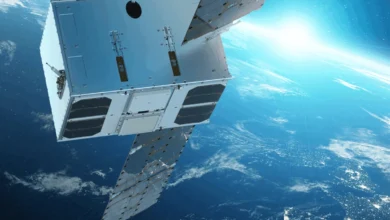
Element-1 serves as a technology demonstrator that successfully integrates CesiumAstro’s proprietary communications payloads, active phased array hardware, onboard compute systems, and customized spacecraft bus architecture. The mission represents the physical proof of concept for nearly a decade of research and development.
Element-1 is merely the vanguard of an initial eight-spacecraft pathfinder program, with launch windows already secured for the remaining seven units. The Element program directly feeds operational telemetry, orbital performance data, and edge-processing insights into the development of the broader Synchronicity constellation, ensuring that risk is systematically mitigated before scaled manufacturing begins.
Global Manufacturing Expansion and Workforce Growth
To support the massive production demands of the 737-satellite Synchronicity constellation and its broader defense contracts, CesiumAstro is undertaking an aggressive global infrastructure expansion.
At the center of this industrial scaling is a $500 million, five-year investment plan centered on the company’s Austin, Texas global headquarters. As part of this commitment, CesiumAstro has acquired 270,000 square feet of advanced manufacturing space. This facility will house precision electronics production, spacecraft assembly, integration, and rigorous environmental testing laboratories. The expansion is projected to create 550 new high-tech jobs, expanding the Austin workforce past 1,000 employees by 2030.
Beyond Texas, the company is committing hundreds of millions of dollars to expand its domestic footprint across Colorado, California, Alabama, Florida, and the Washington, D.C. metropolitan area. Internationally, CesiumAstro is scaling its commercial and engineering presence across key allied markets, including operations in the United Kingdom, Germany, Switzerland, Taiwan, Singapore, and Japan.
Industry Implications and Market Outlook
The closure of CesiumAstro’s Series D financing and the formal introduction of Synchronicity underscore a broader structural transformation within the global space economy. As traditional telecommunications architectures struggle to keep pace with escalating demands for resilient, low-latency, and secure data pipelines, market capital is increasingly favoring fully vertically integrated providers.
By controlling the entire stack—from custom silicon and phased-array antennas to spacecraft manufacturing, software, and end-user terminals—CesiumAstro has positioned itself to bypass typical supply chain bottlenecks. Furthermore, by dual-targeting lucrative commercial connectivity markets and high-priority national security missions, the company has insulated its business model against sector-specific cyclical downturns.
As CesiumAstro deploys the remaining Element pathfinders and initiates mass production of the Synchronicity constellation across its newly expanded manufacturing facilities, the company stands ready to challenge legacy defense primes and commercial megaconstellation operators alike. With over $1.2 billion secured in 2026 alone and a validated technology stack operating on orbit, CesiumAstro has firmly transitioned from an ambitious aerospace upstart into a dominant pillar of modern space infrastructure.
Related posts: