Unveiling the Dynamic Evolution of Chariklo: New Insights into the Shifting Ring System of the Solar System’s Largest Centaur

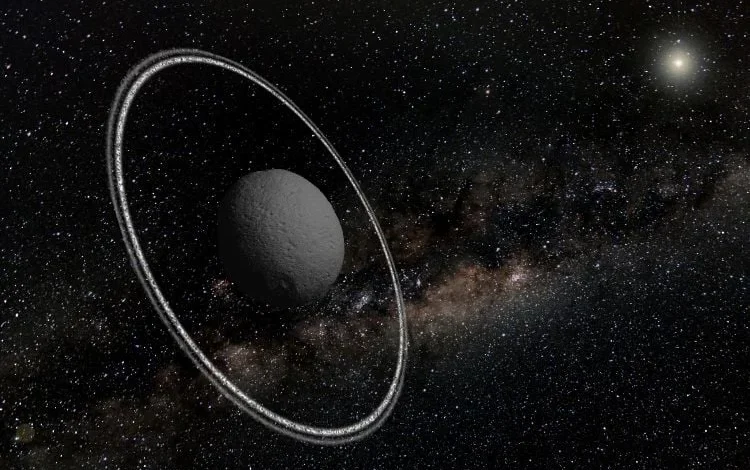
While the popular imagination of the solar system often centers on the well-defined main asteroid belt situated between the orbits of Mars and Jupiter, the outer reaches of our planetary neighborhood are populated by a complex and often overlooked class of icy, transient wanderers known as Centaurs. These objects, which occupy unstable orbits that cross those of the giant outer planets, represent a transitional population between the Kuiper Belt and the short-period comets that occasionally grace our inner solar system. Among these enigmatic bodies, one stands out as a focal point of modern astronomical intrigue: 10199 Chariklo. Discovered in 1997, Chariklo is the largest known Centaur, boasting a radius of approximately 125 kilometers. However, its true significance was not fully realized until 2013, when astronomers made the startling discovery that this minor body possesses a complex, dual-ring system.
Recent findings published in the journal Science Advances have now cast new light on the behavior of these rings. An international research collective, involving over two dozen scientists, has presented compelling evidence suggesting that the rings of Chariklo are not static, unchanging structures but are instead dynamic, evolving environments characterized by the constant gain and loss of material. This discovery challenges existing models of ring formation around minor bodies and opens a new chapter in our understanding of the small, icy architecture of the outer solar system.
A Chronology of Discovery: From 1997 to the Present
The journey to understand Chariklo has been marked by a series of precise, observational milestones. After its initial detection in 1997, the object was tracked primarily to determine its orbital path and physical properties. The 2013 revelation of a ring system—the first ever discovered around a minor body—shattered the prevailing belief that such structures were exclusive to the gas giants like Saturn or Uranus.
The methodology used to study these rings relies on stellar occultation, a technique where an object passes directly in front of a distant, background star. By measuring the minute, characteristic dips in the light of that star as the object and its rings transit, astronomers can map the physical dimensions and opacity of the structures with incredible precision. In 2017, a comprehensive observational campaign established a critical baseline for the rings, detailing their composition and spatial distribution. This baseline proved essential for the comparative analysis performed in 2022, which utilized the unprecedented sensitivity of NASA’s James Webb Space Telescope (JWST).
Analyzing the Shift: Density and Opacity
The recent study highlights a dramatic shift in the physical characteristics of the rings. The inner ring, designated C1R, orbits approximately 265 kilometers from Chariklo’s surface, while the outer ring, C2R, is positioned at roughly 280 kilometers. When researchers compared the data from the 2017 campaign with the 2022 JWST observations, they noted significant fluctuations in opacity.
Opaqueness, in this context, serves as a proxy for the density of material within the rings. A completely transparent region would hold an opacity of zero percent, while a fully obscured light path would represent 100 percent opacity. The 2022 data revealed that the C1R ring had increased its opaqueness by more than 50 percent since the 2017 study. Conversely, the outer C2R ring demonstrated a decline in opaqueness of approximately 60 percent.
These shifts indicate that the rings are not only physically distinct in their density but are also subject to active, ongoing mass-transfer processes. The researchers posit that the inner ring is currently experiencing a period of replenishment, potentially through the capture or gravitational settling of local material, while the outer ring is losing mass, perhaps due to gravitational dispersion or the orbital migration of particles away from the ring plane.
The Role of James Webb Space Telescope
The application of the James Webb Space Telescope to this problem represents a watershed moment for planetary science. While ground-based telescopes have served as the primary tool for occultation studies for decades, the JWST’s infrared capabilities allow for a much cleaner observation of the rings, free from the atmospheric interference that complicates ground-based data collection.
The transit method, while commonly associated with exoplanet hunting, is effectively inverted in the study of Chariklo. In exoplanet research, a planet passes in front of a massive star; with Chariklo, the object is massive relative to the small, distant background star it occults. The success of this observation underscores the JWST’s utility in studying "minor bodies"—objects that, despite their relatively small size, provide crucial data on the volatile, icy processes that shaped the early solar system. By capturing the subtle changes in starlight, the telescope has provided the highest-resolution evidence to date of a minor body in a state of active structural evolution.
Scientific Implications and Future Trajectories
The implications of these findings extend far beyond Chariklo itself. The research team noted that these observations reveal "previously unrecognized behavior in minor-body ring systems." If rings around minor bodies are consistently subject to such temporal evolution, the current classification of these systems must be re-evaluated. The study authors explicitly stated that while the data points toward dynamical behavior, the exact physical drivers—whether they be seasonal thermal changes, collisions with micro-meteoroids, or internal mass-redistribution—remain an open question.
The scientific community is now faced with a fundamental challenge: determining the physical origin of these changes. Is the variation in opacity a result of particles clumping together, or is there a genuine gain and loss of total mass? Furthermore, does this cycle of evolution suggest that rings around minor bodies are ephemeral, lasting only for a fraction of an object’s lifetime before dissipating or being re-accreted?
As the international team continues to monitor Chariklo, the focus will likely shift to longitudinal data collection. Longer-term monitoring will be required to determine if these fluctuations are periodic or stochastic. If the changes are periodic, it could point toward orbital resonances or complex gravitational interactions with Chariklo itself. If they are stochastic, it may imply a high-energy, chaotic environment where impacts and collisions are the dominant forces of change.
Broader Context of Solar System Dynamics
Understanding the dynamics of Chariklo provides a microcosm for the chaotic processes occurring in the outer solar system. Because Centaurs like Chariklo are essentially "escapees" from the Kuiper Belt, their physical state provides clues about the composition and stability of the icy debris that remains in the far reaches of our sun’s influence.
The fact that a ring system can not only exist around such a small body but also change its physical configuration on the scale of a few years is a testament to the complexity of orbital mechanics. It serves as a reminder that the solar system is not a static clockwork mechanism but a living, changing environment where even the smallest objects are subject to the same physical laws that govern the evolution of planetary rings around giants like Saturn.
The research published in Science Advances stands as a definitive call for further study. It demonstrates that our current inventory of solar system objects is far from complete and that the "minor" bodies of our neighborhood are capable of hosting major scientific surprises. As technology advances and the use of space-based observatories like the JWST becomes more routine, the study of Chariklo will undoubtedly serve as a foundational case study for future inquiries into the evolution of small-body ring systems.
For now, the rings of Chariklo remain a mystery in flux, a celestial laboratory where the basic building blocks of the solar system are caught in a constant, observable struggle between gravity and dispersion. The scientific community will continue to monitor these distant, shifting bands of ice, waiting for the next occultation to reveal whether the rings will thicken, fade, or maintain their precarious, changing equilibrium. This, fundamentally, is the nature of planetary science: an ongoing process of discovery that reminds us how much remains to be learned about the objects orbiting in the darkness of our own backyard.
Related posts: