BepiColombo Mission Unveils Solar Secrets as Mercury Flyby Reveals Vulnerabilities in Planetary Shielding

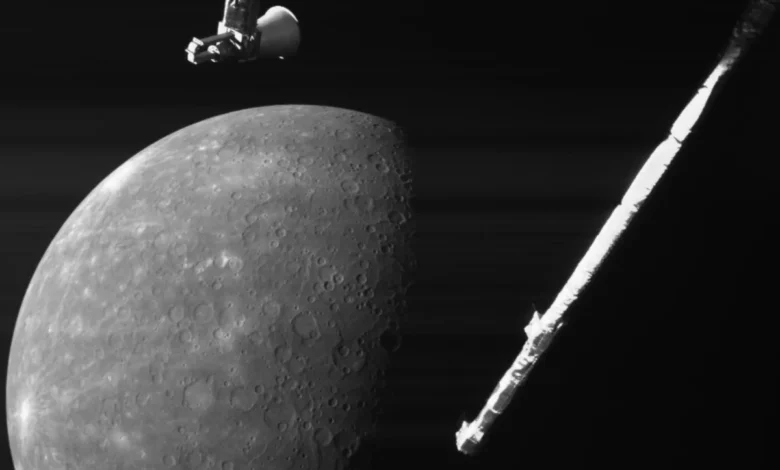
The joint European Space Agency (ESA) and Japan Aerospace Exploration Agency (JAXA) BepiColombo mission has reached a critical scientific juncture, providing unprecedented insights into how planets interact with the violent whims of their host stars. Eight years after its initial launch, the mission’s ongoing campaign of Mercury flybys has yielded a landmark discovery: the direct observation of a massive solar particle eruption impacting the surface of the innermost planet. This event, captured during the spacecraft’s fourth close approach in September 2024, offers a vital "natural laboratory" for understanding space weather—a phenomenon that poses increasing risks to Earth’s modern technological infrastructure.
A Chronology of Exploration: The Long Road to Mercury
Launched in October 2018, BepiColombo was designed to overcome the immense gravitational challenges of reaching Mercury. Because the planet sits deep within the Sun’s gravity well, the mission requires a complex series of gravity-assist maneuvers to shed orbital energy.
The mission’s journey has been marked by a series of precise milestones:
- October 2018: Launch from the Guiana Space Centre in Kourou, French Guiana.
- April 2020: First Earth flyby, utilizing the planet’s gravity to adjust the spacecraft’s trajectory.
- October 2020 & August 2021: Two Venus flybys, further refining the path toward the inner solar system.
- October 2021: First Mercury flyby, beginning the long process of characterization.
- June 2022, June 2023, and September 2024: Subsequent Mercury flybys, each bringing the probe closer to the surface.
- November 2025: Scheduled arrival, where the Mercury Planetary Orbiter (MPO) and the Mercury Magnetospheric Orbiter (Mio) will begin their primary science phase.
The September 2024 encounter was particularly significant. During this fourth pass, BepiColombo dipped to a mere 165 kilometers above the planet’s scorched surface. This proximity, while transient, provided the Solar Intensity X-ray and Particles Spectrometer (SIXS) with a front-row seat to a massive solar event.
The SIXS Instrument and the Solar Particle Event
The SIXS instrument, a Finnish-engineered marvel of space instrumentation, serves as a high-precision sensor for X-rays and charged particles. Developed by researchers at the University of Helsinki, it was specifically designed to monitor the radiation environment surrounding the spacecraft.
During the September 4, 2024 flyby, the Sun unleashed a significant eruption, casting a torrent of high-energy charged particles across the inner solar system. As these particles collided with Mercury’s thin exosphere and rocky crust, the SIXS sensors recorded a dramatic spike in activity. The data showed that the particles penetrated Mercury’s magnetic field—which is notoriously weak compared to Earth’s—and struck the surface directly. This collision triggered a reaction where the kinetic energy of the solar particles was converted into detectable X-rays, providing scientists with a map of where and how much energy was being deposited onto the planet.
"The fourth flyby was truly unique," stated Professor Emilia K. J. Kilpua, the Principal Investigator for the SIXS instrument at the University of Helsinki. "The spacecraft came much closer to the surface than it will be on its final orbit, and we were lucky that a major particle eruption occurred on the Sun at exactly that moment."
Mercury as a Proxy for Earth’s Resilience
While Mercury and Earth are vastly different environments, the physics of their interaction with the Sun remains fundamentally linked. Earth is shielded by a robust, global magnetic field—the magnetosphere—that deflects the majority of the solar wind and protects the atmosphere from being stripped away. Mercury, by contrast, possesses a magnetic field that is roughly 100 times weaker than Earth’s.
This disparity makes Mercury the ideal testing ground for "worst-case scenario" space weather. By observing how solar particles circumvent Mercury’s weak magnetic defenses, researchers can calibrate models to better predict how Earth’s magnetosphere would react under the pressure of extreme solar storms—events that are becoming a focus of global concern as society grows more dependent on orbital assets.
The data gathered during the flyby is now being integrated into the Center of Excellence in Space Resilience. This program, led by Finnish researchers, aims to ensure the continuity of scientific and commercial operations in Low Earth Orbit (LEO). As the number of satellites in orbit continues to climb, the ability to predict, detect, and mitigate the effects of solar radiation has moved from a theoretical interest to a matter of economic and national security.
Analyzing the Scientific Implications
The study, recently published in the journal Nature Astronomy, provides a detailed quantitative analysis of the particle flux observed during the flyby. The research team noted that the penetration of these particles reached a wide geographical area, challenging previous assumptions about the protective capacity of planetary magnetic fields during high-intensity solar activity.
Rami Vainio, co-Principal Investigator of SIXS and a professor of space physics at the University of Turku, highlighted the gravity of these findings. "Mercury’s magnetic field is weaker than Earth’s, and its magnetosphere is much smaller than Earth’s," Vainio explained. "SIXS’s observations help us assess how destructive particle radiation would penetrate Earth’s near-space environment and atmosphere during the most powerful space storms."
The implications are clear: the more we understand about how a planet acts as a shield, the better we can engineer our satellite constellations to withstand the inevitable bursts of solar energy. Major solar events have historically disrupted electrical grids and communication networks on Earth; understanding the penetration depth and energy distribution of these particles is a necessary step toward hardening modern infrastructure.
The Path to Orbital Insertion
The BepiColombo mission is now entering its final approach phase. Earlier this month, the Mercury Planetary Orbiter (MPO) and the Mercury Magnetospheric Orbiter (Mio) successfully separated from the transfer module, a maneuver that marks the beginning of the end of the long cruise.
In November, the two orbiters are scheduled to perform a series of braking maneuvers that will lock them into Mercury’s orbit. By December, the orbiters will further separate, with the MPO focusing on mapping the planet’s surface and subsurface composition, while Mio investigates the planet’s complex magnetic and plasma environment.
As the mission transitions into its primary science phase, the legacy of the SIXS flyby data will continue to provide a foundation for planetary science. The mission represents a triumph of international cooperation, combining European engineering with Japanese scientific goals to answer some of the most enduring questions about our Solar System.
Broader Impact on Space Weather Forecasting
Space weather forecasting is currently in a state of rapid evolution. Historically, models relied on sporadic data from a handful of long-lived missions like the SOHO or SDO solar observatories. BepiColombo adds a new layer of complexity: by providing in situ data from the heart of the inner solar system, it provides a "ground truth" that satellite-based solar observatories cannot match.
The ability to correlate solar eruptions observed at the Sun with the subsequent impact measured at the planet’s surface allows for the refinement of predictive models. This is particularly relevant for the "Resilience" aspect of the current research. If a solar storm can be tracked from the Sun to a planetary destination, it provides a temporal window—a "lead time"—that can be used to put satellites into "safe mode," protecting sensitive electronics from the incoming wave of charged particles.
In conclusion, the data returned by BepiColombo during its fourth flyby is not merely a collection of numbers; it is a critical diagnostic tool. It offers a glimpse into the raw power of the Sun and the fragile nature of planetary magnetic defenses. As the mission progresses into its orbital phase, the global scientific community will continue to look to BepiColombo not just to understand Mercury, but to protect the digital civilization that has blossomed on Earth.
Related posts: