NASA Reassigns SunRISE Mission to SpaceX Falcon Heavy Following ULA Vulcan Performance Anomalies

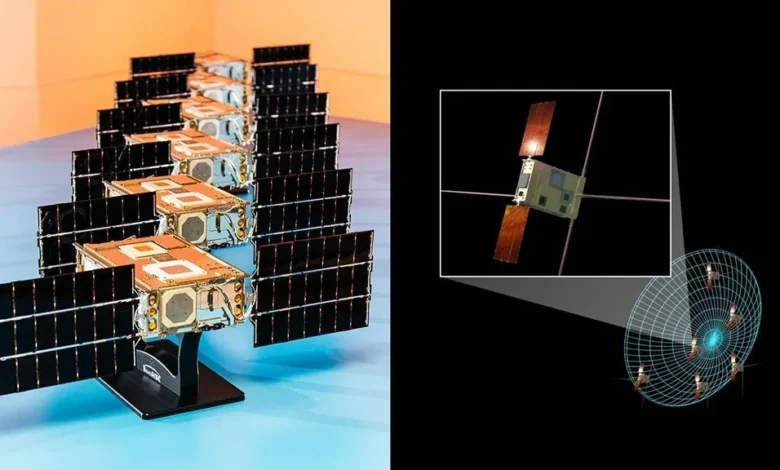
NASA has officially updated the launch manifest for its Sun Radio Interferometer Space Experiment, better known as SunRISE, shifting the mission from United Launch Alliance’s Vulcan Centaur rocket to SpaceX’s Falcon Heavy. This strategic pivot, announced through a NASA mission update, marks a significant change in the logistics for the heliophysics project, which aims to deploy a constellation of six small satellites to study the sun’s most violent outbursts. While the mission remains a high priority for the NASA Science Mission Directorate, the change in launch vehicles reflects broader shifts within the United States Space Force’s launch procurement strategies and the ongoing certification process for new heavy-lift rocket systems.
The SunRISE mission is designed to operate as a space-based radio telescope, providing an early warning system for solar storms that can have devastating effects on terrestrial and orbital infrastructure. Originally manifested to fly as a secondary payload on a Vulcan Centaur, the mission will now utilize the proven flight heritage of the Falcon Heavy. This transition occurs as the U.S. Space Force’s Space Systems Command (SSC) continues to manage its National Security Space Launch (NSSL) Phase 2 contracts, which distribute high-priority missions between SpaceX and United Launch Alliance (ULA).
The Catalyst for Change: Vulcan Centaur Performance Anomalies
The decision to remanifest SunRISE follows a series of technical challenges encountered by the Vulcan Centaur during its early flight history. While ULA’s newest heavy-lift vehicle has successfully reached orbit in its initial launches, its most recent flight—designated USSF-87—experienced a notable performance anomaly. During the ascent, one of the rocket’s solid rocket boosters (SRBs) suffered a visible malfunction, with debris seen trailing from the nozzle area. Although the Vulcan Centaur’s core stage and Centaur V upper stage were able to compensate for the thrust loss and deliver the primary payload to its target orbit, the incident raised red flags for the U.S. Space Force.
Following the USSF-87 mission, the Space Force initiated a pause on national security launches utilizing the Vulcan Centaur to allow for a comprehensive investigation into the booster glitch. For a mission like SunRISE, which is part of a rideshare program managed by the SSC, such delays can create a cascading effect on the schedule. By shifting SunRISE to a SpaceX Falcon Heavy, NASA and the Space Force are likely seeking to ensure the mission stays on track for its projected launch window while ULA works to resolve the SRB issues and finalize the rocket’s certification for the most sensitive national security payloads.
This is not the first time the Space Force has shuffled payloads between its two primary providers. The SSC maintains a "dual-access to space" policy, designed specifically to provide flexibility in the event that one launch vehicle family faces grounding or technical delays. The shift of SunRISE suggests that the Space Force is prioritizing the delivery of space weather monitoring capabilities, opting for the Falcon Heavy—a vehicle with 12 successful launches to its name—to mitigate further schedule risks.
Technical Architecture of the SunRISE Mission
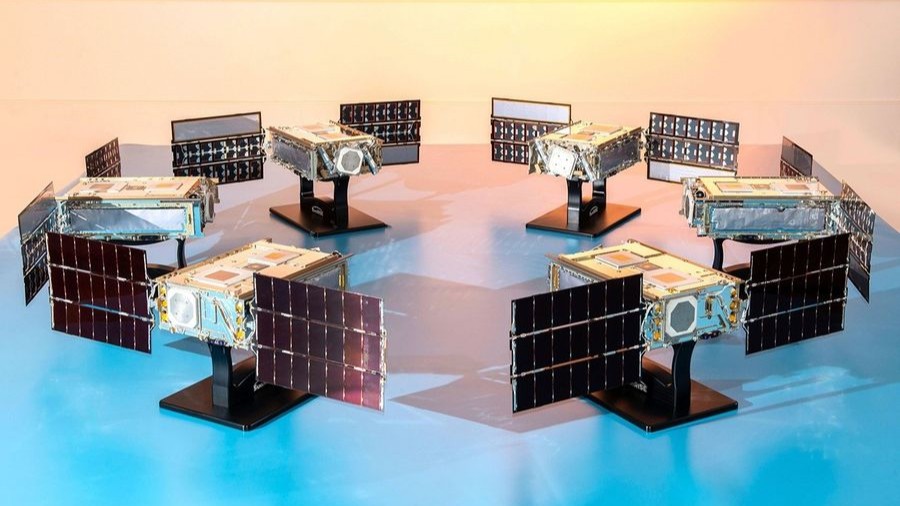
SunRISE represents a unique approach to heliophysics, utilizing a "fractionated" spacecraft architecture. Instead of a single, massive observatory, the mission consists of six small satellites, each approximately the size of a household toaster or a large mailbox. These cubesats will be deployed into a supersynchronous Earth orbit, roughly 22,000 miles (35,000 kilometers) above the planet’s surface.
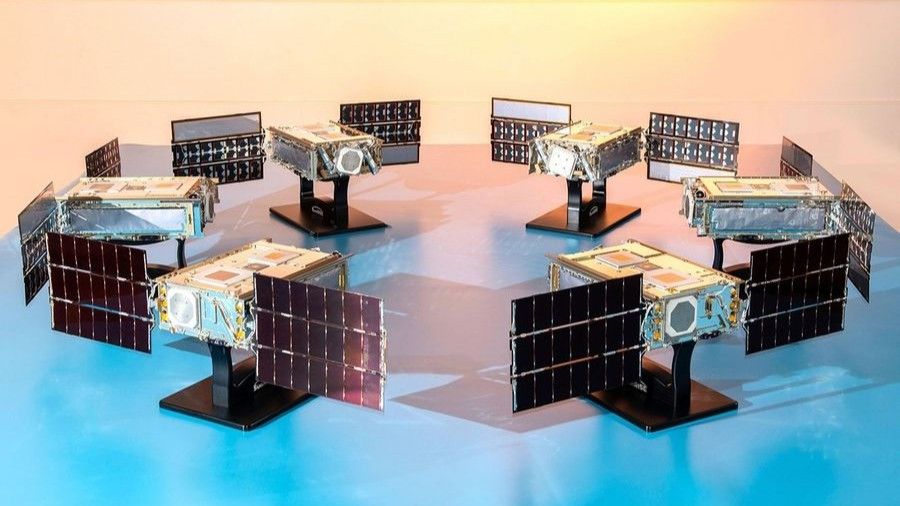
Once in position, the six satellites will maneuver into a precise "X" formation, spanning approximately 10 miles (16 kilometers) across. Each satellite is equipped with 10-foot (2.5-meter) antenna booms. By working in concert, these six individual units will function as a single, massive radio interferometer. This technique, known as aperture synthesis, allows the constellation to mimic the resolution of a radio telescope miles wide—a feat that would be physically and financially impossible to achieve with a single monolithic satellite.
The mission is led by the University of Michigan and managed by NASA’s Jet Propulsion Laboratory (JPL) in Southern California. It falls under the "missions of opportunity" category within the Explorers Program, a division managed by the Goddard Space Flight Center. The primary goal is to map the locations where solar radio bursts originate. These bursts are generated by accelerated electrons in the sun’s atmosphere and are often precursors to Coronal Mass Ejections (CMEs) and solar flares.
The Science of Solar Radio Bursts and Space Weather
The urgency behind the SunRISE mission is driven by the increasing vulnerability of modern technology to space weather. Solar radio bursts are of particular interest to scientists because they travel at the speed of light, arriving at Earth well before the slower-moving energetic particles and plasma clouds associated with solar storms. By detecting and mapping these bursts, SunRISE will provide researchers with the data needed to predict the intensity and direction of incoming solar radiation.
When a major solar storm hits Earth, it interacts with the planet’s magnetic field, potentially inducing geomagnetically induced currents (GICs) in power grids. Historical events, such as the 1859 Carrington Event, demonstrate the potential for solar activity to cripple communication systems. In the modern era, the risks are even higher. High-energy particles can penetrate satellite shielding, causing "single-event upsets" in electronics, degrading solar panels, and interfering with GPS signals.
Furthermore, as NASA prepares for the Artemis missions to the moon and eventual human missions to Mars, understanding the radiation environment beyond Earth’s protective magnetosphere is critical. Astronauts in deep space are at high risk of radiation sickness during solar particle events. SunRISE will contribute to a more robust "weather report" for the solar system, helping mission controllers determine when astronauts need to retreat to shielded areas of their spacecraft.
Falcon Heavy: A Proven Heavy-Lift Workhorse
The reassignment to the Falcon Heavy places SunRISE on one of the most powerful operational rockets in the world. The Falcon Heavy is essentially composed of three Falcon 9 first-stage cores strapped together, featuring a total of 27 Merlin 1D engines. This configuration generates over 5 million pounds of thrust at liftoff, allowing it to carry massive payloads or, in the case of SunRISE, deliver rideshare missions to high-energy orbits with high precision.
Since its debut in 2018—marked by the famous launch of Elon Musk’s Tesla Roadster—the Falcon Heavy has established a reputation for reliability. It has successfully launched various payloads, including the USSF-52 mission and the Viasat-3 F3 telecommunications satellite. Its ability to perform complex orbital insertions makes it an ideal candidate for SunRISE’s high-altitude requirements.
SpaceX’s rapid launch cadence and the reuse of side boosters also provide a level of manifest flexibility that is currently unmatched in the industry. For NASA, utilizing the Falcon Heavy for SunRISE ensures that the heliophysics data collection can begin during the current solar cycle. The sun is currently approaching "solar maximum," the period of peak activity in its 11-year cycle, making the next few years the most critical window for observing intense solar radio bursts.
Broader Implications for National Security and Science Launches
The shift of the SunRISE mission is a microcosm of the current state of the U.S. launch industry. The transition from the aging Delta IV and Atlas V fleets to the Vulcan Centaur has been a complex multi-year process. While ULA remains a stalwart partner for the Department of Defense and NASA, the teething issues of the Vulcan Centaur have allowed SpaceX to solidify its position as the primary alternative for heavy-lift missions.
For the scientific community, the move is a pragmatic one. The SunRISE mission’s budget and timeline are relatively tight compared to "Flagship" missions. Any significant delay caused by launch vehicle grounding could lead to increased storage costs and the potential for hardware degradation. By moving to a vehicle with a clear flight path, NASA JPL and the University of Michigan can focus on the final integration and testing of the six-satellite constellation.
Timeline and Future Milestones
While a specific launch date for SunRISE on the Falcon Heavy has not been finalized, NASA indicates that the mission is still targeted for a launch in the near future. The Falcon Heavy’s manifest is currently crowded, with the high-profile launch of the Nancy Grace Roman Space Telescope scheduled for late 2026 and various other Department of Defense missions on the books. However, as a rideshare payload, SunRISE has the advantage of being able to slot into various mission profiles where excess performance capacity exists.
In the coming months, engineers at JPL and the Space Dynamics Laboratory will finalize the testing of the smallsats, ensuring that the inter-satellite communication links are robust. Once in orbit, the satellites will undergo a commissioning phase to calibrate their antennas and synchronize their clocks to the nanosecond level, a requirement for accurate interferometry.
The data gathered by SunRISE will be integrated into the larger network of NASA’s heliophysics fleet, which includes the Parker Solar Probe and the Solar Orbiter. Together, these missions are providing an unprecedented look at the mechanics of our star, turning the sun from a mysterious celestial body into a predictable component of our solar system’s environment.
Ultimately, the reassignment to SpaceX’s Falcon Heavy is a testament to the importance of the SunRISE mission. Whether launched by ULA or SpaceX, the goal remains the same: to safeguard our technological civilization by peering into the heart of solar storms before they reach our doorstep. The shift ensures that despite the technical hurdles of new rocket development, the pursuit of vital scientific knowledge continues without interruption.
Related posts: