Amazon Web Services Expands Elastic Block Store Capabilities with Cross-Account Volume Clones and Advanced Re-Encryption Security

Amazon Web Services (AWS), a subsidiary of Amazon.com Inc., has announced a significant expansion of its Amazon Elastic Block Store (Amazon EBS) volume cloning capabilities. The cloud computing giant revealed that users can now execute cross-account volume copies, allowing enterprises to securely duplicate EBS volumes across distinct AWS accounts and re-encrypt them utilizing targeted AWS Key Management Service (AWS KMS) keys. This new operational feature bridges a long-standing gap in multi-account cloud architectures, providing an optimized pathway for developers, systems administrators, and DevOps engineers to manage data isolation, compliance, and testing environments without compromising production security.
The introduction of this cross-account functionality builds upon the foundational release of EBS Volume Clones, which debuted previously to enable instantaneous, point-in-time volume copies within a single Availability Zone. By extending this mechanism across account boundaries via AWS Resource Access Manager (RAM), AWS is addressing complex enterprise demands for streamlined staging, rigorous software testing, and secure data sharing across organizational units.
Main Facts and Core Mechanics of Cross-Account EBS Cloning
At its core, the new feature allows organizations to bridge data from a production environment to secondary, isolated environments housed within entirely separate AWS accounts. This capability is vital for software engineering teams that require fresh, real-world application data to run debugging sessions, performance benchmarks, and automated test suites.
The technical execution of a cross-account EBS volume copy relies on integration with AWS Resource Access Manager (RAM), a service designed to safely share AWS resources across multiple accounts or within an entire AWS Organization. The workflow is structured into a precise series of steps to ensure administrative control and security compliance:
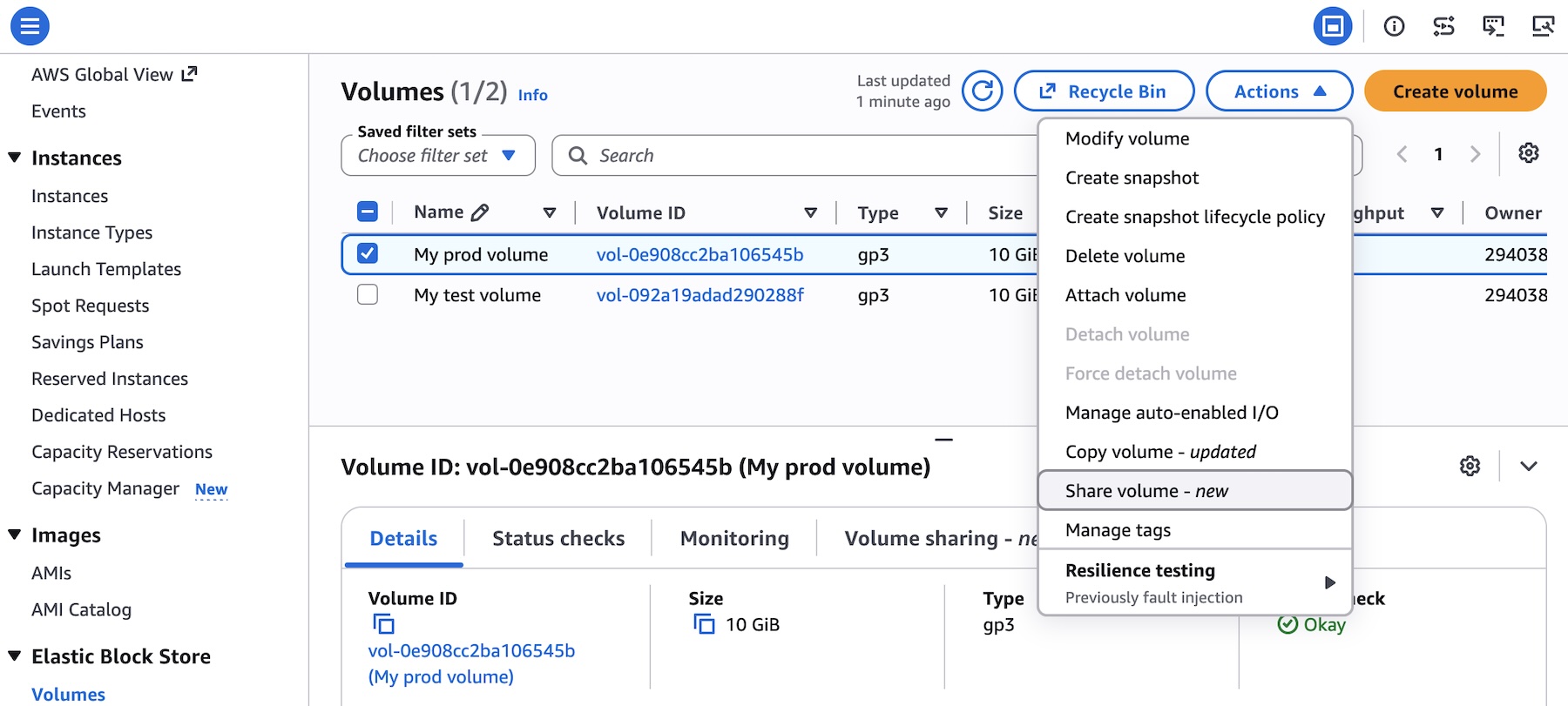
- Volume Sharing Authorization: The owner of the source EBS volume initiates the process through the Amazon EBS console by selecting the "Share volume" option.
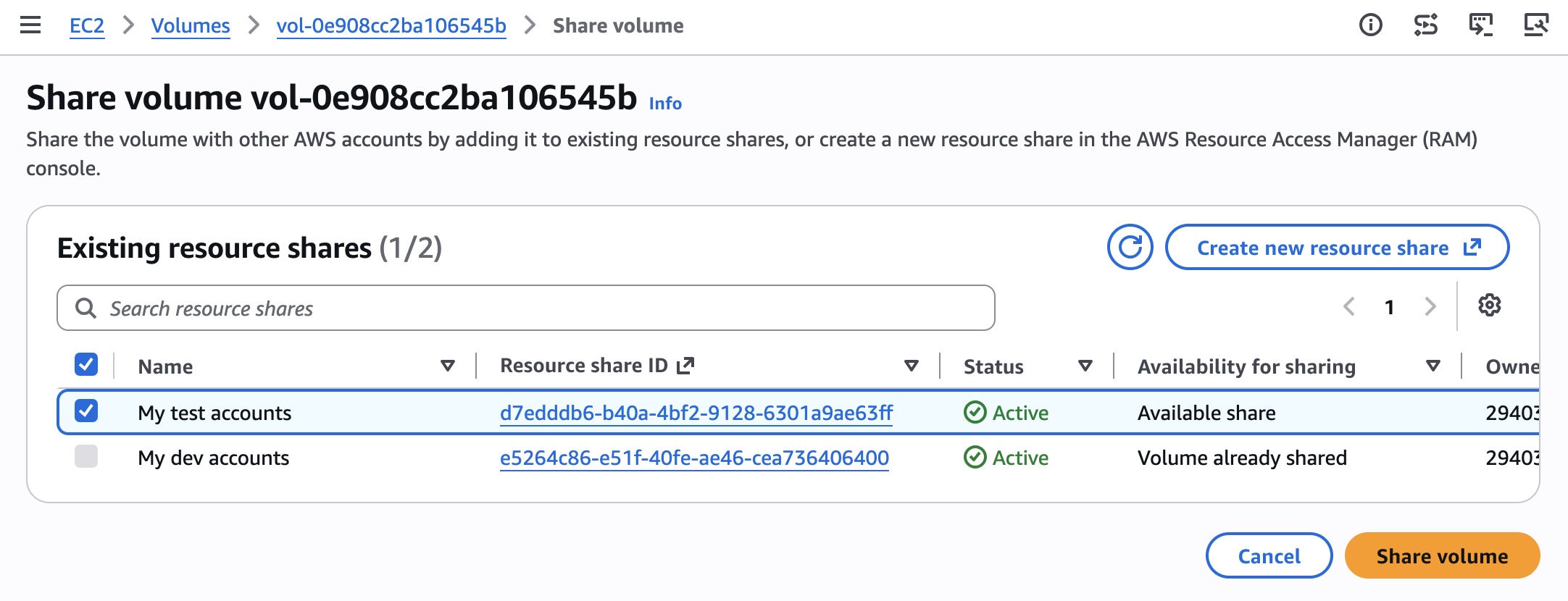
- Resource Allocation: The administrator adds the volume to an existing resource share or establishes a new one via the AWS RAM console, specifying the target AWS account IDs.
- Acceptance Phase: The target account administrator navigates to the RAM console to review and explicitly accept the incoming resource share.
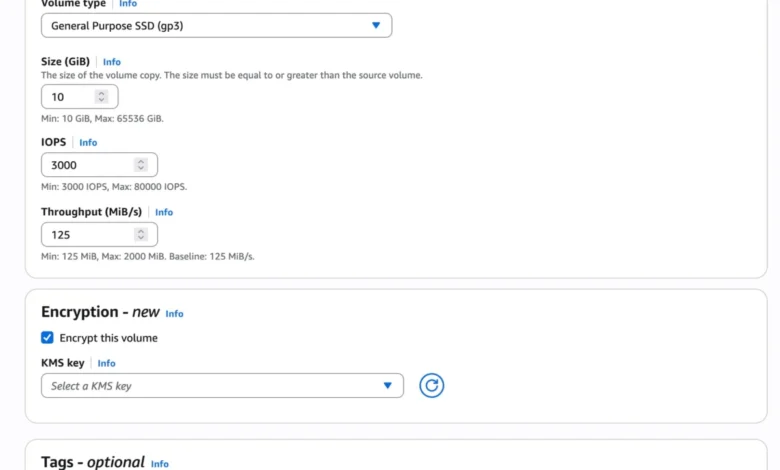
- Execution and Re-Encryption: Once accepted, the shared volume becomes visible within the EBS volume dashboard of the target account. The user selects "Copy volume," at which point they can designate a target AWS KMS key to re-encrypt the data payload according to the security policies of the secondary account.
Additionally, AWS has integrated support for the AWS Model Context Protocol (MCP) Server and associated plugins. This allows development teams to execute and automate these cross-account cloning workflows programmatically through AI-assisted coding tools and specialized developer environments.

Chronology and Evolution of EBS Volume Management
To fully understand the significance of this update, it is necessary to examine the historical trajectory of Amazon EBS data management and volume replication.
- The Early Era of Snapshots: For over a decade, Amazon EBS relied primarily on EBS snapshots—incremental backups stored in Amazon Simple Storage Service (Amazon S3)—to duplicate or migrate volume data. While effective, creating a new volume from a snapshot often involved initialization delays and storage performance overhead, particularly for large-scale enterprise databases.
- Introduction of EBS Volume Clones: Recognizing the need for instantaneous data duplication, AWS introduced EBS Volume Clones. This capability decoupled volume creation from traditional snapshot restoration, allowing users to spin up near-instantaneous, writable point-in-time copies of active block storage volumes within the same Availability Zone.
- The Multi-Account Imperative: As modern enterprises increasingly adopt multi-account strategies—partitioning workloads by department, environment, or security clearance under AWS Organizations—the limitation of single-account cloning became apparent. Organizations frequently found themselves burdened by complex manual export-import routines or cumbersome snapshot-sharing workflows just to provision test environments with production-grade data.
- Current Expansion (Cross-Account Clones): The latest release directly addresses this friction point by merging the speed of volume clones with the organizational flexibility of AWS RAM, culminating in a streamlined cross-account duplication and re-encryption pipeline.
Supporting Data and Technical Architecture
Enterprise cloud environments operate under strict compliance frameworks, meaning data movement across administrative boundaries must be tightly audited and cryptographically secured. The integration of AWS RAM and AWS KMS into the EBS cloning pipeline provides a robust cryptographic foundation.
When a volume is cloned across accounts, the underlying data blocks are mapped efficiently without requiring a monolithic data transfer across the network infrastructure before the clone is initialized. This metadata-driven architecture ensures that the cloning process remains performant, minimizing operational latency even for massive storage volumes scaling into several terabytes.
Furthermore, the capability to apply a unique AWS KMS key in the target account ensures adherence to the principle of least privilege and strict data segregation. Production encryption keys remain isolated from development and staging environments, mitigating the risk of credential leakage or unauthorized data exposure in secondary workspaces. According to AWS infrastructure deployment data, this feature is immediately available across all global AWS Regions that currently support standard Amazon EBS Volume Clones.
Industry Implications and Technical Analysis
Industry analysts and cloud architects view the introduction of cross-account EBS volume clones as a notable step forward for enterprise DevOps productivity and security posture management.
In traditional cloud operations, maintaining synchronization between production databases and test environments often introduces significant friction. Developers either work with stale, synthetic mock data—which fails to capture edge-case bugs present in live systems—or they bypass security protocols to pull production backups into less-secure development accounts. By formalizing a secure, compliant, and instantaneous pipeline via AWS RAM and KMS, AWS has eliminated the technical justification for risky data-handling workarounds.
From a financial perspective, the optimization of storage provisioning translates to measurable cost efficiencies. Organizations no longer need to maintain redundant, permanently active staging databases that mirror production specifications 24/7. Instead, engineering teams can spin up precise clones of production data on-demand, run their experiments or diagnostic tests, and subsequently terminate the resources when no longer required.
However, IT governance teams must remain vigilant. While the technical process of sharing volumes has been simplified, administrators must implement strict Service Control Policies (SCPs) and IAM guardrails within AWS Organizations. Ensuring that only authorized personnel can initiate resource shares via AWS RAM prevents accidental exposure of sensitive corporate data to unauthorized or external AWS accounts.
Official Guidance and Future Outlook
AWS leadership and engineering teams have encouraged cloud administrators to evaluate the new feature within non-production environments before deploying it across mission-critical operational pipelines. Feedback mechanisms have been established via the AWS re:Post community for Amazon EBS, alongside standard enterprise support channels, allowing users to report performance metrics and request enhancements for future platform iterations.

As cloud architectures continue to evolve toward hyper-distributed, multi-account operational models, capabilities like cross-account EBS volume cloning are expected to become standard benchmarks for enterprise-grade cloud infrastructure. AWS has indicated that further regional rollouts and roadmap enhancements will be tracked continuously via the official AWS Capabilities by Region portal, ensuring global parity as adoption scales across industries.
Related posts: