Voyager 2 Captures the Enigmatic Crescent of Neptune in a Historic Interplanetary Retrospective

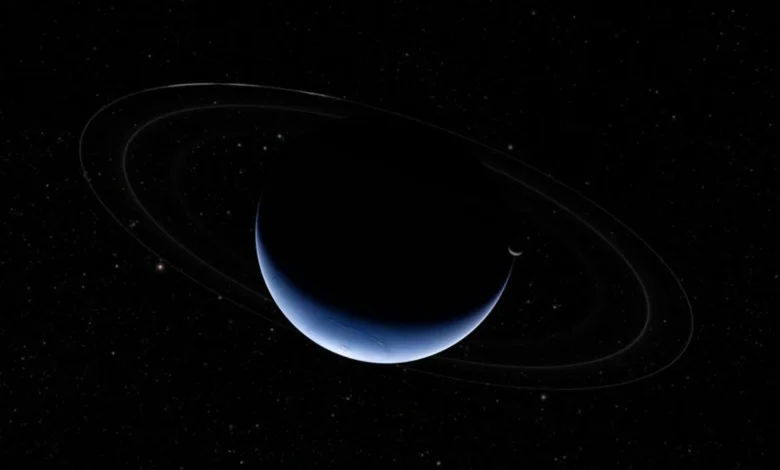
On August 25, 1989, NASA’s Voyager 2 spacecraft achieved a milestone in human exploration by conducting the first and only close-range flyby of Neptune, the solar system’s outermost ice giant. Decades later, composite imagery derived from that mission continues to offer profound insights into the planet’s atmospheric composition, ring structure, and its largest satellite, Triton. The recent release of a meticulously crafted composite image, featuring the Neptunian system as seen from a vantage point looking back toward the Sun, serves as a poignant reminder of the mission’s legacy as Voyager 2 traverses the reaches of interstellar space in 2026.
The Voyager 2 Neptune Encounter: A Chronological Overview
The arrival of Voyager 2 at Neptune was the culmination of a 12-year odyssey that began with its launch on August 20, 1977. While the primary objective of the Voyager program was to explore Jupiter and Saturn, the success of those encounters allowed NASA to extend the mission to Uranus and eventually Neptune.
- August 1989: As the spacecraft approached the Neptunian system, it accelerated toward a precise window of observation. On August 25, 1989, Voyager 2 passed within 4,950 kilometers (3,075 miles) of Neptune’s north pole.
- The Flyby Phase: During this encounter, the spacecraft’s cameras and instruments operated at high capacity, documenting the planet’s dynamic weather patterns, including the Great Dark Spot, and revealing the presence of complex, thin ring arcs.
- Triton Observation: Following the planetary close approach, Voyager 2 performed a targeted flyby of Triton, the planet’s largest and most intriguing moon. This data confirmed the existence of nitrogen-spewing geysers and a surface terrain that suggested geological activity.
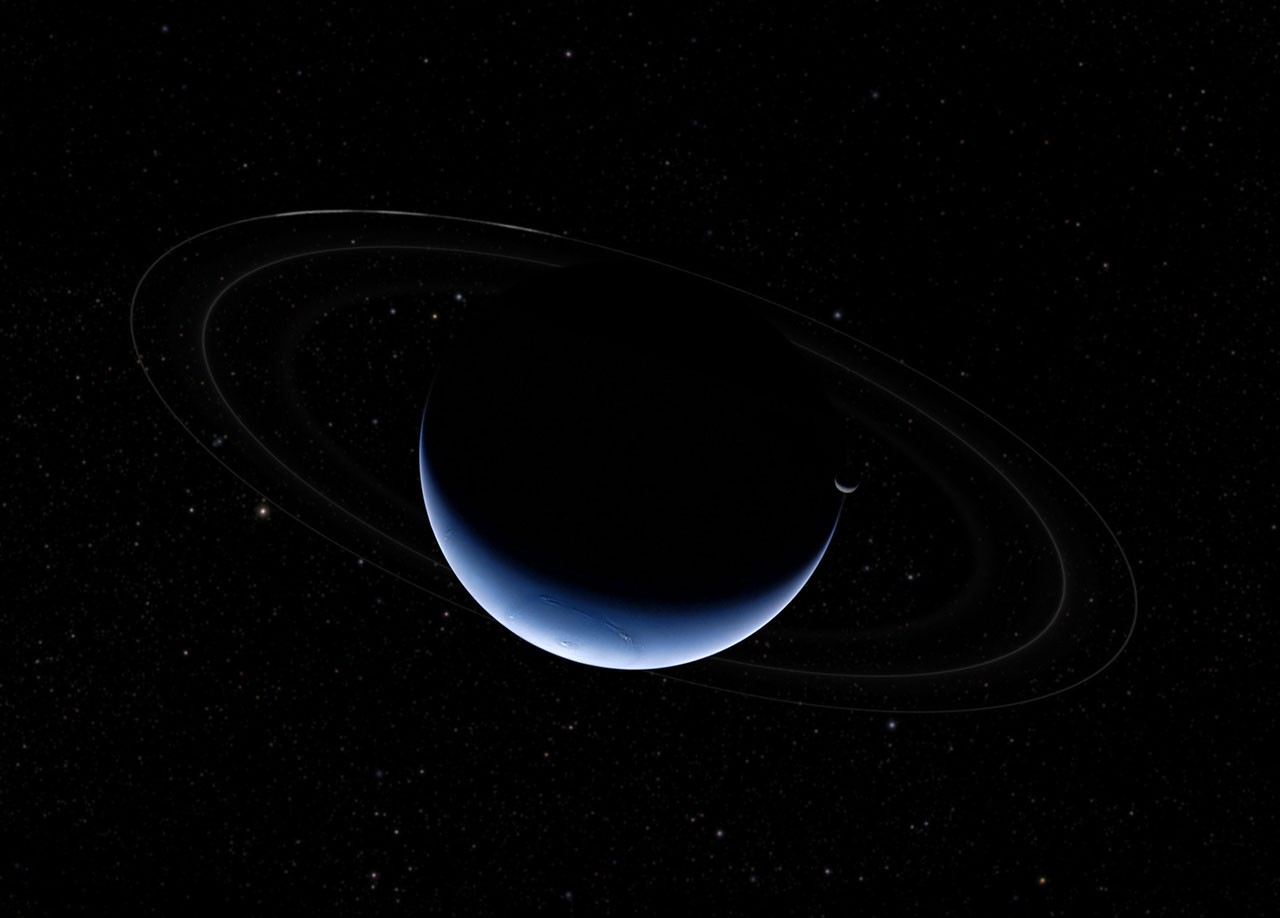
- Post-Flyby Retrospective: The current imagery, which features the crescent phase of Neptune and Triton, represents a "look-back" perspective. This orientation was captured as the probe continued its trajectory out of the solar system, providing a rare view of the planet’s dark side illuminated by the distant Sun.
Atmospheric Dynamics and the Ice Giant Environment
Neptune is categorized as an ice giant, a class of planet distinct from the gas giants Jupiter and Saturn due to the high concentration of "ices"—water, ammonia, and methane—within its interior. The imagery provided by the Voyager mission remains the gold standard for studying the planet’s atmospheric features from a proximity that no subsequent mission has yet matched.
The crescent view highlights the south polar region, where distinct cirrus clouds and a dark, rotating band are visible. Observations from the 1989 encounter identified a cloudy vortex hovering above the pole, a feature that remains a subject of intense study for planetary scientists. The blue hue of the planet, caused by the absorption of red light by atmospheric methane, provides a stark contrast against the dark, cold vacuum of the outer solar system.
The ring system, which was confirmed during the flyby, consists of several distinct, faint rings. These structures are notably uneven, containing "arcs" of higher-density material. While Voyager 2 was able to image the brightest portions of these rings, contemporary astrophotographers and planetary scientists have used the original data to model and reconstruct the fainter, more elusive segments that make up the complete system.
Technical Synthesis: Constructing the Composite Scene
The recently featured composite image is the result of advanced digital processing. By integrating raw data from the 1989 encounter with modern star-field mapping, researchers have produced a visualization that accurately reflects the perspective of the departing Voyager 2 spacecraft.
The starfield background is derived from comprehensive sky survey data, specifically centered on the constellation Camelopardalis. This alignment provides a scientifically accurate representation of the orientation Voyager 2 maintained as it exited the Neptunian system. The inclusion of Triton as a crescent-shaped companion underscores the scale of the system, with the moon’s surface reflectivity and position calculated based on its orbital mechanics at the time of the flyby.
Official Perspectives and Mission Continuity
NASA officials and the broader astronomical community view the continued relevance of the Voyager 2 data as a testament to the longevity of the mission. While the spacecraft is now over 12 billion miles from Earth, having entered interstellar space in November 2018, the data transmitted during the 1980s continues to serve as the foundation for our current understanding of Neptune.
Dr. Edward Stone, the long-serving project scientist for the Voyager mission, has frequently noted that the Neptune encounter was a "final check" on the architecture of the solar system. The discovery of Triton’s active cryovolcanism—which implies that the moon is still geologically alive despite its distance from the sun—remains one of the most significant findings in planetary science. It shifted the paradigm of what "habitable" or "active" environments might look like in the outer solar system, influencing the design of subsequent missions such as the Cassini-Huygens mission to Saturn and the New Horizons mission to Pluto.
Broader Impact and Scientific Implications
The enduring nature of the Voyager 2 data carries implications that extend beyond the study of Neptune. By establishing a high-fidelity record of an ice giant, the mission provided a benchmark for detecting and analyzing exoplanets. As telescopes like the James Webb Space Telescope (JWST) identify ice giants orbiting distant stars, astronomers rely on the Voyager Neptune data to interpret light signatures and atmospheric composition.
Furthermore, the Voyager mission has functioned as a "pathfinder" for deep-space communication. The challenges faced by NASA engineers in 1989—managing data transmission over a four-hour round-trip time for signals—helped refine the Deep Space Network (DSN) technologies that are currently essential for modern interplanetary missions.
Looking Toward the Future of Neptune Exploration
While Voyager 2 remains the only probe to have visited Neptune, the scientific community is currently evaluating proposals for a dedicated orbiter mission to the Neptune-Triton system. The 1989 encounter, while groundbreaking, was a flyby—a brief snapshot of a complex, evolving system. A long-term mission would aim to answer lingering questions regarding the interior structure of Neptune, the origins of Triton, and the mechanisms behind the planet’s intense internal heat, which is significantly higher than that of Uranus despite the latter being closer to the Sun.
Until such a mission is approved and launched, the imagery provided by the Voyager 2 legacy serves as the primary window into the Neptunian world. The crescent Neptune, hanging in the void with its faint ring system and distant moons, serves not only as a record of a historic achievement but as a motivation for the next generation of space exploration.
In 2026, as Voyager 2 continues its silent journey through the interstellar medium, the data it gathered remains a vital asset. It is a reminder that the reaches of our solar system are not static; they are dynamic, complex, and still full of mysteries waiting to be decoded by the next generation of planetary scientists. The composite imagery of a sunlit crescent Neptune serves as the final, enduring chapter of a mission that forever expanded the boundaries of human knowledge.
Related posts: