AWS Lambda Now Supports GPU-Accelerated Workloads on EC2 G-Series Instances Using Managed Instances

Amazon Web Services (AWS) has officially announced native graphics processing unit (GPU) support for Amazon EC2 G-series instances operating within AWS Lambda Managed Instances (LMI). This landmark release introduces serverless simplicity to heavy computing workloads, allowing organizations to run machine learning inference, complex media processing, advanced rendering, and high-performance scientific computing without the traditional overhead of managing lower-level infrastructure.
By bridging the gap between high-performance hardware and serverless architecture, AWS aims to eliminate the historical friction points of deploying GPU-based applications in the cloud. The new capability is generally available immediately across standard AWS regions, supporting a wide array of Amazon EC2 G-series instance families, including G4dn, G5, G6, G6f, Gr6, Gr6f, and G6e.
Main Facts and Architecture of Serverless GPU Computing
Under the new paradigm, GPU-accelerated functions are deployed packaging Open Container Initiative (OCI) images. Developers build an OCI container image, configure the Lambda function to point toward it, and delegate provisioning, automatic scaling, and native event integration entirely to AWS.
Crucially, engineering teams no longer need to manually reconcile GPU drivers, specific CUDA toolkit versions, or Amazon Machine Images (AMIs), nor do they have to configure clusters, orchestration software, or device plugins. These GPU-accelerated functions execute on the robust foundation of Lambda Managed Instances, inheriting Amazon EC2 pricing structures and specialized compute capabilities while completely abstracting server management.
The system natively accepts container images up to 32 GB—with individual files limited to 10 GB—complemented by up to 32 GB of NVMe ephemeral storage in the /tmp directory. Memory allocations range flexibly from 2,048 to 32,768 MB, while accelerator memory scales between 3 and 48 GB. Furthermore, environments support up to 48 concurrent requests per execution environment and an impressive 15,000 vCPUs per capacity provider. To accommodate lengthy batch operations and complex transcoding pipelines, function timeouts have been extended up to 90 minutes for asynchronous and event source mapping invocations.

Addressing Industry Pain Points: Complexity and Cost
Historically, organizations looking to leverage GPU acceleration faced a dual dilemma: architectural complexity and prohibitive costs. Self-managed GPU infrastructure required teams to meticulously select instance types, install and maintain compatible driver versions and CUDA libraries, forecast peak capacity, custom-code scaling logic, and manually wire event integrations to tie the GPU processing step into the broader application ecosystem. Conversely, alternative serverless GPU platforms often existed outside the core corporate AWS environment, lacking native event sources, unified identity management, and secure enterprise networking.
The second major hurdle was resource utilization and cost efficiency. GPUs are traditionally expensive computing resources, and real-world utilization rates frequently lag because individual workloads rarely saturate an entire card continuously. A lightweight inference query, for instance, might leave the vast majority of a provisioned GPU sitting idle, yet organizations remained financially liable for the entire unit.
The integration of GPU support into Lambda Managed Instances addresses both challenges simultaneously. Developers can deploy code that spins up on a GPU in minutes, triggered directly by standard AWS event sources, secured through existing IAM policies, and billed transparently. Moreover, the architecture maximizes cost efficiency by consolidating multiple concurrent functions onto shared instances, keeping the underlying hardware continuously engaged across overlapping requests.
Chronology and Implementation Methodology
The rollout of serverless GPU capabilities represents the culmination of multi-year architectural enhancements within AWS serverless computing. Following the internal development and stabilization of Lambda Managed Instances, engineers focused heavily on abstracting specialized hardware accelerators to align with event-driven execution models.
Implementing a GPU-accelerated function follows a streamlined, four-step workflow:
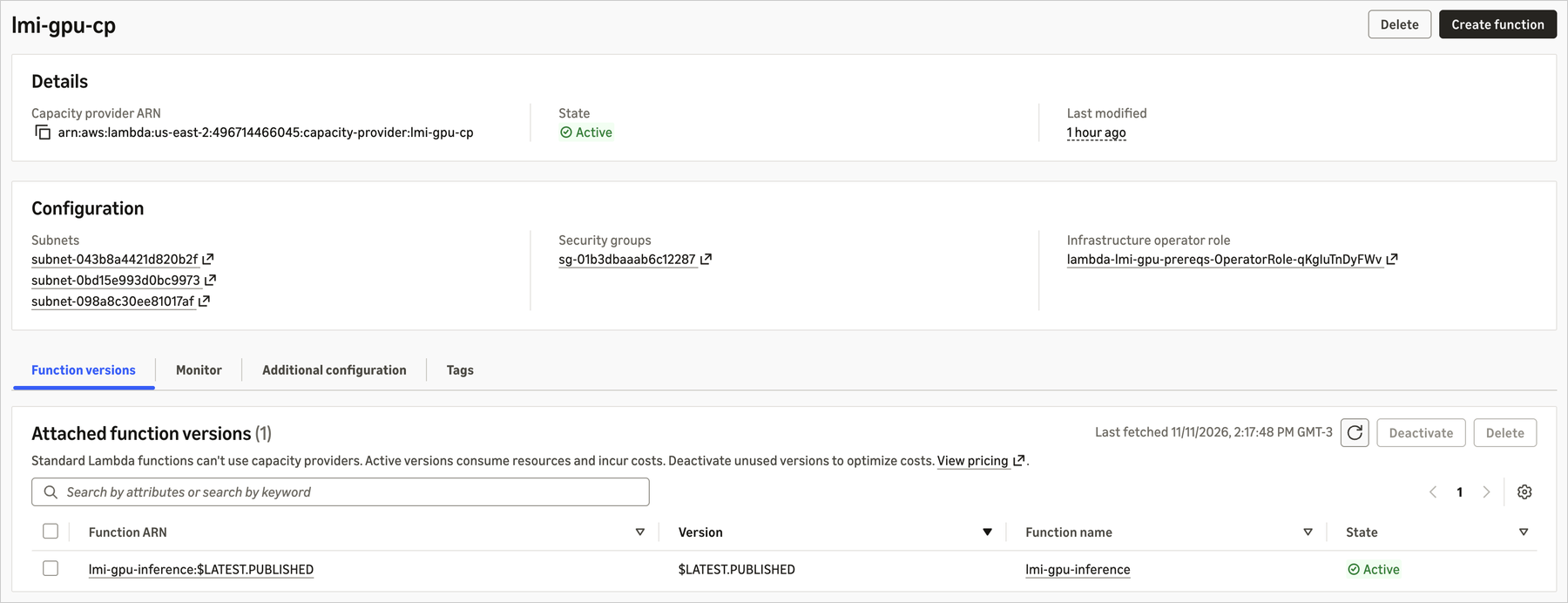
- Capacity Provider Creation: The developer defines a capacity provider specifying permissible GPU instance types (such as g5.2xlarge, g6.2xlarge, or g6e.2xlarge) alongside VPC subnets and security groups, allowing Lambda to manage automated scaling and fallback.
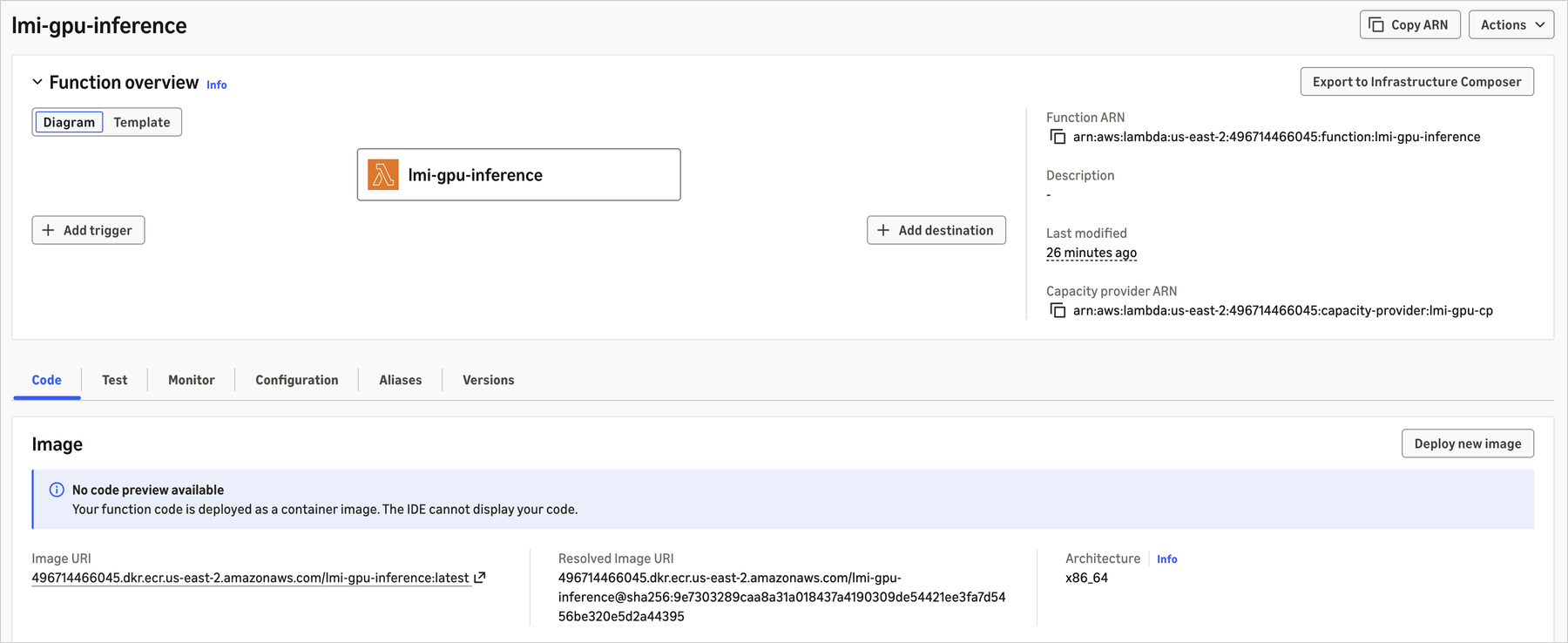
- Container Image Construction: Developers leverage curated AWS base images—such as the vLLM base image containing PyTorch, Transformers, the CUDA toolkit, and a runtime interface client—requiring minimal custom code. By setting a
MODEL_IDenvironment variable pointing to a Hugging Face repository, Amazon S3 bucket, or local path, the system automatically downloads model weights and provisions memory. - Function Deployment: Using the AWS CLI or console, the function is created with designated memory, storage limits, and
AcceleratorConfigparameters specifying minimum accelerator memory requirements. - Publishing and Invocation: Publishing a version triggers the initialization phase, downloading weights and warming up the engine within the execution environment so that the initial caller experiences zero cold-start latency. Standard payloads—such as OpenAI-compatible chat completion requests—can then be dispatched instantly.
Supporting Data and Out-of-the-Box Capabilities
The platform includes a robust suite of native features designed to strip away operational burdens:
- Curated Software Stacks: Out-of-the-box base images include
base:cuda,cupy:cuda,pytorch:cuda, and serving-optimized images likevllm:cudaandsglang:cuda. - Native Event Triggers: Over 200 AWS event sources—including Amazon S3, Amazon SQS, Amazon API Gateway, and Amazon EventBridge—can trigger GPU functions directly without intermediary integration logic.
- Concurrent Execution Management: Fine-grained per-environment concurrency controls allow multiple requests to share a single model instance loaded in GPU memory, drastically increasing throughput.
- Flexible Capacity Options: Instances operate on Amazon EC2 On-Demand terms, fully compatible with existing Savings Plans and Reserved Instances. Organizations can also map workloads directly to EC2 On-Demand Capacity Reservations (ODCRs).
- Seekable OCI (SOCI) Lazy Loading: Reduces execution environment startup latency by up to 70% by permitting functions to begin execution before the complete container image is fully downloaded.
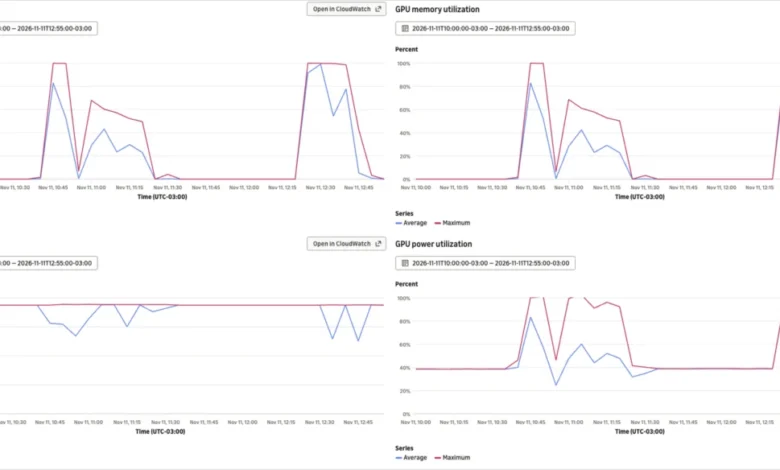
- Comprehensive Monitoring: Amazon CloudWatch and the AWS Lambda console surface granular, real-time telemetry tracking GPU utilization, GPU memory utilization, absolute memory usage, and GPU power consumption.
Fact-Based Analysis of Implications and Industry Impact
Industry analysts note that bringing GPU power into the serverless fold marks a significant maturation point for cloud-native artificial intelligence and machine learning operations (MLOps). By removing the necessity of cluster administration and low-level driver maintenance, AWS has effectively lowered the barrier to entry for small-to-midsize engineering teams seeking to deploy custom open-source models, natural language processing tasks, and intensive media pipelines.
Financially, the pricing model—combining underlying EC2 instance fees, eligibility for Savings Plans, a modest 9.75 percent management fee for GPU instances, and standard Lambda request fees—provides a highly predictable cost structure. Enterprises can now experiment with custom machine learning inference and specialized computing workloads in lightweight, ephemeral environments, signaling a profound shift in how modern distributed applications will harness accelerated hardware moving forward.