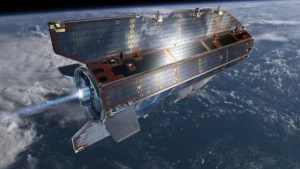
The tyranny of the rocket equation remains the most significant barrier to the expansion of human presence in the solar system. For decades, space agencies and private aerospace firms have been constrained by the physical dimensions of launch vehicle fairings, which dictate the maximum size of any payload sent into orbit. While missions like the James Webb Space Telescope (JWST) have pushed the boundaries of engineering through complex, origami-like deployment mechanisms, this approach is fundamentally limited by mechanical complexity and mass constraints. To achieve the next generation of infrastructure—structures spanning hundreds of meters or even kilometers—humanity must pivot from launching completed assets to performing autonomous in-space manufacturing and assembly.
The Novel Orbital and Moon Manufacturing, Materials and Mass-efficient Design (NOM4D) program, spearheaded by the Defense Advanced Research Projects Agency (DARPA), is currently shifting this paradigm. By focusing on the automated assembly of space-based structures using modular, mass-efficient components, the program aims to bypass the limitations of current launch architecture. A pivotal milestone was reached recently when the program successfully executed the first-ever demonstration of automated in-space structural assembly, signaling a potential shift in how large-scale orbital assets are realized.
The Mechanics of Orbital Construction
The recent successful test involved a gantry-style robotic system, which utilizes linear motion along the X, Y, and Z axes to position components with high precision. Developed in collaboration with researchers at the California Institute of Technology (Caltech), the system functioned similarly to terrestrial modular construction kits, such as Tinkertoys or K’nex. By joining individual truss members at pre-defined nodes, the robot was able to form a rigid structural framework while simultaneously applying a thin, reflective mesh. This mesh serves as a proxy for the high-precision surfaces required for large-aperture antennas or solar energy collection arrays.
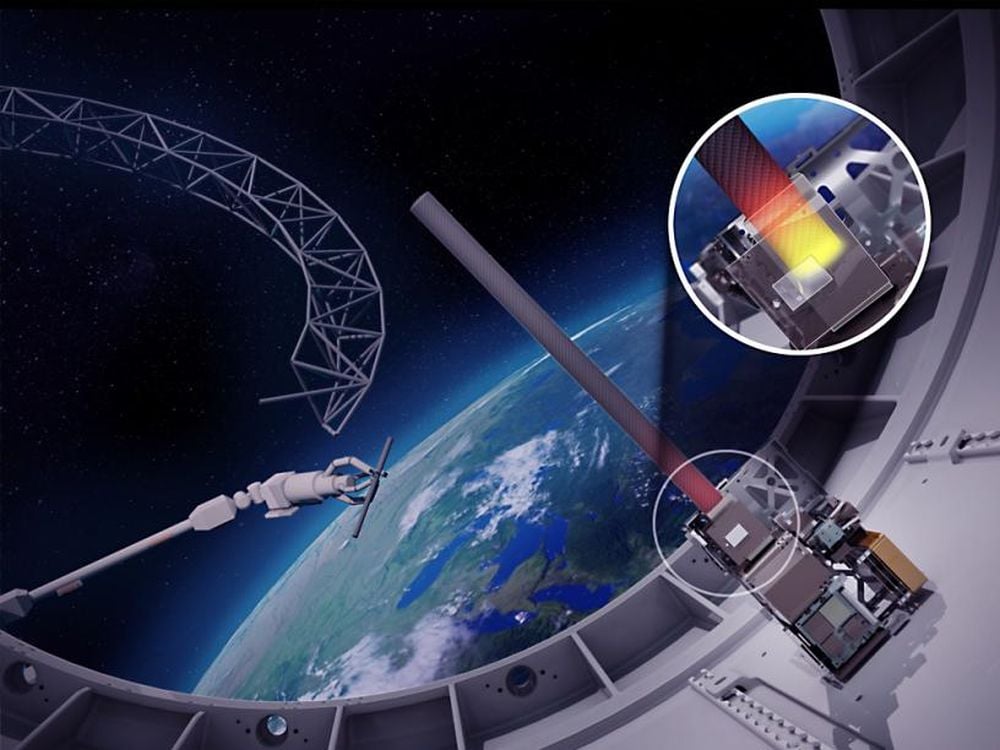
The simplicity of this approach is its primary strategic advantage. By eschewing overly complex, high-degree-of-freedom robotic arms in favor of linear gantry systems, the engineering team has prioritized reliability and scalability. In the vacuum of space, where thermal expansion, radiation, and the lack of a stable gravity vector complicate mechanical operations, a predictable, deterministic assembly process is essential.
A Chronology of Rapid Development
The trajectory of the NOM4D program has been defined by an aggressive shift from theoretical research to flight hardware. Initially, the program was structured to follow a traditional multi-phase development cycle, emphasizing long-term laboratory testing and design validation.
In February 2025, leadership made the strategic decision to accelerate the timeline. Recognizing that the maturity of the assembly processes developed by Caltech and the University of Illinois Urbana-Champaign had outpaced projections, DARPA bypassed a planned third phase of ground-based testing. This decision led to the launch of the prototype payload via a SpaceX vehicle in March 2026.
The transition from a laboratory concept to an on-orbit demonstration within a 15-month window represents a significant acceleration in aerospace development cycles. According to program manager Andrew Detor, the decision to move to space early was driven by the realization that operating in an orbital environment presents unique challenges—such as microgravity dynamics and vacuum-induced material behavior—that cannot be fully replicated on Earth. By testing directly in the operational theater, the program has effectively compressed years of iterative development into months of actionable flight data.
Supporting Data and Technical Context
The limitations of current technology are stark. Current heavy-lift launch vehicles, such as the SpaceX Starship or NASA’s Space Launch System (SLS), are limited by fairing diameters typically between 5 and 9 meters. A telescope or antenna exceeding this diameter must be folded, which increases the "stowage mass" ratio—the amount of weight dedicated to deployment hinges, motors, and locks rather than scientific utility.
NOM4D aims to minimize this ratio by shipping "raw" structural elements that are lightweight and high-strength. The program is currently focused on:
- Mass-Efficiency: Reducing the launch weight of structures by eliminating the need for rigid support mechanisms required to survive launch loads.
- Scalability: Enabling the creation of "very large" structures, defined by DARPA as reaching hundreds of meters in scale, which are currently impossible to launch in one piece.
- Automated Precision: Utilizing software-driven assembly to ensure that complex structures meet the geometric tolerances required for optical or radio-frequency applications.
Implications for Future Space Infrastructure
The successful demonstration of the NOM4D prototype has far-reaching implications for the emerging space economy. The ability to assemble large-scale infrastructure in situ transforms the business case for several high-value orbital assets:
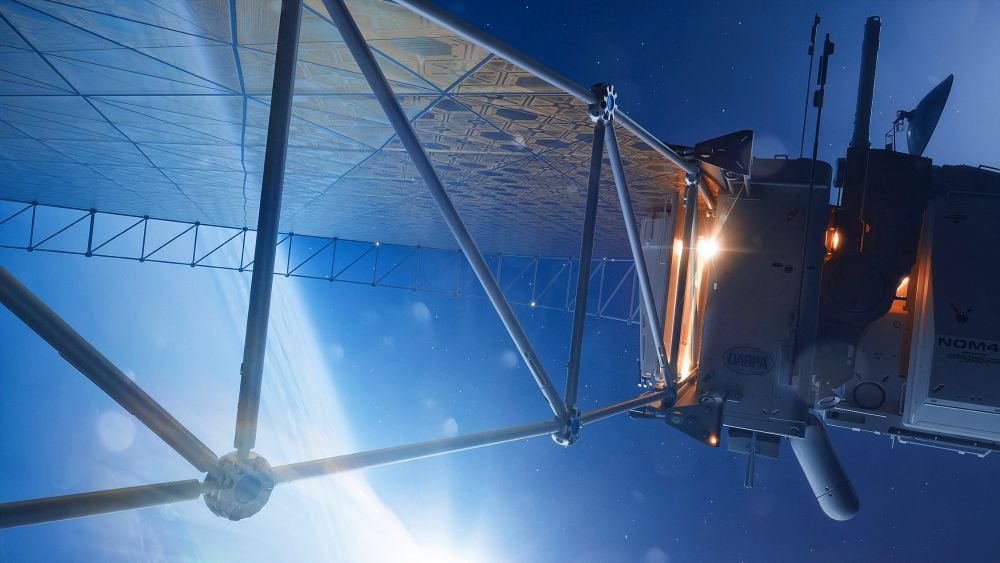
- Large-Aperture Antennas: Future communication and surveillance assets require massive parabolic surfaces to maintain signal strength and resolution. NOM4D-style assembly could allow for the deployment of antennas that would otherwise require hundreds of launches if sent as fully assembled units.
- Space-Based Solar Power (SBSP): Harvesting solar energy in orbit requires massive arrays that must track the sun. The modular, scalable nature of NOM4D makes it a primary candidate for constructing the kilometer-scale arrays needed to make orbital power generation economically viable.
- Orbital Depots: As humanity expands its reach to the Moon and Mars, orbital fuel and logistics depots will be required. These facilities need large shielding and pressurized volumes, which are best constructed in orbit to avoid the structural stresses of atmospheric ascent.
Furthermore, the technology extends beyond low-Earth orbit. The concept of utilizing lunar lava tubes—naturally occurring subsurface voids—as protected habitats relies on the ability to reinforce these structures with robotic systems. If NOM4D-inspired machines can autonomously deploy trusses and mesh liners within these tubes, the challenge of protecting human crews from solar radiation and micrometeorites on the lunar surface would be significantly mitigated.

The Next Frontier: Advanced Material Processing
While the initial demonstration proved the efficacy of truss assembly, the next phase of the program, led by the University of Illinois Urbana-Champaign, will target the International Space Station (ISS). This upcoming mission aims to move beyond simple mechanical assembly into in-space material processing.
The team plans to use a monomer resin to synthesize high-strength composite structures directly in the space environment. This process mimics the production of Carbon Fiber Reinforced Polymers (CFRP) on Earth but optimizes the curing process for the unique vacuum and thermal conditions of orbit. By heating and curing the resin in real-time, the system will demonstrate the ability to create bespoke, high-performance structural elements that are too bulky or fragile to be transported from the ground.
Historical Context and Long-term Vision
The ambition behind NOM4D echoes the visionary work of Gerard K. O’Neill, whose 1976 seminal work, The High Frontier: Human Colonies in Space, proposed the construction of massive rotating space habitats. While O’Neill’s vision of O’Neill Cylinders housing thousands of people remains a distant goal, the foundational technologies required to achieve it—large-scale structural assembly and autonomous manufacturing—are finally catching up to the theory.
As Andrew Detor noted, the Caltech demonstration is not an endpoint but a catalyst. The program has successfully proven that the "Tinkertoy" approach to orbital construction is not only feasible but scalable. As DARPA continues to push the boundaries of what is possible in the vacuum of space, the focus will increasingly shift from "how do we get it there" to "what can we build now that we are there."

The rapid maturity of the NOM4D program suggests that the timeline for large-scale orbital infrastructure may be shorter than previously anticipated. By reducing reliance on the rocket fairing as the primary arbiter of size, DARPA is setting the stage for a new era of space exploration—one where the architecture of the cosmos is defined by human ingenuity and autonomous production rather than the rigid, narrow confines of current launch vehicle design. The next decade of space development will likely be judged by the ability of these automated systems to assemble, rather than just deploy, the future of human infrastructure in the high frontier.
Related posts: