The Remarkable Legacy of Ingenuity: How a Tiny Helicopter Redefined Martian Exploration

The mid-1960s marked the dawn of humanity’s obsession with the Red Planet, a period defined by the National Aeronautics and Space Administration’s (NASA) nascent efforts to breach the celestial frontier. Following the disappointment of a failed 1964 mission, the Mariner 4 spacecraft successfully completed a flyby of Mars, transmitting the first close-up images of another world back to Earth. This milestone served as the catalyst for a half-century of technological ambition, eventually leading to the successful 1976 landing of Viking 1. These early successes laid the groundwork for a lineage of robotic explorers—Spirit, Opportunity, and Curiosity—that would fundamentally alter our understanding of Martian geology and the potential for ancient life. However, none captured the global imagination quite like the Mars Helicopter, Ingenuity, which transformed from a high-risk experimental project into a cornerstone of interplanetary aviation.
The Genesis of Extraterrestrial Flight
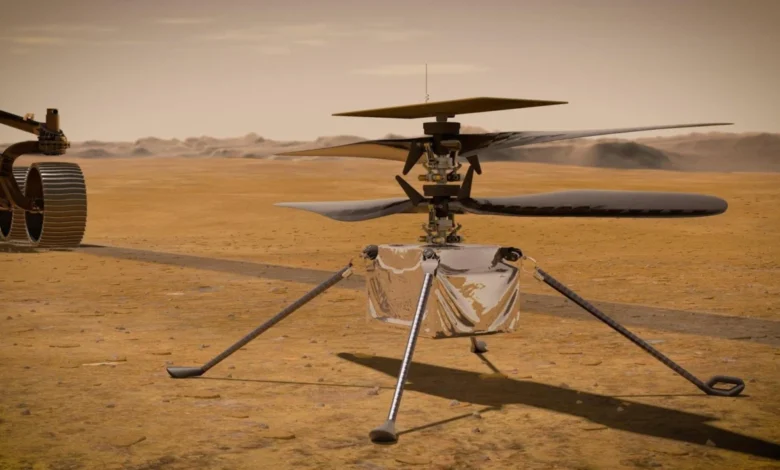
The deployment of Ingenuity in 2020 was a bold gamble. Arriving at the Jezero Crater as a stowaway tucked beneath the belly of the Perseverance rover, the helicopter was tasked with a singular, daunting objective: to prove that powered, controlled flight was possible in the thin, carbon-dioxide-rich atmosphere of Mars, which boasts only one percent of Earth’s atmospheric density.
Engineers at NASA’s Jet Propulsion Laboratory (JPL) faced an unprecedented aerodynamic challenge. To achieve lift in such a sparse medium, Ingenuity had to be exceptionally lightweight—weighing just four pounds on Earth and a mere 1.5 pounds under Martian gravity—while utilizing massive, four-foot-long carbon-fiber rotor blades that spun at nearly 2,400 revolutions per minute, roughly eight times faster than a standard Earth-bound helicopter.
On April 19, 2021, the world watched as Ingenuity ascended into the Martian sky for the first time. The success of this 39-second flight was quickly dubbed a "Wright Brothers moment" for the 21st century. It was the first instance of human-made flight on another planet, a feat that defied the skepticism of many within the aerospace community who doubted the feasibility of flight in such extreme conditions.
A Chronology of Perseverance and Ingenuity
The mission timeline of Ingenuity serves as a testament to the engineering prowess of the JPL team. Initially, the project was intended to last only 30 days, with a strict limit of five test flights. The primary goal was purely scientific validation: could a drone-like craft navigate the Martian terrain without succumbing to the cold, dust, or power failures?
- February 2021: Perseverance lands in Jezero Crater, carrying Ingenuity.
- April 2021: The first controlled flight occurs, establishing the viability of rotorcraft on Mars.
- May–December 2021: The mission is extended as Ingenuity successfully scouts challenging terrain for the Perseverance rover, providing aerial reconnaissance that ground-based navigation could not match.
- 2022–2023: Ingenuity overcomes seasonal dust storms and freezing temperatures, consistently exceeding its planned flight envelope.
- January 2024: Following 72 successful flights, Ingenuity sustains damage to its rotor blades during a landing in the "Valinor Hills" region. The mission is officially declared over as the helicopter is grounded permanently.
Statistical Triumphs: By the Numbers
The data collected by Ingenuity’s flight computer paints a picture of a mission that far exceeded its design specifications. Over the course of nearly 1,000 Martian sols (days), the helicopter spent a cumulative 128 minutes in the air. While two hours of flight time may appear modest by terrestrial aviation standards, this performance was an exponential leap forward in interplanetary exploration.
Ingenuity covered a total distance of approximately 11 miles—14 times the distance originally targeted by NASA engineers. Each flight served as an experimental data point, providing NASA with critical information on atmospheric density, energy management via solar charging, and the durability of lithium-ion batteries in sub-zero environments that regularly drop below -100 degrees Fahrenheit. The helicopter acted as an essential scout, identifying obstacles such as sand traps and rocky outcrops, effectively increasing the speed and safety of the Perseverance rover’s scientific traverses.
Official Responses and the Final Transmission
The decision to ground Ingenuity was handled with the gravity of a formal retirement ceremony. NASA leadership acknowledged that while the helicopter was still structurally intact, its mobility had been compromised by the damage to its blades, rendering further flight dangerous to the mission’s integrity.
"The historic journey of Ingenuity, the little helicopter that could, has come to flight," NASA Administrator Bill Nelson stated during the formal announcement. "That remarkable helicopter flew higher and farther than we ever imagined and helped NASA do what we do best—make the impossible, possible."
In its final act, the JPL team commanded Ingenuity to perform a final, comprehensive system check. The helicopter successfully activated its flight computers, verified the status of its solar panels, and collected one last set of environmental data before sending a final transmission to Earth. This data serves as a legacy, contributing to the archival knowledge of Mars’ surface conditions for future researchers and mission planners.
Broader Implications for Future Missions
The success of Ingenuity has permanently shifted the paradigm for planetary exploration. The mission demonstrated that aerial platforms are no longer a luxury for space exploration but a necessity. The ability to view terrain from an aerial perspective provides a level of context that rovers, constrained by their two-dimensional ground-level viewpoint, cannot replicate.
This proof-of-concept has already influenced the design of future missions. NASA is currently evaluating concepts for "Mars Science Helicopters"—larger, more robust rotorcraft capable of carrying scientific instrumentation rather than just cameras. These future craft could reach regions of the Martian surface that are inaccessible to wheeled rovers, such as deep crater walls, cliff faces, or volcanic vents where signs of ancient microbial life might be preserved.
Furthermore, the "Ginny" mission has revolutionized our approach to software updates in deep space. The ability to send complex, life-extending code to a craft millions of miles away, ensuring its survival long past its "best-by" date, sets a new standard for mission sustainability.
A Lasting Martian Legacy
While the communication link between Earth and Ingenuity has been severed, the helicopter remains on the surface of Mars, a silent, solar-powered monument to human ingenuity. It sits in the Jezero Crater, a testament to the era when humans first learned to fly on another world.
Meanwhile, the Perseverance rover continues its mission, driving across the Martian landscape to collect samples that will eventually be retrieved by future international efforts. The rover continues to search for biosignatures, traversing the 140-million-mile void between Earth and Mars with a newfound efficiency granted by the reconnaissance provided by its late, small companion.
Ingenuity’s journey illustrates a core tenet of exploration: the most significant breakthroughs often come from the smallest packages. By proving that atmospheric flight is possible in the thin, cold, and unpredictable environment of Mars, the Ingenuity team has unlocked a new dimension of discovery. As humanity looks toward future crewed missions to the Red Planet, the data gathered by this plucky helicopter will serve as the blueprints for the next generation of spaceflight, proving once and for all that the sky is not the limit, even on a planet 140 million miles away.