Meta Expands Tests Limiting Unpaid Facebook Pages to Two Link Posts Per Month as Part of Subscription Rollout

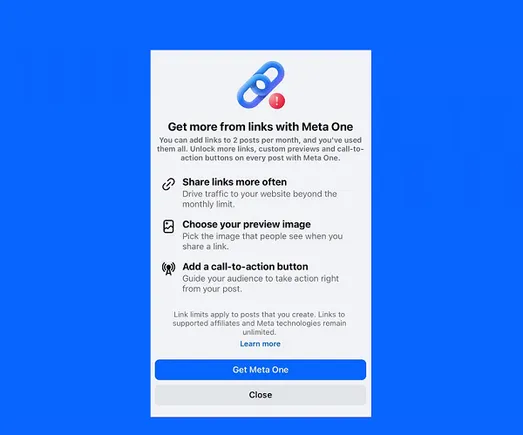
The modern social media landscape is undergoing a profound structural transformation, characterized by the gradual erosion of organic reach and the aggressive monetization of professional features. Meta, the parent company of Facebook and Instagram, has significantly expanded a contentious test that restricts non-paying professional accounts to a maximum of two link posts per month on Facebook. This operational adjustment coincides directly with the global rollout of the Meta One for Business paid subscription packages, signaling a pivotal shift in how businesses, creators, and brands are permitted to drive external traffic from the world’s largest social network.
The introduction of these tiered subscription bundles, which initially promised functionalities such as monthly allowances for adding external links to Instagram posts and Reels, is now bleeding over into the core Facebook platform. For years, businesses have utilized Facebook Pages as a primary gateway to drive web traffic, generate leads, and convert casual scrollers into paying customers through direct hyperlinks. However, as Meta operationalizes its latest monetization frameworks, those foundational capabilities are increasingly being locked behind paywalls.
The Genesis of the Link-Limiting Strategy
To fully comprehend the gravity of Meta’s current operational pivot, one must examine the chronological progression of the company’s monetization experiments. The restriction of outbound links on Facebook Pages is not an entirely novel concept born out of the Meta One launch. The foundational phase of this initiative began quietly in December 2025, when Meta initiated a limited beta test targeting a select cohort of business accounts. During this initial testing phase, participating pages discovered that their capacity to publish content directing users away from the Facebook ecosystem was abruptly capped at two link posts per month.
At the time, Meta defended the trial as an analytical endeavor designed to measure user behavior and assess whether increasing the volume of outbound links genuinely added value for the platform’s audience. Company representatives emphasized that certified publisher pages—such as recognized news organizations and media outlets—would remain exempt from these restrictions to ensure a steady and uninterrupted flow of informative content within the application feeds.
Despite initial pushback from small business owners and digital marketers, the trial remained localized and somewhat ambiguous regarding its long-term future. However, the commercial debut of Meta One for Business this week has removed any lingering ambiguity. The deployment of the subscription service has catalyzed a rapid expansion of the link-capping test, with numerous Facebook Page managers reporting sudden, automated pop-up alerts notifying them of the new publishing constraints. Unless these administrators upgrade to a paid Meta One tier, their capacity to share external links on Facebook is severely constricted, fundamentally altering the economics of operating a professional page.
Decoding the Meta One for Business Ecosystem
The Meta One for Business subscription packages represent a comprehensive restructuring of how commercial entities interact with Meta’s application suite. Historically, business tools on Facebook and Instagram were offered free of charge as part of a grand bargain: businesses populated the platforms with engaging content and user attention, which in turn attracted advertisers eager to purchase sponsored placements.
Under the new paradigm, Meta is implementing a multi-tiered subscription model that segments platform utility. While specific tier benefits continue to evolve, the core framework of Meta One includes enhanced customer support, advanced analytics, prioritized content delivery features, and—most crucially—the authorization to include a specified volume of outbound links in posts and Reels.
For Instagram, the tie-in is direct, allowing businesses to bypass traditional hurdles in sharing clickable destinations. For Facebook, the expansion of the link restriction test into a formal monetization lever indicates that outbound sharing is no longer viewed by the platform as a baseline right for commercial accounts, but rather as a premium utility. This strategy mirrors broader industry trends where traditional web infrastructure is walled off, compelling corporate entities to pay recurring fees simply to maintain baseline operational functions.
The Reality of Organic Reach: A Data-Driven Analysis
While business advocates and community managers have voiced considerable frustration regarding the new limitations, an objective examination of platform metrics suggests that the practical impact on traffic generation may be far less catastrophic than anticipated. For years, Meta’s internal algorithm has systematically de-prioritized content containing external links, favoring native video, photos, and text posts that keep users enclosed within the Facebook and Instagram applications.
This algorithmic shift is comprehensively documented in Meta’s own Widely Viewed Content reports. According to data released in the Q1 Widely Viewed Content report, a staggering 98.7% of all post views in the United States during that operational period did not feature a link pointing to a source outside of the Facebook ecosystem. Only a minute 1.3% of viewed content contained an outbound link.

This figure represents a dramatic, long-term decline in organic visibility for external links. When Meta first began publishing transparency data regarding widely viewed content in 2022, approximately 9.8% of viewed content included an external link. Over the intervening years, that percentage has steadily plummeted, driven by algorithmic updates designed to optimize user retention and maximize advertising inventory.
Consequently, digital marketing analysts point out that many businesses have already adapted to the reality of declining organic link performance. Because posts featuring external URLs traditionally receive negligible organic exposure, capping unpaid accounts at two link posts per month may have a minimal statistical impact on overall reach. For brands determined to drive external traffic, organic posting has long been superseded by paid advertising campaigns, making the new Meta One subscription an alternative tool rather than a definitive death knell for web referral strategies.
The Historical Context of Meta’s Monetization Playbook
The rollout of Meta One and the accompanying link restrictions fit neatly into a well-documented historical pattern of platform management. The philosophical blueprint for Meta’s monetization strategy was articulated nearly a decade ago by CEO Mark Zuckerberg during an annual stockholder meeting in 2016.
At that time, Zuckerberg outlined a three-stage monetization model for the company’s burgeoning applications: first, build a massive, highly engaged consumer utility by offering services entirely free of charge; second, organically cultivate business adoption and brand presence by integrating commercial entities into the ecosystem; and third, once businesses become fundamentally dependent on the platform to reach their audiences, introduce monetization mechanisms, fees, and paywalls to extract revenue from that dependence.
This playbook has been executed with methodical precision across multiple product verticals. When business pages were first introduced on Facebook, organic reach was exceptionally high, allowing brands to build massive audiences without spending a dime on advertising. Gradually, organic reach was throttled down to near-zero levels, transforming Facebook into a "pay-to-play" advertising medium. Similarly, features that were once freely available to developers, community administrators, and advertisers have steadily been corralled into paid tiers or restricted by algorithmic barriers.
While critics frequently decry this approach as a classic bait-and-switch tactic—inviting businesses to invest time, capital, and creative energy into building an audience before charging for basic access—it remains an exceptionally effective corporate strategy. From an objective business perspective, Meta is simply capitalizing on the commercial value of its network, shifting the financial burden of platform maintenance onto the corporate entities that derive direct commercial profit from its user base.
Broader Industry Implications for Businesses and Marketers
The formalization of Meta One and the expansion of link restrictions carry significant implications for the broader digital marketing industry. Brands, publishers, small businesses, and social media managers must re-evaluate their resource allocation and content distribution strategies in light of these developments.
First, the economic calculation of maintaining a Facebook Page is changing. Organizations must now weigh the monthly subscription cost of Meta One against the incremental value of the link posts and features included in the package. For e-commerce brands, local service providers, and digital publishers whose primary objective is funneling social media traffic back to a transactional website, the subscription may quickly transition from an optional luxury to an essential overhead cost of doing business.
Second, the structural decline of organic link visibility underscores the necessity of platform diversification. Relying heavily on any single social media network for inbound traffic has always carried inherent vulnerabilities, but algorithmic suppression combined with explicit paywalls accelerates the need for robust owned-media channels, such as email newsletters, SMS marketing, and search engine optimization (SEO).
Finally, the policy exemptions granted to certified publishers highlight Meta’s delicate balancing act. By protecting news and media organizations from link restrictions, Meta ensures that its feeds remain populated with breaking news and timely information, which keeps everyday users engaged. Without this steady stream of content, the platform risks losing the very consumer attention that makes commercial participation valuable in the first place.
As Meta continues to test, refine, and globally deploy the Meta One for Business ecosystem, the digital landscape will continue to adapt. While the restriction of link posts to two per month for unpaid accounts may initially sting affected managers, it ultimately serves as a stark reminder of the realities governing the modern attention economy: access to massive digital audiences is increasingly a commodity, and platforms will extract their price.
Related posts: