Amazon DynamoDB Introduces Native Vector Search Capabilities to Eliminate Architectural Complexity for Developers

The architecture of modern cloud applications is undergoing a fundamental shift as artificial intelligence and machine learning models become deeply integrated into everyday software solutions. Today, Amazon Web Services has officially announced the general availability of native vector search in Amazon DynamoDB, a significant evolution for one of the cloud computing industry’s most widely adopted fully managed NoSQL databases. This new capability allows developers to store high-dimensional vector embeddings directly alongside their operational data within DynamoDB tables, entirely removing the long-standing requirement to provision, configure, and maintain separate vector databases or complex synchronization pipelines.
For years, engineering teams building applications powered by generative AI, semantic search, Retrieval-Augmented Generation (RAG), and sophisticated recommendation engines faced an architectural tax. While relational and NoSQL databases effectively handled traditional workloads like user profiles, product catalogs, and transactional histories, they lacked the mathematical underpinnings required to execute similarity searches across complex vector spaces. Consequently, developers were forced to adopt a dual-database architecture. They would store operational data in DynamoDB while simultaneously replicating and syncing subsets of that data into dedicated vector stores such as OpenSearch, Pinecone, or pgvector instances.
This multi-service approach introduced significant operational overhead. Maintaining synchronization pipelines between operational databases and vector stores frequently led to data drift, heightened latency during peak traffic events, inflated data movement and licensing costs, and complex debugging cycles when distributed systems fell out of sync. By integrating native vector search directly into its serverless database engine, Amazon Web Services has bypassed these friction points, enabling operational data and vector embeddings to share the exact same serverless infrastructure and familiar pay-per-request pricing model.

Technical Architecture and Performance Metrics
At launch, Amazon DynamoDB’s native vector search is engineered to perform at enterprise scale, supporting workloads encompassing trillions of vectors without requiring capacity planning, server provisioning, software patching, or maintenance windows. The architecture delivers single-digit millisecond latency while maintaining a recall accuracy rate exceeding 99 percent. Furthermore, the newly introduced vector indexes impose no storage limits, scaling horizontally and automatically as underlying datasets expand.
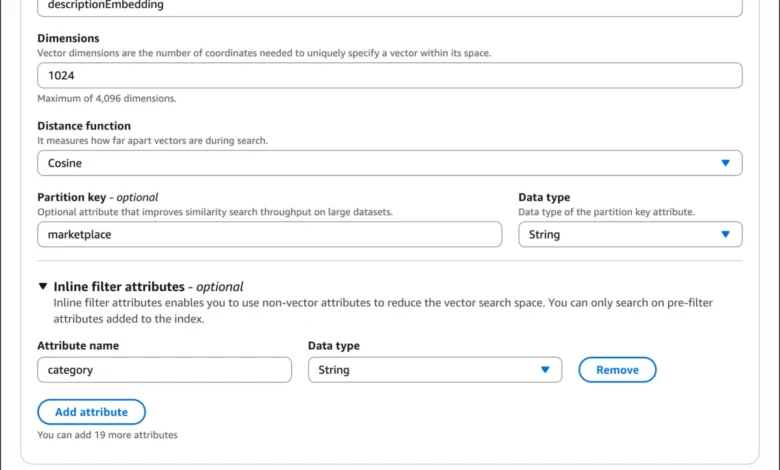
The system accommodates embedding vectors of up to 4,096 dimensions, aligning seamlessly with outputs generated by leading large language models and embedding models such as Amazon Bedrock Titan Text Embeddings, Cohere Embed, and various OpenAI text embedding iterations. To calculate semantic proximity, the service supports three primary distance functions: Cosine similarity, Euclidean distance, and Dot product calculations.
Unlike traditional multi-store implementations, DynamoDB’s vector search allows for inline filtering. When executing a query, developers can specify non-vector operational attributes—such as product categories, regional markets, or user permissions—as exact-match filter conditions. This enables the database engine to narrow down the search space dynamically at query time, ensuring that similarity evaluations are performed only against relevant subsets of data without requiring expensive post-processing steps or external filtering layers.

Step-by-Step Implementation and Workflow Integration
The integration process leverages standard DynamoDB paradigms, meaning development teams do not need to learn entirely new data types or fundamentally alter their database schemas. Embeddings are generated using a machine learning model of the developer’s choice, capturing the contextual semantic meaning of unstructured inputs such as product descriptions, customer support tickets, or user generated content.
Once generated, these vectors are stored within standard DynamoDB tables as a list of floating-point numbers utilizing existing PutItem or UpdateItem API calls. A new vector attribute type houses the numerical array, which is then indexed using the database’s newly created vector index structure.
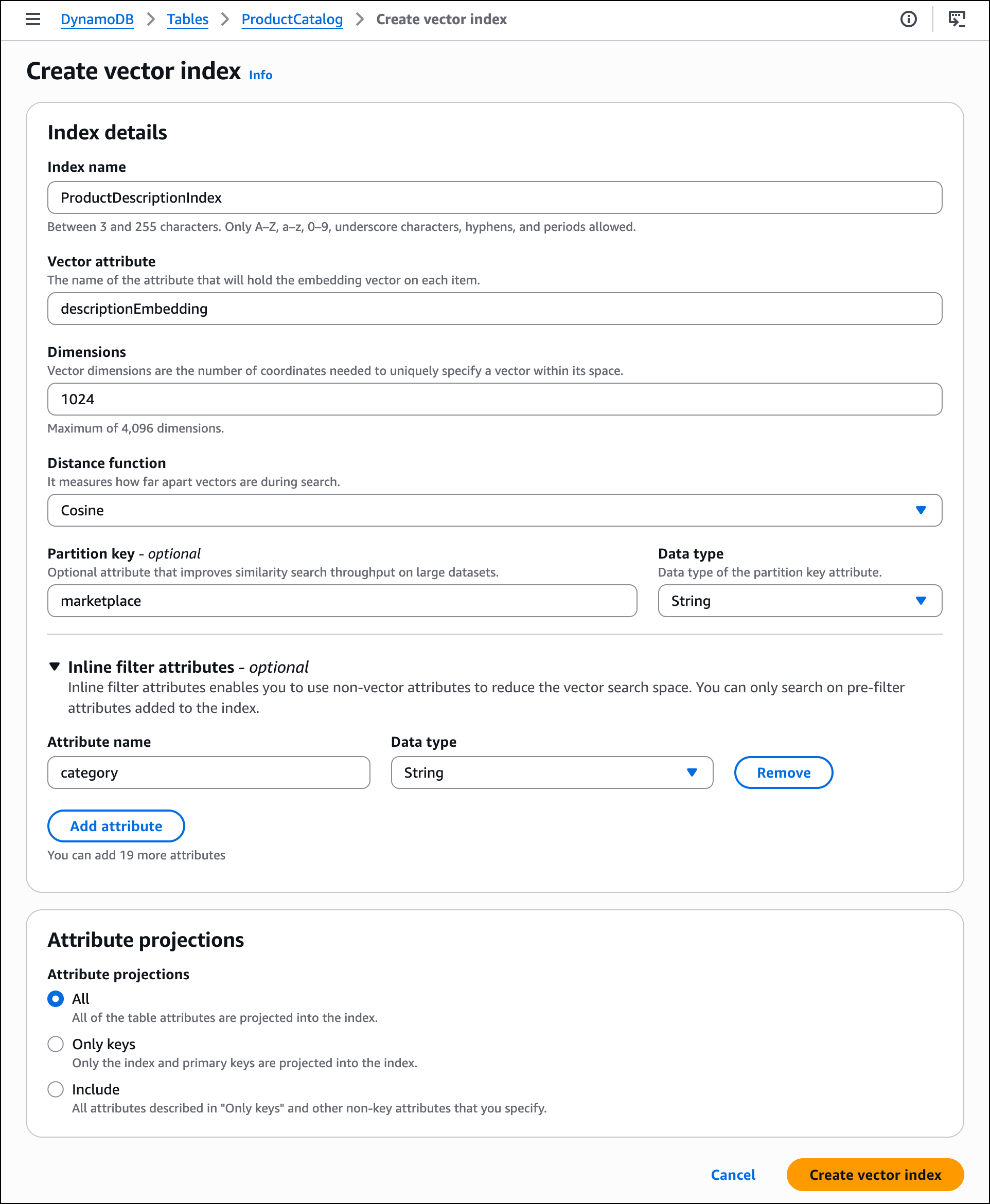
Creating a vector index involves specifying the index name, the target vector attribute, the dimensionality matching the upstream machine learning model, and the preferred distance function. Additionally, engineers can configure a partition key for the vector index. The partition key dictates how vectors are distributed across physical storage partitions, enabling massive horizontal scale while maintaining predictable, low-latency search responses. For example, an international e-commerce platform operating across multiple geographic markets can scope its vector indexes by a marketplace partition key, ensuring that searches executed for US-based shoppers query only the relevant regional subset of inventory without scanning the entire global catalog.
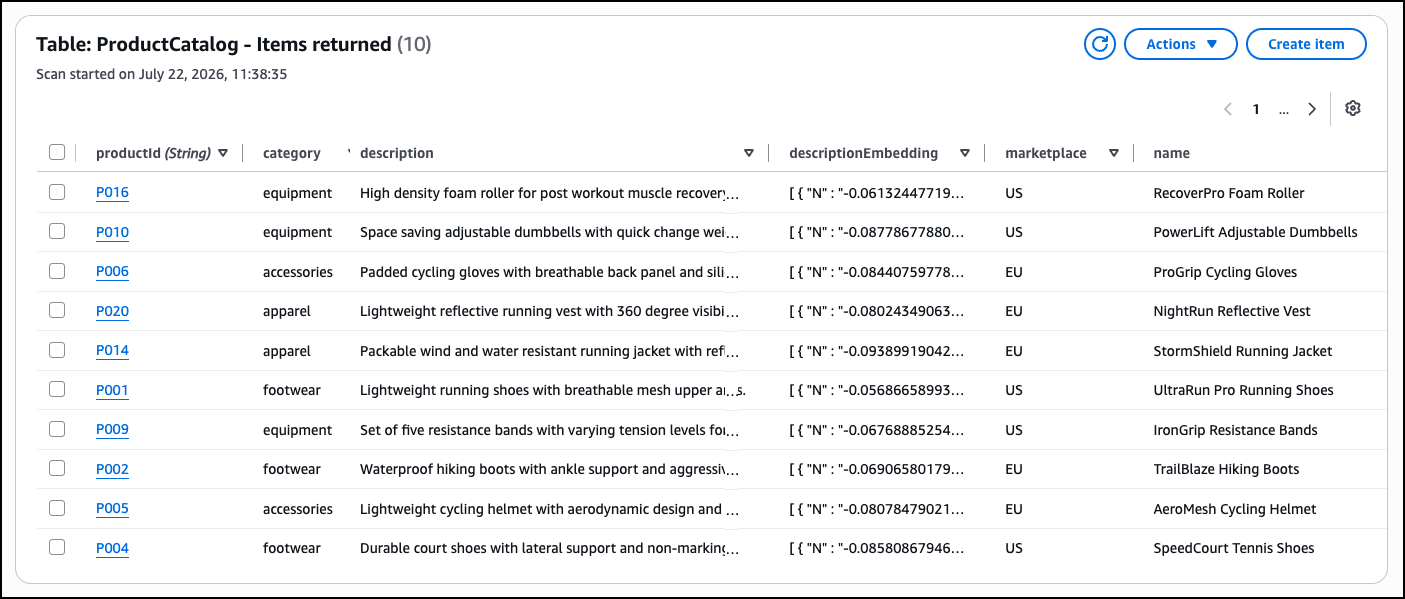
Executing queries is achieved through the newly introduced SearchVectors API. Developers pass a query vector generated from natural language inputs—such as a user searching for lightweight running shoes for summer—alongside a specified Top K result limit (up to 100 items) and optional inline filter criteria. The service returns a ranked list of items ordered by similarity score, accompanied by all standard operational attributes stored in the row, such as product names, SKUs, pricing, and availability.
Industry Implications and Broader Market Context
The general availability of native vector search in DynamoDB arrives at a pivotal juncture in the enterprise software market. As corporate adoption of generative AI transitions from experimental proof-of-concept phases to production-grade enterprise deployments, cost optimization and architectural simplicity have become paramount concerns for engineering leadership.
Industry analysts note that reducing the number of disparate database engines required to power an application significantly shrinks the operational footprint, lowers compliance and security auditing costs, and streamlines developer workflows. Organizations no longer need to manage distinct data governance frameworks for operational databases and vector stores, as the security, backup, point-in-time recovery, and compliance guarantees inherent to DynamoDB automatically extend to the stored vector embeddings.
Furthermore, the integration strongly positions DynamoDB as a foundational building block for agentic memory systems and autonomous software agents. These advanced AI architectures require continuous, real-time read and write access to conversational history and contextual state data alongside high-speed semantic retrieval. By unifying operational storage and vector indexing under a single serverless roof, Amazon Web Services has minimized the latency barriers that previously hindered real-time agentic reasoning at scale.
Availability and Pricing
Native vector search in Amazon DynamoDB is generally available across all commercial AWS Regions, including AWS GovCloud (US) Regions. The feature operates under DynamoDB’s standard serverless pricing model, charging only for the storage consumed by the vectors and the request units consumed during index creation and query execution, with no minimum fees or idle capacity overhead. Developers seeking to integrate the capability can access comprehensive implementation guides through the Amazon DynamoDB Developer Guide, utilize infrastructure-as-code frameworks such as AWS CloudFormation, or leverage modern AI coding assistants equipped with AWS Model Context Protocol (MCP) servers to accelerate their integration cycles.