Snapchat Releases New Research Highlighting High Voter Turnout and Political Open-Mindedness Ahead of U.S. Midterm Elections

With the United States midterm elections approaching, social media platforms are aggressively positioning themselves as indispensable arenas for political advertising and voter mobilization. Among them, Snapchat has released a comprehensive new research report aimed at capturing the attention of political campaigns, political action committees (PACs), and media buyers. The study focuses on civic engagement among its user base, detailing how younger generations interact with political content, discover candidates, and formulate their voting decisions within the application.
The report, commissioned by Snapchat and executed by research firm Alter Agents earlier this year, draws from a survey of over 1,000 platform users aged 18 to 45. As political strategists look for effective ways to reach the elusive demographic of younger voters, Snapchat’s data seeks to challenge long-held assumptions about youth apathy, portraying its audience as politically active, highly receptive to cause-driven messaging, and remarkably open-minded compared to the broader electorate.
Methodology and Core Findings of the Alter Agents Study
The Alter Agents study was designed to measure political attitudes, media consumption habits, and civic intentions among millennials and Generation Z users on Snapchat. According to the response data, nearly 80 percent—specifically 78 percent—of surveyed Snapchat users plan to cast a ballot in the upcoming midterm elections. Furthermore, the study asserts that active Snapchat users are 1.2 times more likely to participate in elections than non-users within the same age brackets.
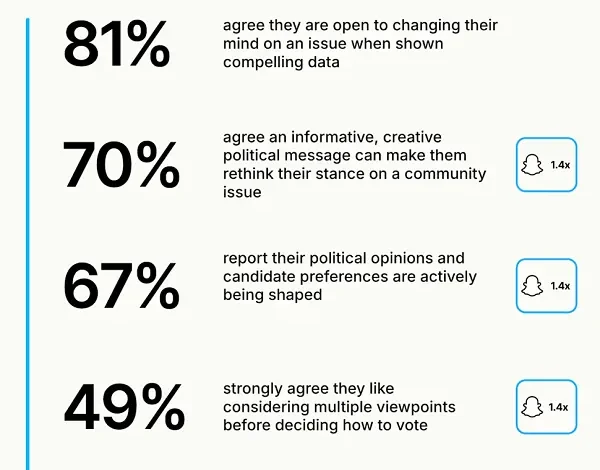
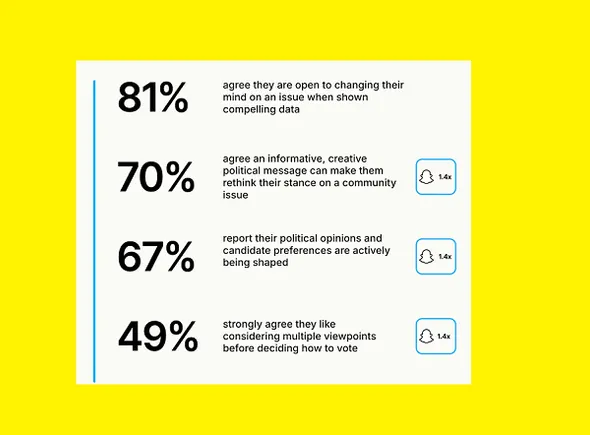
This statistical revelation comes at a time when campaigns are increasingly searching for reliable digital touchpoints to combat voter fatigue. Rather than tuning out political discourse, Snapchat’s younger demographic appears actively engaged in seeking out information. Snap’s internal analysis of the data highlights a distinct trait among its users: "In a complex political landscape, Snapchatters are uniquely open-minded in their political approach, seeking out viewpoints before choosing how to vote and open to changing their positions."
This purported open-mindedness presents a significant opportunity for down-ballot candidates, ballot initiatives, and advocacy groups that often struggle to break through the noise of national partisan media. By fostering an environment where users are willing to weigh multiple perspectives, Snapchat is pitching its ecosystem as a fertile ground for persuasive political advertising rather than merely a space for base mobilization.
The Influence of Digital Ads on Candidate Discovery
One of the most compelling insights for political advertisers contained within the report revolves around the efficacy of in-app advertisements. Traditional campaign strategies often rely on television broadcasts, direct mail, or broad-reach social media feeds. However, the Snapchat demographic exhibits a distinct reliance on digital ad formats for political education.
According to the findings, 80 percent of respondents indicated that political promotions on Snapchat introduced them to candidates and political causes of which they were previously unaware. This points to a discovery mechanism that bridges the gap between low-information voters and campaign platforms. Additionally, 74 percent of surveyed users stated that they were significantly more likely to actively research candidates and policy positions after encountering relevant advertisements on the platform.
These metrics suggest that digital advertisements on Snapchat function not just as reinforcement tools for voters who have already made up their minds, but as critical educational touchpoints that can alter the trajectory of a voter’s decision-making process. For campaigns operating on tight budgets, the ability to drive high-intent follow-up research through targeted ad placements offers a high return on investment.
A Historical Chronology of Snapchat’s Civic Engagement Initiatives
Snapchat’s push into the political advertising market is not a sudden pivot, but rather the continuation of a multi-year strategy focused on civic tech and non-partisan voter registration initiatives. Understanding the platform’s current political positioning requires examining its historical evolution in this space.
In 2016, as political polarization intensified across digital networks, Snapchat launched its first major voter registration campaigns, partnering with non-partisan organizations to make voter registration accessible directly within the app. These early efforts laid the groundwork for what would become a robust infrastructure supporting democratic participation.
The turning point came during the 2018 midterm elections. Leveraging its proprietary tools, Snapchat integrated native registration features that allowed users to register to vote in under two minutes without ever leaving the application. The company reported that these efforts directly drove more than 450,000 people to register to vote, proving the platform’s viability as a civic mobilization tool.
Building upon this success, the platform scaled its operations dramatically ahead of the 2020 U.S. presidential election. Through a series of targeted in-app prompts, dynamic lenses, and educational filters distributed under its "CitizenSnap" initiative, Snapchat successfully drove 1.2 million users to register to vote. A significant portion of these newly registered voters were first-time participants, highlighting the platform’s unique capacity to activate demographics that historically exhibit low turnout rates.
By the time the platform began preparing for the subsequent midterm cycle, voter engagement had been firmly established as a core pillar of its corporate social responsibility and monetization strategies. The release of the Alter Agents report serves as the commercial culmination of these years of civic infrastructure development, signaling to advertisers that Snapchat’s user base is primed for political messaging.
Implications for Political Campaigns and Media Buyers

The release of Snapchat’s civic engagement report arrives at a critical juncture for political media buyers. With election cycles growing increasingly expensive and traditional media channels saturated with competing messages, campaigns are forced to diversify their digital expenditures.
The data underscores several key implications for modern political strategy:
- Target Audience Accessibility: Reaching voters under 45 requires meeting them on platforms where they spend significant time. Snapchat’s user base is heavily skewed toward younger demographics who increasingly consume news and information via mobile-first, vertical video formats.
- The Power of Cause-Based Messaging: The survey indicates that users are more responsive to outreach framed around specific causes rather than purely partisan rhetoric. Campaigns that translate complex policy proposals into accessible, cause-driven narratives are likely to see higher engagement rates on the app.
- Trust and Transparency: Platforms that have historically prioritized user privacy and positive social engagement can sometimes offer a more brand-safe environment for political advertisers looking to avoid the toxic discourse often found on open-feed social networks.
Broader Industry Context and Competitor Landscape
Snapchat is not alone in courting political ad dollars. Competitors such as Meta (parent company of Facebook and Instagram), TikTok, and Google-owned YouTube command massive shares of digital political ad spend. However, each platform faces distinct regulatory challenges and public scrutiny regarding misinformation, data privacy, and the moderation of political content.
While some platforms have oscillated in their policies regarding political advertising—ranging from outright bans to heavy restrictions—Snapchat has maintained a structured approach that permits paid political and advocacy ads while enforcing strict transparency requirements. All political ads on Snapchat must include clear "paid for by" disclaimers, and the platform maintains a public political ads library, allowing researchers, journalists, and opposing campaigns to scrutinize ad spending and targeting parameters.
This regulatory compliance, combined with proprietary research demonstrating high voter intent and openness to persuasion, forms the bedrock of Snapchat’s value proposition to political marketers. As campaigns finalize their media allocations in the final stretch before election day, reports like the one compiled by Alter Agents provide the empirical justification needed to redirect budgets toward mobile-first, youth-centric environments.
Conclusion: The Evolving Role of Tech Platforms in Democracy
The intersection of technology and electoral politics continues to evolve rapidly. What began a decade ago as a supplementary channel for digital banner ads has transformed into a sophisticated ecosystem capable of driving millions of voter registrations and shaping the political consciousness of an entire generation.
Snapchat’s latest research reinforces the notion that younger voters are neither politically disengaged nor impervious to digital persuasion. Instead, they represent a dynamic, information-seeking segment of the electorate that relies heavily on digital touchpoints to navigate complex political landscapes. As the platform continues to release data supporting its utility in civic outreach, it cements its role not merely as a messaging application, but as a significant infrastructure partner in the democratic process. Whether campaigns successfully capitalize on this open-minded, highly active demographic will be one of the defining narratives of the election cycle.
Related posts: