The Meatball Sub Phenomenon: How NFL Fans Are Redefining Quarterback Slander Through Culinary Metaphors

The return of college football and the NFL season has ushered in a new era of digital sports discourse, characterized by an increasingly inventive and absurd lexicon. As fans dissect every play with granular detail, a peculiar trend has emerged on social media platforms: the use of elaborate sandwich descriptions to mock a quarterback’s performance, specifically when they throw an interception. This phenomenon, often referred to as "sandwich slander," represents the latest evolution in the high-stakes, hyper-critical world of online sports commentary.
The Linguistic Evolution of Sports Slander
The term "meatball" has a well-documented history in American sports, though it originated in the diamond rather than the gridiron. In baseball, a "meatball" describes a pitch thrown directly over the heart of the plate, characterized by low velocity and minimal movement, essentially serving as an easy target for a batter. For decades, the term has been synonymous with a pitcher’s failure to execute a difficult task.
As sports culture migrated from broadcast television to real-time social media analysis, the vocabulary shifted to reflect the chaotic nature of the internet. The transition from the baseball "meatball" to the football "meatball sub" is a logical, albeit humorous, progression. Because the football is an oblong spheroid rather than a sphere, the "meatball" analogy struggled to gain traction in the NFL until fans began pivoting to sandwich-based metaphors. The structure of a sandwich—often layered, messy, and prone to falling apart—provides a perfect visual analog for a turnover.
A Chronology of Culinary Critique
While the trend saw a massive spike in popularity during the opening weeks of the 2024 season, its origins date back to the previous year. Digital archives indicate that the earliest notable instance of this vernacular appeared in November 2023. During a Saints game, a social media user described quarterback Derek Carr’s performance by stating, "They got Carr in 4K throwing a fully loaded shrimp poboy."
The specificity of the "shrimp poboy"—a staple of New Orleans cuisine—highlighted the creative potential of this new form of mockery. By 2024, the trend had evolved from simple food references into a complex game of one-upmanship. During a Week 1 matchup between the Cleveland Browns and the Jacksonville Jaguars, observers labeled Deshaun Watson’s turnover as a "pastrami on pumpernickel," signaling a departure from standard critiques into the realm of hyper-specific, absurd culinary descriptions.
The Catalyst: The Case of Drake Maye
The rapid acceleration of this trend is inextricably linked to the performance and public profile of New England Patriots quarterback Drake Maye. Following a high-profile offseason marked by debates surrounding his MVP candidacy and his team’s performance, Maye became a lightning rod for social media criticism.
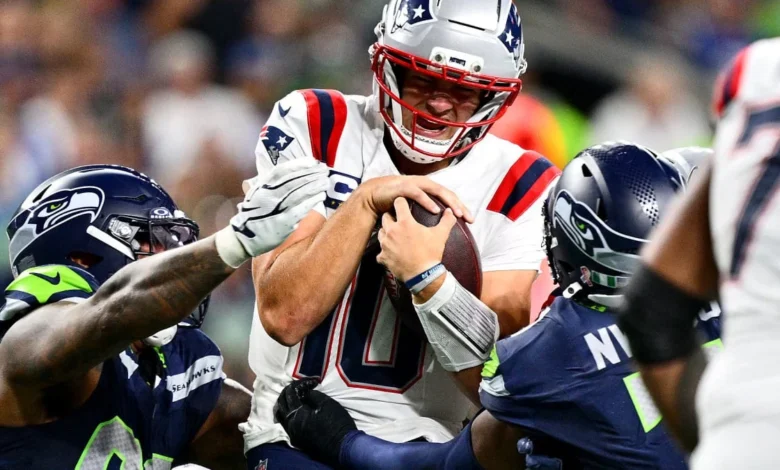
The intersection of his professional performance and his off-field activities played a significant role in the trend’s virality. Maye had previously participated in promotional events at local Jersey Mike’s sandwich shops in the Boston area to support charitable causes. When Maye delivered a lackluster performance against the Seattle Seahawks—an event that served as a high-stakes "hate-watch" for fans wary of the Patriots’ post-dynasty trajectory—the internet quickly connected his professional failures to his association with the sandwich chain. The result was a wave of social media posts, with users describing his three interceptions as various types of "sandwiches" being served up to the opposing defense.
Broader Context: The Digital Sports Ecosystem
This trend is not an isolated incident but rather the latest iteration of a long-standing tradition of "sports terrorism" and "flaming out" discourse. For years, the NBA has provided the blueprint for this type of fan-driven commentary. When a player underperforms or faces a decline in their career, the discourse often pivots to hypothetical scenarios where the athlete is forced to play in foreign leagues, such as the Chinese Basketball Association. Phrases like "Get ready to learn Chinese, buddy" have become institutionalized in basketball culture, serving as a shorthand for professional failure.
The shift toward sandwich-based slander in the NFL suggests that football fans are seeking a similar shorthand for the unique pressure of the quarterback position. Unlike the NBA, where players move between leagues with relative frequency, the NFL is an insular ecosystem. When an NFL quarterback performs poorly, they are not usually "sent" to another league; instead, they face the metaphorical threat of unemployment. The sandwich metaphor serves as a digestible way to frame the idea that a quarterback is "cooking" nothing but errors, effectively serving up victories to the opposition.
Statistical Implications and Fan Sentiment
From a sociological perspective, this trend reflects the changing demographic of sports consumption. As younger, digital-native fans become the primary drivers of sports discourse, the barrier to entry for criticism has dropped. It is no longer enough to argue that a quarterback lacks pocket presence or decision-making skills; the critique must now be shareable, meme-worthy, and culturally resonant.
Data from the first month of the 2024 season shows a significant correlation between high-interception games and the volume of food-related social media tags. While traditional media outlets continue to focus on pass completion percentages and quarterback ratings (QBR), the sentiment analysis on platforms like X (formerly Twitter) suggests that the "sandwich" vernacular is becoming a primary driver of engagement for younger demographics.
However, the longevity of this trend remains in question. As with most internet memes, there is a clear "saturation point." By the end of September 2024, reports indicated that a segment of the football-watching audience was already expressing fatigue regarding the trend. Despite this, the language is likely to be preserved in the "generational" highlight reels and year-end retrospectives that define modern sports content.
Future Implications for Sports Media
The rise of the "meatball sub" discourse presents a challenge and an opportunity for mainstream sports media. As professional analysts and journalists cover these games, they must navigate a landscape where their technical breakdowns are increasingly competing with, or being replaced by, viral internet tropes.
While the sandwich trend is clearly satirical, it underscores a shift in how fans consume professional athletics. The game has become a background element to the broader entertainment spectacle of social media interaction. For players, this means that their performance on the field is now subject to a secondary, and arguably more permanent, digital legacy. A player’s "sandwich" moment can be archived, shared, and referenced long after the final whistle, transforming a single poor pass into a lasting piece of internet folklore.
Ultimately, the phenomenon of sandwich slander serves as a reminder that the NFL is a cultural product as much as it is a sporting competition. As fans continue to find new ways to articulate their frustrations and observations, the boundary between the gridiron and the kitchen—or any other aspect of daily life—will likely continue to blur. Whether this specific trend survives the duration of the season or fades into the archives of digital history, it has already secured its place as a marker of the 2024 NFL season’s unique position in the digital zeitgeist.
Related posts: