Meta Expands Tests Limiting Free Facebook Page Links as Part of Its New Subscription Rollout

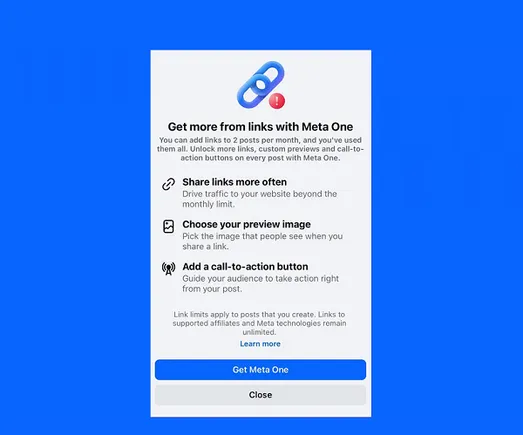
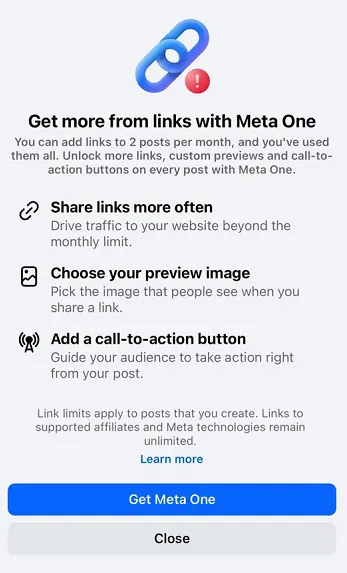
The digital marketing landscape is undergoing a notable shift as Meta accelerates its monetization efforts for professional accounts. Following the recent rollout of the Meta One for Business subscription packages, numerous Facebook Page managers have reported seeing restrictive pop-up alerts on their dashboards. These notifications indicate that unpaid professional accounts are facing a strict cap of just two link-containing posts per month. This move signals a broader implementation of a strategy initially tested in late 2025, effectively pushing businesses to evaluate whether paying for a subscription tier is necessary to maintain their external web traffic strategies on the platform.
The expansion of these link restrictions coincides directly with the debut of Meta One for Business. While the initial tier benefits largely focused on granting users the ability to incorporate a limited number of outbound links into Instagram posts and Reels—with allowances varying depending on the chosen subscription tier—Facebook posts with links were not initially listed as a primary benefit in early promotional materials. However, recent developments demonstrate that Meta is actively integrating Facebook link limitations into the ecosystem. Page managers encountering the new pop-up alerts are informed that exceeding the two-link threshold requires an upgrade to a paid Meta One package, directly tying standard publishing capabilities to recurring subscription fees.
Chronology of the Link Restriction Strategy
To understand how Meta arrived at this juncture, it is helpful to examine the timeline of how the platform has handled outbound links and business monetization over the past decade.
The foundation of Meta’s current approach can be traced back to a framework outlined by CEO Mark Zuckerberg during the 2016 annual stockholder meeting. At that time, Zuckerberg detailed a systematic three-stage monetization strategy for the company’s family of apps. First, Meta focuses on building utility and attracting a massive consumer base. Second, the company encourages organic business use, allowing brands to establish a presence, build communities, and reach audiences without immediate financial barriers. Finally, once businesses are thoroughly integrated into the daily operations of the platform and rely on it for customer acquisition, Meta introduces targeted monetization mechanisms, charging for enhanced access, visibility, and features.
Adhering to this long-term blueprint, Meta began laying the groundwork for direct link-posting restrictions in December 2025. During that initial phase, the company launched a limited test that restricted selected business pages to a maximum of two link posts per month. At the time, Meta characterized the pilot as an exploratory initiative designed to understand whether publishing a higher volume of outbound links genuinely added intrinsic value for users or if it primarily contributed to low-quality, promotional clutter on the feed.
Throughout these early tests, Meta carved out specific exemptions—most notably for recognized publisher pages—to ensure that news and essential media content continued to flow unimpeded through the app. However, with the formal commercial launch of Meta One for Business, the company has transitioned this experimental constraint into a structured, scalable feature of its paid tiers, expanding the restriction to a much wider array of commercial and professional pages.
Data and Platform Realities: Do Outbound Links Matter on Facebook?
While the prospect of facing publishing caps may alarm digital marketers who rely on social media referrals to drive traffic to e-commerce sites, blogs, and landing pages, platform metrics suggest that the practical impact on overall visibility might be lower than anticipated.
Data compiled by Meta itself reveals a dramatic, long-term decline in the organic reach and user engagement of link posts on Facebook. According to Meta’s Widely Viewed Content Report for the first quarter of 2026, an overwhelming 98.7% of all post views in the United States during that period did not include a link to an external source outside of the Facebook ecosystem.
This figure represents a continuation of a steady downward trend that has persisted for years. When Meta first began publishing transparency data regarding widely viewed content in 2022, approximately 9.8% of viewed content included an external link. Over the subsequent four years, that figure experienced a precipitous drop, reaching a historic low of just 1.3% by early 2026.

Industry analysts point out that Meta’s algorithmic preferences have long favored native content—such as native video, Reels, photos, and text-only posts—over content designed to drive users away from the platform. Because the algorithm inherently suppresses posts containing external URLs to keep users engaged within the app for longer periods, many business pages already struggle to achieve meaningful referral traffic through organic link posts alone. Consequently, marketing experts note that for many small and medium-sized enterprises, the two-link monthly cap may restrict a feature that was already yielding diminishing returns.
Industry Reactions and Strategic Implications for Brands
The introduction of the Meta One for Business subscription packages and the concurrent tightening of free posting capabilities have elicited mixed reactions from the digital marketing community.
On one hand, professional account managers and small business owners have expressed frustration over what many perceive as a classic bait-and-switch tactic. Businesses that spent years cultivating audiences on Facebook under the assumption that basic publishing tools would remain free are now facing a reality where core functionalities are locked behind paywalls. Critics argue that charging businesses to post content that ultimately generates platform engagement and keeps users active feels counterintuitive, placing an additional financial burden on enterprises already navigating rising advertising costs.
On the other hand, pragmatic marketers view the shift as an inevitable evolution of the social media landscape. As organic reach for external links has dwindled toward near-zero levels, sophisticated brands have already pivoted their strategies away from relying purely on organic link posts. Instead, successful modern digital strategies emphasize paid advertising campaigns, direct messaging tools, community building, and native content creation that captures attention without needing an immediate outbound click.
For brands determined to maintain a high frequency of link-sharing on Facebook, the decision now rests on a cost-benefit analysis. Businesses must evaluate whether the traffic generated by frequent outbound link posts justifies the monthly expenditure required for a Meta One for Business subscription tier.
Outlook for Professional Accounts on Meta
As Meta continues to roll out the Meta One for Business subscription packages globally, the digital marketing sector is closely monitoring how these tests evolve. The company has yet to confirm whether the two-link restriction will eventually become a permanent, platform-wide standard for all unpaid professional accounts, or if publisher exemptions will remain indefinitely.
What remains clear, however, is that the era of completely free, unfettered commercial utilization of major social media platforms is drawing to a closer alignment with corporate monetization models. For digital strategists and business owners, success on Facebook will increasingly depend on diversifying traffic acquisition channels, optimizing native content formats, and carefully calculating the return on investment for platform-specific subscription add-ons.
Related posts: