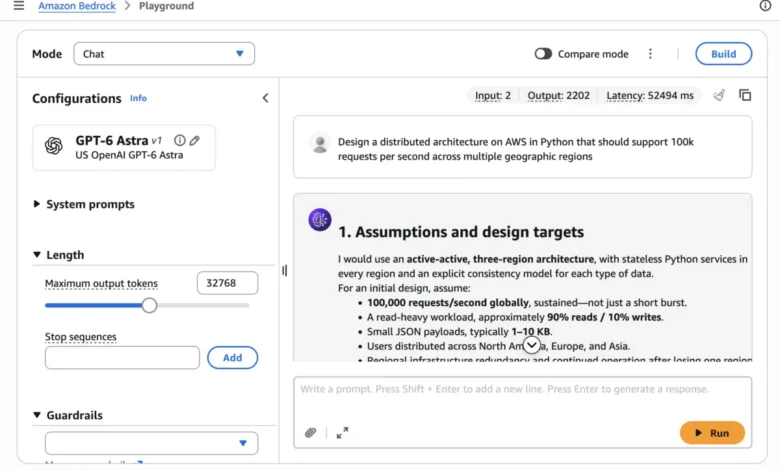
The technological landscape of artificial intelligence has entered a new phase of integration as major industry pioneers continue to consolidate their infrastructure offerings. Amazon Web Services (AWS) has officially announced the general availability of OpenAI’s most advanced model to date, GPT-6 Astra, on the Amazon Bedrock platform. This integration marks a significant milestone for enterprise-grade generative AI, bridging the gap between frontier model capabilities and the rigorous security, governance, and scalability demands of global corporate environments.
As autumn begins in major tech hubs like New York, the cadence of enterprise software releases accelerates. The arrival of GPT-6 Astra on Bedrock is positioned to reshape how organizations handle complex, multi-layered data workflows, software engineering pipelines, and automated reasoning tasks. By combining OpenAI’s state-of-the-art model architecture with AWS’s enterprise infrastructure, the collaboration offers businesses a powerful avenue to deploy advanced cognitive tools without compromising data privacy or operational oversight.
Main Facts and Technological Capabilities
GPT-6 Astra represents a profound leap forward in foundational model design. Unlike its predecessors, the model is engineered specifically to excel in domains requiring deep reasoning, nuanced judgment, and professional-grade generation across multiple mediums, including text, design, and code.
One of the most notable technical features of GPT-6 Astra is its expansive context window, which supports up to 1 million input tokens. This massive capacity allows developers and enterprise users to upload entire software codebases, comprehensive legal contracts, multi-volume technical documentation, or extensive corporate archives into a single prompt session. The model can then process, cross-reference, and reconcile competing inputs across these vast datasets with unprecedented accuracy.
Furthermore, GPT-6 Astra introduces advanced computer and browser-use capabilities. This functionality enables the model to interact directly with software interfaces and web environments, executing complex, multi-step workflows that previously required human intervention. Whether it is auditing financial records across disparate systems, automating software testing, or managing digital asset pipelines, the model functions as an autonomous agent capable of executing sophisticated tasks from end to end.

Chronology and Integration Pathway
The path toward the general availability of GPT-6 Astra on Amazon Bedrock has been marked by iterative advancements in cloud-based AI orchestration. Over the past several years, Amazon Bedrock has evolved from a nascent multi-model hosting service into a comprehensive orchestration layer for generative AI, enabling enterprises to choose from a diverse ecosystem of foundational models.
The integration of GPT-6 Astra follows a structured rollout designed to meet the strict compliance needs of enterprise clients:
- API Accessibility: Enterprises can invoke GPT-6 Astra directly through standard, supported Amazon Bedrock APIs, ensuring seamless integration into existing cloud architectures and microservices.
- Application Configuration: Organizations can configure developer-focused environments such as Codex and enterprise productivity suites like ChatGPT Work to utilize GPT-6 Astra directly through the Bedrock backbone.
- Ecosystem Expansion: Simultaneously, OpenAI has introduced new enterprise plugins for ChatGPT Work. These plugins extend Astra’s browser-use capabilities directly into common business applications, allowing for frictionless deployment across standard corporate software stacks.
This deployment model ensures that organizations do not have to overhaul their existing cloud infrastructure to harness cutting-edge intelligence. Instead, they can layer OpenAI’s most powerful reasoning engine on top of established AWS management frameworks.
Enterprise Security, Governance, and Data Privacy
A critical consideration for large-scale enterprise adoption of artificial intelligence is the safeguarding of proprietary data. The integration of GPT-6 Astra on Amazon Bedrock addresses these concerns by embedding the model within AWS’s established security and governance framework.
Under the terms of the deployment, enterprise data processed via Amazon Bedrock remains strictly confidential. Critically, customer inference data is not utilized by OpenAI to train subsequent iterations of the model, mitigating risks related to intellectual property leakage or competitive data exposure.
Furthermore, IT administrators can leverage existing AWS tools—such as AWS Identity and Access Management (IAM), Amazon CloudWatch, and AWS CloudTrail—to secure workloads, govern user access permissions, and maintain detailed audit trails of every model invocation. This level of transparency and control is vital for organizations operating in highly regulated sectors such as finance, healthcare, and government contracting, where compliance mandates leave no room for ambiguity regarding data handling practices.

Industry Implications and Market Analysis
The general availability of GPT-6 Astra on Amazon Bedrock carries broad implications for the enterprise software market and the future of knowledge work. Industry analysts note that the primary bottleneck in enterprise AI adoption has shifted from model capability to integration friction and security compliance. By streamlining the delivery of a 1-million-token context model through a trusted cloud provider, AWS and OpenAI are effectively removing these barriers.
Organizations are increasingly discovering that the highest productivity gains do not come merely from utilizing superior standalone chat interfaces, but from deeply embedding autonomous agents into core business processes. With Astra’s advanced reasoning and browser-use features, developers and knowledge workers can transition from performing manual, repetitive data synthesis to acting as supervisors of automated digital workflows.
The availability of GPT-6 Astra on Amazon Bedrock also intensifies competition in the managed AI services market, compelling cloud providers to offer increasingly sophisticated models coupled with uncompromising enterprise guarantees. As businesses evaluate their long-term artificial intelligence strategies, the ability to deploy frontier-class reasoning models within a secure, auditable, and scalable cloud ecosystem will likely become a decisive competitive advantage.
Future Outlook and Community Engagement
As the enterprise AI sector continues its rapid maturation, AWS is maintaining a heavy calendar of developer-focused initiatives, webinars, and in-person events designed to help builders navigate these new technological capabilities. Professionals looking to deepen their expertise in deploying models like GPT-6 Astra are encouraged to engage with the AWS Builder Center, participate in regional developer meetups, and monitor the official AWS News and Blogs channels for ongoing updates, architectural blueprints, and best practices.
The convergence of massive context windows, autonomous agent capabilities, and robust enterprise governance signifies that generative AI has firmly crossed the threshold from experimental novelty to core operational infrastructure. With GPT-6 Astra now live on Amazon Bedrock, organizations possess the necessary tools to tackle their most ambitious and data-intensive workloads to date.