For many enterprise organizations, the generative artificial intelligence lifecycle follows a predictable, euphoric curve. A proof-of-concept is deployed, initial user feedback glows with optimism, and engagement metrics tick upward. Stakeholders marvel at time saved on drafting emails, summarizing reports, or generating code snippets. Buoyed by early momentum, leadership demands an accelerated path to scale, prompting teams to request larger budgets and expansive new use cases.
Yet, this initial enthusiasm frequently hits a wall of disillusionment once tools migrate from sandboxes to production environments. Real-world operational constraints—ranging from runaway inference costs and token latency to user adoption fatigue and governance bottlenecks—quickly erode perceived gains. Enterprises find themselves struggling to answer a foundational question from the boardroom: Where is the actual return on investment?
According to artificial intelligence strategist and enterprise architect Dr. Adnan Masood, the persistent failure to capture true financial value stems from treating generative AI ROI as an abstract technological achievement rather than a strict measurement problem. Moving past the perpetual pilot phase requires organizations to reframe ROI not around models, but around core business workflows bounded by clear financial and operational constraints.
Redefining ROI: Workflows Over Models
In enterprise technology deployments, the core unit of value is rarely the foundational model itself. Whether an organization utilizes proprietary Large Language Models (LLMs) or open-source alternatives, the model is merely a software component. True value emerges only when that component is integrated into a repeatable workflow that directly impacts the enterprise balance sheet.
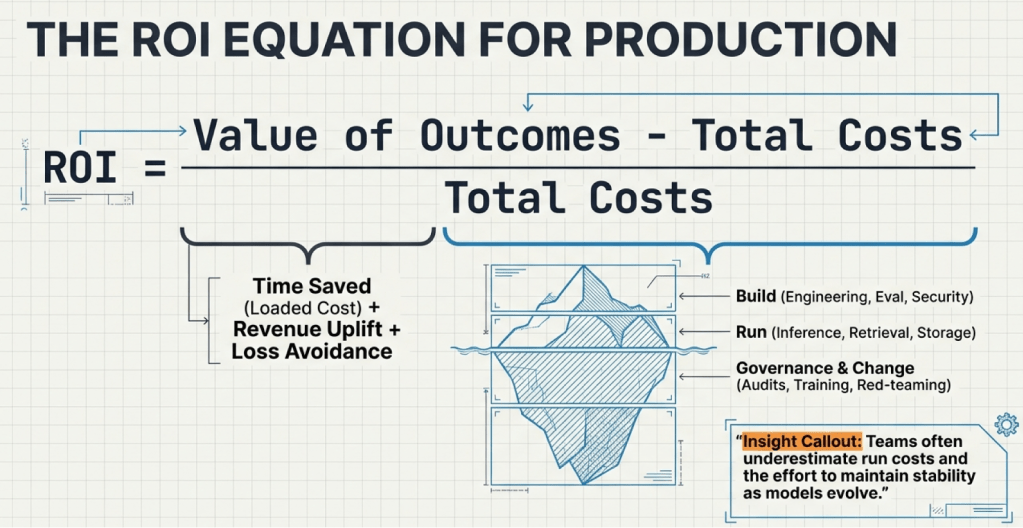
Dr. Masood defines the financial return of generative AI through a definitive equation that captures both the tangible value of outcomes and the comprehensive, often overlooked life-cycle costs of operating artificial intelligence at scale:
$$textROI = fractextValue of Outcomes – textTotal CoststextTotal Costs$$

Where the value of outcomes is calculated as:
$$textValue of Outcomes = (textTime Saved times textLoaded Cost) + textRevenue Uplift + textLoss Avoidance$$
And total costs encapsulate the full spectrum of production overhead:
$$textTotal Costs = textBuild Costs + textRun Costs + textGovernance Costs + textChange Management Costs$$
By establishing these boundaries, enterprise finance and engineering departments can strip away the hype surrounding generative AI and evaluate initiatives with the same rigorous scrutiny applied to traditional cloud infrastructure or enterprise resource planning (ERP) deployments.
The Hidden Costs of Production AI
One of the primary pitfalls in early-stage generative AI deployment is the systemic underestimation of ongoing operational expenses. While leadership teams routinely budget for initial software development and data engineering, they frequently overlook the compounding costs associated with running and maintaining models in live environments.
Build costs typically capture initial engineering hours, platform configuration, rigorous model evaluation, security reviews, and integration with legacy systems of record. However, run costs are where budgets frequently derail. Inference token consumption, complex retrieval-augmented generation (RAG) pipelines, high-performance vector storage, continuous monitoring, and around-the-clock incident response accumulate rapidly. Furthermore, vendor pricing shifts and API rate limits can introduce unpredictable financial volatility.
Beyond direct technical expenses, organizations must account for governance and change management overhead. Regulatory compliance audits, red-teaming exercises to identify vulnerabilities or bias, policy maintenance, specialized workforce training, and continuous workflow redesign represent significant investments. Without factoring these expenses into the initial financial equation, organizations risk discovering that the cost of maintaining an AI assistant outweighs the productivity gains it delivers.
Establishing Baselines and Metrics Stacks
To accurately measure the impact of generative AI, organizations must establish credible performance baselines prior to rolling out any tooling. These baselines must reflect normal operational conditions, including seasonal business fluctuations, to ensure that subsequent performance metrics are evaluated against an accurate standard of comparison. Without a baseline, organizations risk attributing normal operational variances or external market shifts to artificial intelligence interventions.

Effective measurement requires a tiered metrics stack that connects daily user activity to overarching business outcomes. This stack typically spans four distinct layers:
- Activity and Engagement: Tracking daily and monthly active users, prompt volume, and session frequency to gauge baseline interaction with the system.
- Workflow Velocity: Measuring cycle times, response speeds, and throughput to determine if the tool accelerates task completion.
- Output Quality: Evaluating error rates, user correction frequencies, and defect escape rates to ensure that speed does not compromise accuracy.
- Business Impact: Connecting the tool’s performance directly to top-line revenue growth, cost reduction, customer satisfaction scores, or risk mitigation.
When these layers are properly instrumented within existing enterprise platforms—such as ticketing systems for customer support, Customer Relationship Management (CRM) software for sales, or Continuous Integration (CI) pipelines for software engineering—leaders gain immediate visibility into adoption friction points and quality regressions.
Operational Leverage and Strategic Use Cases
Not all business use cases yield the same financial or operational return. While generative AI can be applied to a vast array of tasks, organizations achieving sustainable ROI focus on workflows characterized by high operational leverage.
Ideal use cases typically involve high volumes of unstructured text or data, clear and repeatable operational steps, established compliance frameworks, and existing audit trails. Examples include customer support resolution, insurance claims processing, vendor onboarding, engineering change management, and security triage. These domains provide structured environments where productivity gains can be systematically quantified and where existing institutional policies already govern human decision-making.
Conversely, ad-hoc or poorly defined use cases often produce isolated, short-lived savings that fail to scale across the broader enterprise. Selecting high-leverage workflows ensures that the integration of artificial intelligence complements existing business processes rather than creating unnecessary friction or forcing unnatural workflow redesigns.
Managing Adoption and Organizational Change
Technology adoption is fundamentally a delivery challenge. Even the most sophisticated generative AI model will fail to deliver financial return if end users reject the tool or find it cumbersome to incorporate into their daily routines.
To maximize adoption, enterprise architects must design artificial intelligence assistants to appear natively within the applications where work already happens, minimizing disruptive context-switching. Furthermore, tools must be engineered to preserve human oversight, ensuring that employees maintain ultimate control over final decisions and critical outputs.
Training strategies must move beyond generic platform overviews to provide role-specific guidance. Providing concise playbooks tailored to distinct job functions—complete with realistic examples mirroring daily tasks—helps bridge the gap between technical capability and practical application. Maintaining a predictable user interface and ensuring that tool outputs are fully traceable fosters user trust and long-term engagement.
Controlled Rollouts and Cohort Analysis
To substantiate ROI claims to executive leadership and financial auditors, organizations should implement a controlled rollout methodology utilizing cohort analysis. By comparing teams equipped with generative AI access against control groups lacking access over the exact same operating period, organizations can isolate the true impact of the technology.
Controlling for workload variations and tracking longitudinal drift in usage, quality, and business outcomes reveals precisely where value is concentrating within the enterprise. This empirical approach also highlights areas requiring enhanced system integration, better retrieval mechanisms, or targeted re-training.
Overcoming Common Failure Modes
When generative AI initiatives stall or fail to demonstrate clear financial return, organizations typically encounter a recurring set of systemic failure modes:
- Pilot Purgatory: Projects remain indefinitely in proof-of-concept mode without a clear roadmap for production scaling, security hardening, or financial budgeting.
- Metric Mismatch: Teams measure vanity metrics, such as total prompt volume or user sentiment, while failing to track hard business outcomes like revenue uplift or cost reduction.
- Unmonitored Drift: Models degrade in accuracy or relevance over time due to shifting enterprise data sources and evolving user requirements without adequate oversight.
- Integration Friction: Tools operate in isolation, requiring manual data entry or disruptive context switching that eliminates the time-saving benefits of automation.
A 90-Day Plan for Credible ROI Signals
For enterprises looking to transition from experimental pilots to disciplined, production-ready artificial intelligence operations, a structured 90-day roadmap provides a reliable framework for establishing credible financial signals:
- Days 1–30 (Baseline & Scoping): Select a single high-leverage workflow, establish rigorous baseline performance metrics under normal operating conditions, and define the complete life-cycle cost structure including build, run, and governance expenses.
- Days 31–60 (Integration & Controlled Deployment): Embed the generative AI tool natively within existing systems of record, implement lightweight feedback mechanisms for user rejections, and deploy the solution to a controlled initial cohort of users.
- Days 61–90 (Evaluation & Scaling): Compare cohort performance against control groups, analyze activity-to-outcome metrics stacks, adjust retrieval and integration parameters based on empirical drift data, and present a verified financial ROI assessment to executive leadership.
By grounding artificial intelligence investments in rigorous workflow measurement and strict budgetary operational control, enterprises can move beyond speculative experimentation. This methodical approach ensures that generative AI deployments remain financially sound, operationally sustainable, and fully aligned with broader corporate strategic objectives.