Amazon EKS Introduces Groundbreaking Kubernetes Control Plane Rollback Capability, Revolutionizing Cluster Management and Mitigating Upgrade Risks

Amazon Web Services (AWS) has unveiled a significant advancement for its managed Kubernetes service, Amazon Elastic Kubernetes Service (Amazon EKS), with the introduction of Kubernetes version rollbacks for cluster control planes. This long-awaited feature addresses a critical pain point for organizations managing Kubernetes environments, offering a crucial safety net that significantly de-risks the upgrade process. Historically, open-source Kubernetes lacked a built-in mechanism for control plane rollback, forcing organizations to implement complex, often time-consuming, and resource-intensive compensating strategies to mitigate the risks associated with irreversible upgrades. The new rollback capability empowers cluster administrators to revert to a previous, stable Kubernetes version within a seven-day window, providing an "undo button" for critical infrastructure changes.
The absence of control plane rollback in upstream Kubernetes has presented substantial operational challenges. Organizations, particularly those in regulated industries or managing large fleets of clusters, often found themselves delaying upgrades to avoid potential disruptions. This hesitation led to clusters running on outdated versions, missing out on vital security patches and new features, and eventually facing the expiration of extended support timelines. The common workaround involved meticulous planning, including extended bake periods, staggered group deployments, automated sign-offs, and protracted upgrade cycles that could span months. These strategies, while necessary, introduced significant overhead and complexity, diverting valuable engineering resources away from core application development and innovation. The community has been actively working on solutions, with Kubernetes Enhancement Proposal (KEP) 4330 introducing "emulated versions" to facilitate rollbacks, but the EKS implementation offers a more direct and robust solution by returning the cluster to a fully validated previous production state, rather than a transitional emulation.
A Paradigm Shift in Kubernetes Upgrade Management
The introduction of EKS version rollbacks marks a fundamental shift in how organizations approach Kubernetes cluster lifecycle management. Previously, a failed upgrade could necessitate a complex and potentially disruptive recovery process, often involving rebuilding clusters or undertaking intensive troubleshooting under pressure. With the new rollback feature, administrators can now confidently initiate upgrades, knowing they have a direct path back to a known good state if unforeseen compatibility issues or operational problems arise. This capability is particularly impactful for large-scale deployments, where even minor issues can have widespread consequences.
"Upgrading a Kubernetes control plane has long been a one-way door," the AWS announcement stated, highlighting the historical challenge. "Open source Kubernetes doesn’t support control plane rollback, so once you upgrade, there’s no going back." The announcement further elaborated on the community’s efforts, mentioning KEP-4330, but emphasized that EKS version rollbacks offer a practical and immediate solution. The ability to reverse an upgrade within seven days provides a critical window for validation and error correction, significantly reducing the operational burden and anxiety associated with maintaining up-to-date Kubernetes versions.
How EKS Version Rollbacks Work
The EKS version rollback functionality is designed to be intuitive and integrated seamlessly into the existing EKS management workflow. Administrators can initiate a rollback from the Amazon EKS console or via the AWS API. The process supports rolling back one minor version at a time, mirroring the incremental approach EKS employs for upgrades. This ensures that the rollback process is as controlled and predictable as the upgrade itself.

A key aspect of the rollback feature is its proactive approach to risk mitigation. Before an upgrade is initiated, EKS automatically evaluates the cluster’s rollback readiness. This evaluation, facilitated by EKS Cluster Insights, checks for critical dependencies and potential compatibility issues, such as node version mismatches or add-on dependencies. By flagging these potential problems beforehand, EKS empowers administrators to address them before proceeding, further enhancing the safety and success rate of upgrades. While these checks are designed to be beneficial, administrators can bypass them using the --force flag if they have already assessed the situation and need to proceed quickly.
This rollback capability applies to all EKS clusters, regardless of whether customers manage their own worker nodes or utilize AWS-managed node groups. This broad applicability ensures that a wide range of EKS users can benefit from this enhanced operational control.
Enhanced Rollback for EKS Auto Mode
For customers leveraging EKS Auto Mode, which offers one-click deployment of production-ready Kubernetes clusters by automating compute, networking, and storage management, the rollback process includes additional considerations. In EKS Auto Mode, both the control plane and managed nodes must be rolled back together to maintain consistency. This coordinated rollback respects the administrator’s defined Pod Disruption Budgets (PDBs), ensuring that application workloads remain stable throughout the process. Consequently, the node rollback phase can take time, depending on the specific PDB configurations.
To provide administrators with greater control over this potentially time-consuming process, EKS Auto Mode rollbacks now include a cancel API. This allows users to halt a node rollback at any point. If the rollback is taking longer than anticipated or if an administrator decides to alter their strategy, they can cancel the ongoing rollback and adjust their PDBs to accelerate the process or explore alternative approaches.
By default, EKS prioritizes workload stability and will not bypass customer-defined disruption budgets during a rollback. However, administrators retain the flexibility to modify or remove these budgets if they deem it necessary to expedite the rollback. This balance between automated stability and user-driven control offers a robust solution for managing complex managed infrastructure.
A Practical Walkthrough: Experiencing the Rollback
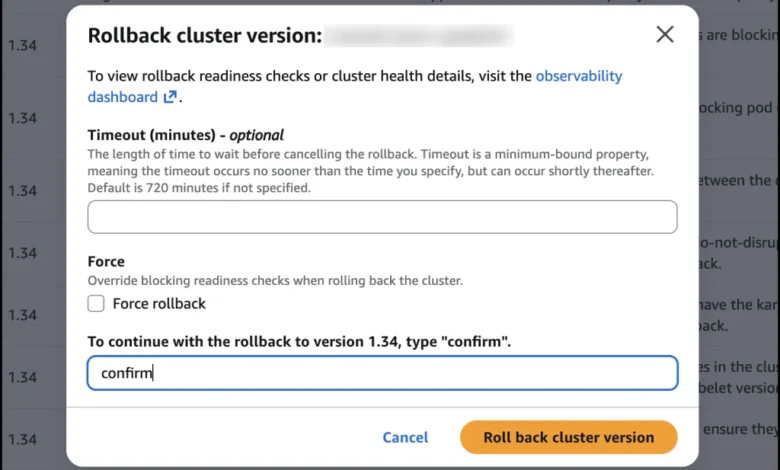
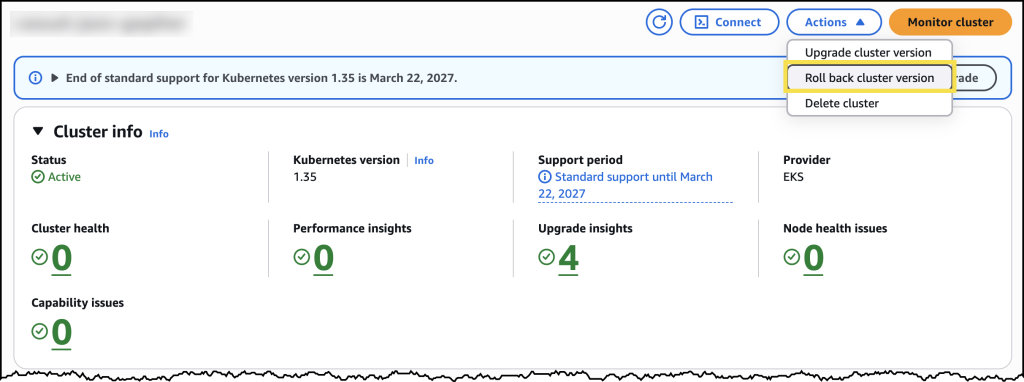
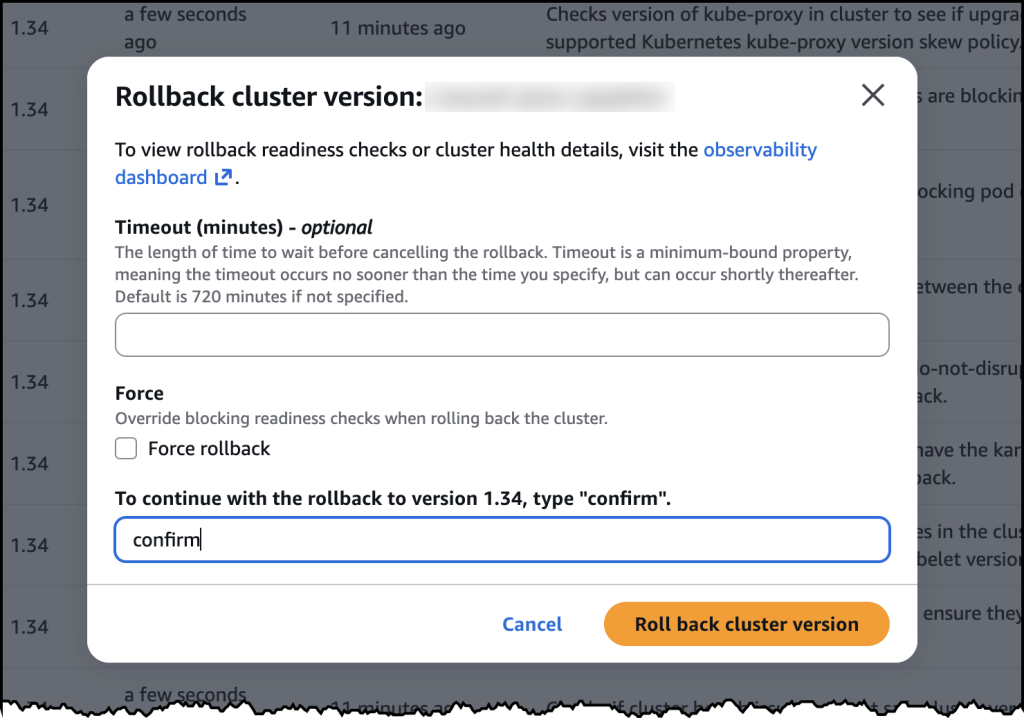
To illustrate the new functionality, the AWS announcement provided a step-by-step guide to performing a rollback. The author navigated to the Amazon EKS console and selected a cluster that had recently undergone an upgrade. From the cluster’s configuration page, the option to initiate a version rollback was readily available, along with information regarding the current rollback window.
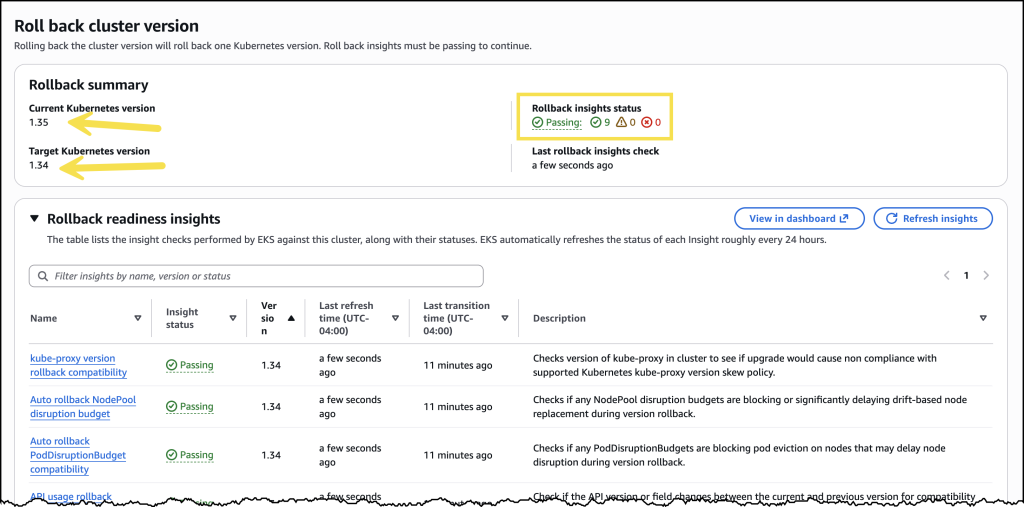
Before initiating the rollback, the administrator reviewed the rollback insights, which provided a clear status of the cluster’s nodes and highlighted any potential issues that required attention. This proactive insight mechanism is crucial for ensuring a smooth transition. After confirming the rollback, the process commenced. The control plane rollback reportedly took approximately 20 minutes, comparable to a standard upgrade. For an EKS Auto Mode cluster, the nodes rolled back gracefully, adhering to the configured disruption budgets. Once the process was complete, the cluster was successfully reverted to its previous Kubernetes version, operating as expected. The accompanying screenshots visually demonstrated the user interface and the insights provided during the rollback process, offering tangible evidence of the feature’s usability.
Availability and Implications
Kubernetes version rollbacks for Amazon EKS are available starting today at no additional cost in all commercial AWS Regions where Amazon EKS is offered. Customers will continue to pay only for the standard EKS and compute resources they utilize, with no extra charges for leveraging the rollback capability.
The rollback feature supports clusters running Kubernetes versions that are within EKS’s standard and extended support policies. Control plane rollbacks are universally available for all EKS clusters, while node rollbacks are specifically designed for clusters operating under EKS Auto Mode.
The introduction of this rollback feature has several significant implications for the Kubernetes ecosystem and for organizations adopting managed Kubernetes services:
- Reduced Operational Risk: The most immediate impact is a dramatic reduction in the risk associated with Kubernetes upgrades. This allows organizations to more confidently adopt new Kubernetes versions, benefiting from the latest security patches, performance enhancements, and features without the fear of irreversible failures.
- Accelerated Adoption of New Versions: By mitigating upgrade risks, EKS version rollbacks are expected to accelerate the adoption of newer Kubernetes versions across the industry. This will lead to a more secure and up-to-date Kubernetes landscape.
- Increased Agility and Innovation: With less time and resources dedicated to managing complex upgrade strategies and mitigating risks, engineering teams can focus more on developing and deploying applications, driving innovation and business value.
- Improved Compliance and Security: Running on outdated Kubernetes versions can expose organizations to security vulnerabilities and compliance issues. The ability to easily roll back allows for more frequent upgrades, ensuring clusters remain patched and compliant.
- Enhanced Developer Experience: For developers building on Kubernetes, a stable and up-to-date platform is crucial. This feature indirectly improves the developer experience by ensuring the underlying infrastructure is robust and manageable.
- Competitive Advantage: For organizations that can efficiently manage their Kubernetes environments, this translates to a competitive advantage, allowing them to adapt more quickly to evolving technology landscapes and business needs.
The EKS version rollback capability is a testament to AWS’s commitment to addressing critical customer pain points and continuously improving the managed Kubernetes experience. It empowers users with greater control, enhanced safety, and increased operational efficiency, solidifying Amazon EKS’s position as a leading platform for running containerized applications at scale.
To get started with this new feature, users can refer to the Amazon EKS documentation or directly access the functionality within the Amazon EKS console. This move is poised to set a new standard for managed Kubernetes services, demonstrating the value of providing robust, built-in solutions for complex operational challenges. The move also reflects a broader trend in the cloud-native space towards providing more forgiving and resilient infrastructure management tools.