AWS Introduces Enhanced Custom Event Bus for Amazon EventBridge to Streamline Enterprise Serverless Architectures

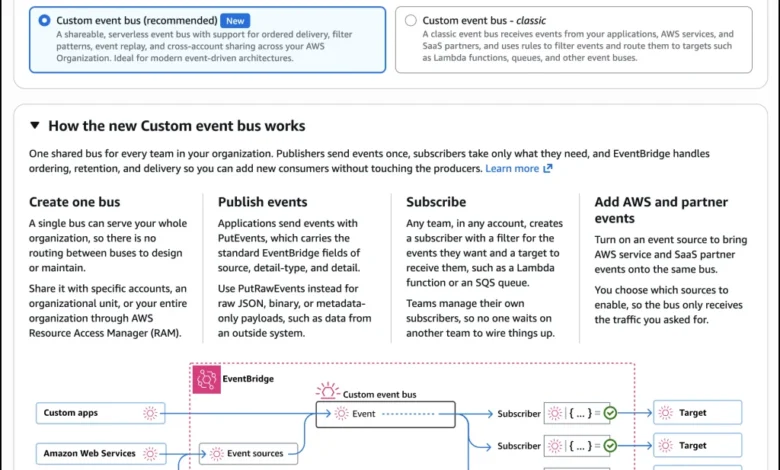
As organizations scale their cloud-native estates, the complexity of managing serverless infrastructure often eclipses the initial promise of operational agility. This friction has been particularly acute in event-driven architectures built on Amazon Web Services (AWS), where enterprise growth typically forces teams into fragmented multi-account topologies. To address these structural hurdles, Amazon Web Services has officially announced the launch of the enhanced custom event bus for Amazon EventBridge. Purpose-built to unify multi-account and multi-team environments, the new architectural tier introduces native organization-wide sharing, rigorous event ordering guarantees, simplified subscriber resources, content-based deduplication, and a reimagined throughput-based pricing model designed to scale cost-effectively.
The Evolution of Event-Driven Scaling Challenges
To understand the significance of the new release, industry analysts point to the historical evolution of event-driven design patterns within enterprise environments. When organizations initially adopt serverless computing, they frequently deploy a single custom event bus housed within an isolated AWS account, managed by a singular foundational engineering team. This centralized setup proves exceptionally efficient for small-scale applications, enabling decoupled communication, low latency, and rapid feature iteration.
However, as cloud adoption accelerates across large enterprises, adherence to AWS well-architected frameworks mandates a multi-account structure. Under this security and governance best practice, individual business units and product teams operate within dedicated AWS accounts. To facilitate inter-team communication and data exchange, architects were previously compelled to construct complex networks of multiple event buses connected via cross-account rules or intricate bus-to-bus routing configurations.
This workaround inadvertently reintroduced the operational overhead that serverless computing was designed to eradicate. Platform engineering teams rapidly lost granular visibility into telemetry, lineage, and subscription dependencies across organizational boundaries. Furthermore, escalating cross-account routing charges compounded operational expenses. Perhaps most critically, teams requiring strict event sequencing—such as financial transaction processors or logistics coordinators—found standard event buses inadequate, forcing them to engineer brittle application-layer workarounds or abandon serverless paradigms altogether in favor of monolithic messaging queues.
An Architectural Breakdown of the Enhanced Event Bus

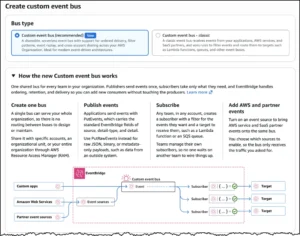
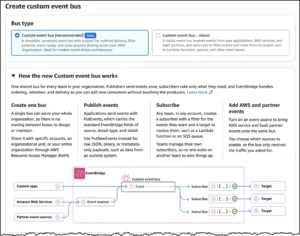
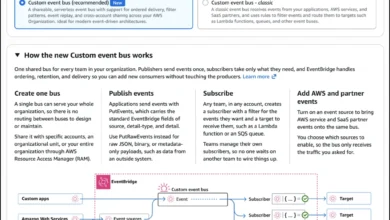
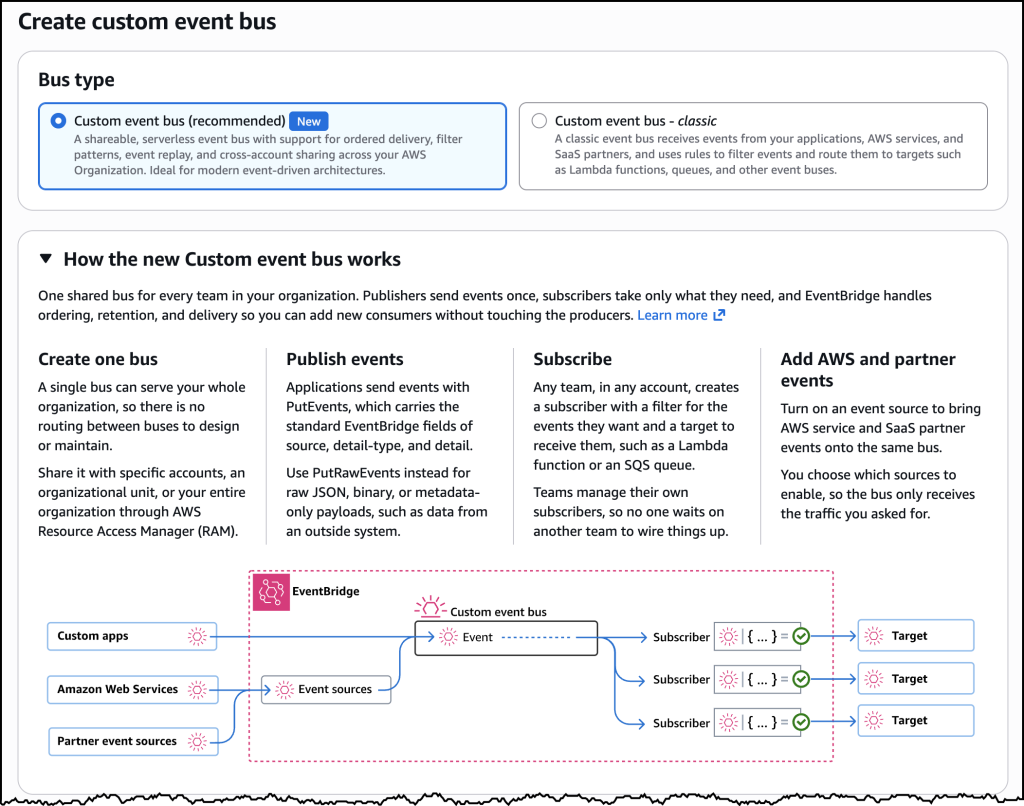
The newly introduced enhanced custom event bus directly targets these multi-account pain points by shifting the architectural paradigm from a fragmented mesh of interlinked buses to a single, highly scalable, centralized event backbone shared across an entire AWS organization.
Through integration with AWS Resource Access Manager (AWS RAM), platform administrators can provision a singular event bus and seamlessly share it with specific AWS accounts, organizational units, or entire enterprises. Publishers can dispatch events to the central hub without needing to know the downstream identity of the consuming teams, while subscribers independently establish granular filters and processing rules. This decoupling removes administrative bottlenecks, allowing application teams to onboard onto the shared event infrastructure without waiting for manual platform provisioning or complex cross-account permission policies.
To support massive enterprise topologies, the enhanced custom event bus ships with a default quota of 10,000 distinct subscribers per bus—a threshold that can be further expanded upon request. This high ceiling effectively eliminates the previous constraint that forced engineering groups to fragment their workloads across artificial bus boundaries simply to accommodate subscriber limits.
Balancing Asynchronicity with Strict Event Ordering
A foundational tenet of event-driven architecture is asynchronous decoupling, where events are processed concurrently and the chronological arrival order is fundamentally irrelevant to system correctness. Yet, real-world enterprise applications frequently encounter domain logic where sequence matters profoundly. For instance, in modern supply chain management and fleet tracking solutions, location telemetry updates for a delivery vehicle must be processed in chronological sequence; an out-of-sequence payload can cause mapping and routing algorithms to ingest stale data, resulting in erroneous operational decisions.
The enhanced custom event bus solves this architectural dichotomy by supporting both asynchronous unordered delivery and strict ordered delivery natively on the same shared bus. Publishers can attach an optional EventGroupId metadata parameter to outgoing payloads. EventBridge intelligently routes messages sharing identical identifiers in strict sequential order to those subscribers configured for ordered processing, while concurrently delivering the same event stream to other consumers operating under standard asynchronous patterns.
To ensure end-to-end reliability during ordered processing, AWS has introduced native synchronous invocation support for downstream compute targets such as AWS Lambda. In this operating mode, EventBridge confirms successful target execution before acknowledging the event payload back to the bus. This native capability removes the historical requirement of deploying intermediate Amazon Simple Queue Service (Amazon SQS) queues purely to manage sequencing and retry buffers between an event bus and a compute function.

Streamlined Subscriptions and Advanced Payload Processing
Subscription management has also undergone a comprehensive redesign. The new Subscriber resource consolidates event filtering criteria, target endpoints, comprehensive retry policies, and dead-letter queue (DLQ) destinations into a single, cohesive, manageable entity. Previously, achieving this level of error handling and routing granularity required the orchestration of numerous disparate rules, targets, and parameter configurations across multiple resources.
To further streamline operational workflows, the enhanced bus features variable start time capabilities, simplifying the onboarding of newly deployed consumer applications and accelerating disaster recovery scenarios through targeted event replay.
Data hygiene and transformation have similarly been elevated. Publishers facing unreliable client environments can now enable content-based deduplication directly on the event bus. Rather than forcing upstream systems to generate and track custom idempotency tokens to handle transient network timeouts or duplicate transmissions, EventBridge algorithmally hashes meaningful payload content. Any duplicate events arriving within a strict five-minute sliding window are automatically collapsed, providing native exactly-once delivery semantics for sources that cannot otherwise guarantee idempotent behavior.
For downstream consumers requiring specialized data shapes, subscribers can leverage native JSONata expressions to evaluate, transform, rename, or compute new values within the event payload prior to target delivery. Additionally, for organizations standardizing on serialization formats such as Apache Avro or Protocol Buffers, EventBridge can natively deserialize binary or specialized payloads into standard JSON. This enables subscribers to execute fine-grained filtering and routing logic across the entire event payload without necessitating custom parsing code or premature data ingestion.
A Value-Aligned Pricing Model for Scale
Economics at scale played a primary role in the design of the enhanced custom event bus. Traditional multi-bus architectures suffered from compounding financial models, where cross-account rules and bus-to-bus data forwarding triggered overlapping charges at every routing hop.
The enhanced tier introduces a modernized ingress and egress throughput pricing structure. Under this framework, event publishers incur costs strictly for events ingested into the bus, while consuming subscribers pay exclusively for events delivered to their designated targets. This transparent, telemetry-aligned pricing model drastically improves cost allocation visibility, allowing enterprise finance and platform teams to accurately attribute infrastructure expenditure to specific business units and product squads.
Availability and Coexistence with Classic Infrastructure
AWS has structured the release to ensure zero disruption for existing enterprise workloads. Legacy custom event buses will remain fully supported, operating seamlessly under the designation of "Custom event bus – classic." Organizations are under no obligation to migrate existing infrastructure, allowing platform engineering teams to adopt the enhanced custom event bus at their own organizational cadence.
At launch, the enhanced custom event bus is globally available across a robust footprint of AWS Regions, including US East (N. Virginia, Ohio), US West (Oregon), Europe (Ireland, Frankfurt, Stockholm, Spain), and Asia Pacific (Hong Kong, Malaysia, Mumbai, Singapore, Sydney, Thailand, Tokyo). Engineering teams can provision, configure, and manage the new resources immediately utilizing the AWS Management Console, the AWS Command Line Interface (AWS CLI), or programmatic calls through EventBridge APIs.
Industry Implications and Future Outlook
Cloud architects and enterprise technology leaders have responded favorably to the announcement, noting that the release bridges a critical gap in enterprise serverless maturity. By removing the administrative friction of cross-account networking and addressing long-standing technical hurdles regarding event sequencing and deduplication, AWS has significantly lowered the barrier to entry for large-scale event-driven transformations.
As enterprises continue to migrate mission-critical workloads to serverless environments, architectural patterns that prioritize governance, visibility, and economic predictability will dictate cloud efficiency. With the rollout of the enhanced custom event bus, Amazon EventBridge transitions from a tactical routing utility into a comprehensive, enterprise-grade event backbone capable of supporting the most demanding organizational topologies.